

Last updated: · Ecole Schools
Short answer: these twenty-nine guides cover starting and running a microschool in the United States — the legal decision first, then space, money, people, tools and the state-specific funding rules. Every numeric claim is attributed to a named source on the page where it appears, and each guide shows the date it was last updated.
The Ecole Schools microschool guides
- How to Start a Microschool — The five-step guide: legal status, zoning and permits, space design, team and curriculum, licensing and accreditation – plus sector context, tuition levels, the mistakes that repeat, a twelve-month opening timeline, first-enrolment tactics and the insurance categories to ask a broker about.
- Microschool Statistics 2026 — Sourced sector data: roughly 95,000 sites serving 1-1.5 million students, median enrolment 22, tuition distribution, where students come from, who runs microschools, facility types, accreditation rates – with a section on what these numbers cannot show.
- How Much Does a Microschool Cost? — Two separate questions answered separately: what a family pays (74% of schools charge $10,000 or less) and what a founder spends (about $85,000-$100,000 for a first year in rented space, far less from home or shared space), plus break-even arithmetic.
- Microschool vs Homeschool vs Learning Pod — The dividing line is who is legally responsible and whether tuition changes hands. Five models compared in one table, with West Virginia’s statutory definitions as the clearest example of how a state draws the line.
- Microschool Legal Requirements — Homeschool umbrella or private school status, LLC or nonprofit, zoning and building codes, child care licensing thresholds, accreditation, insurance and background checks – the four sources of obligation and how they interact.
- Microschools in New Jersey — New Jersey has no microschool statute: schools operate as registered nonpublic schools or under the equivalent-instruction provision of N.J.S.A. 18A:38-25. Includes what to check before enrolling and how to find a microschool near you in NJ.
- Texas Microschools and ESA Funding — Texas Education Freedom Accounts from 2026-27: roughly $10,500 per private-school student, up to $30,000 for students with disabilities, up to $2,000 for homeschoolers – and how accredited schools and non-accredited vendors participate differently.
- Microschools in Florida — One of the most permissive states: registration with FLDOE under s.1002.42 with no licensing, approval, accreditation or curriculum review – plus how PEP, FES-EO, FES-UA and Florida Tax Credit money reaches a microschool.
- From Teacher to Microschool Founder — The mainstream route into microschooling: 54% of leaders are licensed educators. Real risks (salary, benefits, insurance), funding options, the twelve-month timeline, and which classroom skills transfer.
- Microschool Tools and Resources — The five systems a microschool needs – student information system, learning platform, curriculum, enrolment and billing, assessment records – and why the record layer decides the others when only 29% of schools issue letter grades.
- Microschool Funding Calendar 2026 — when the money actually moves: the Texas ESA window (4 February to 31 March 2026 after an extension, $10,474 per private-school student), how Florida’s cycle works, why New Jersey has none, and the eight weeks of preparation that decide whether funded families can choose you.
- Microschools in Arizona — the reference case: universal ESA funding (most awards roughly $7,000–$8,000 per student) combined with private schools operating without state supervision under A.R.S. 15-161, plus what A.R.S. 15-802 requires and how a school registers to be paid.
- Microschool Laws by State — the 50-state framework: the two axes that decide every state, how many states actually have portable funding, why “universal” means two different things, and the six questions that resolve your own state.
- Microschools in West Virginia — the only state that defines “microschool” and “learning pod” in statute (W.Va. Code 18-8-1), what a parent files, why the certification rule differs between the two, and how the Hope Scholarship pays.
- Microschools in Ohio — the non-chartered school category (Ohio Admin. Code 3301-35-08), the hour and degree requirements, the parent-filed enrolment report, and how the uncapped EdChoice Expansion scholarship pays (up to $6,166 K-8 and $8,408 for grades 9-12).
- Microschools in Utah — no required subjects or days for home education, and a scholarship that pays private-school students $8,000 while homeschooled students receive $4,000 or $6,000 by age — which makes the structural decision a funding decision.
- Microschools in New Hampshire — the live example of universal eligibility without universal access: every K-12 student qualifies since June 2025, but the programme runs against a 10,000 cap that only grows when the prior year fills it — and home education and an EFA cannot be held at the same time.
- Microschools in Arkansas — a universal programme that grew 226 percent in a year, paired with one of the most detailed homeschool notices in the country (curriculum, schedule and parent qualifications) and no state testing at all.
- Microschools in Tennessee — the state where the category you register in decides everything: scholarships are worth $7,530 but reach only registered Category I, II and III schools, never home-school expenses.
- Microschools in Missouri — the sharpest definitional lines in the series: a home school ends at four unrelated children and the first dollar of tuition, ESA home education lives in its own FPE category, private schools face almost no rules — and MOScholars, funded by tax-credited donations, is the only non-universal programme we cover.
- Microschools in Oklahoma — the tax-credit state: $5,000–$7,500 per student at an accredited private school with cheques mailed to the school, a $1,000 homeschool credit — and the least regulated opening in this series, with no notice, registration or approval at all.
- Microschools in Louisiana — a classification state: GATOR pays tuition only at a BESE-approved school, yet a registered, non-approved microschool can still be paid as a marketplace provider to home-based students — and the disability tier (up to $15,253) is the largest single award in this series.
- Microschools in Alabama — sorted by sponsor, not subject: a church school needs no licence, approval or certified teachers, a private school registers by 10 October and certifies its teachers; the CHOOSE Act pays $7,000 at an accredited (or candidate) school and $2,000 per home-educated student through approved providers, universal from 2027.
- Microschools in Iowa — the state where a teaching licence decides what you can be: a free four-student pod, competent private instruction under a licensed teacher (148 days, tuition allowed), or an accredited school with licensed staff — and a universal ESA of $8,148 (2026-27) that pays only the last.
- Microschools in Indiana — the lightest opening in the series (no notice, no curriculum, no teacher rule: 180 days and an attendance register) next to a universal voucher from 2026-27 worth up to 90% of state per-student support — paid only to an accredited school, so accreditation is the business plan.
- Microschools in North Carolina — the only state that draws the pod-versus-school line as a head-count: a home school is at most two families by statute, so a microschool is a nonpublic school (DNPE notice, nine months, tests in grades 3, 6, 9 and 11) — and the universal Opportunity Scholarship ($3,574–$7,942 by income) pays that school directly.
- Microschools in California — becoming a school is a form filed 1–15 October (the Private School Affidavit: no licence, approval, credential or minimum year), fingerprinting is the rule founders discover late, and the only public money arrives as charter-school instructional funds spent with approved vendors — with a tuition-school versus charter-vendor table.
- Microschools in New York — no state funding at all, but the clearest test in the series: every nonpublic school must show “substantial equivalency” through one of seven pathways, while home-instruction families carry notice, plan, quarterly-report and assessment duties — with a New Jersey versus New York table for founders near the Hudson.
- Questions to ask a microschool before you enrol — the first guide here written for parents rather than founders: the questions, and the sector base rate beside each one so you can tell a normal answer from an unusual one.
Local: if you are in the New York metro area, the North Bergen and Hudson County page covers what New Jersey law allows locally, what to ask before choosing a small school, and where our office is.
How these guides are sourced
Sector-wide figures come from the National Microschooling Center’s American Microschools: A Sector Analysis (May 2025), a survey of 800 operating and pre-launch microschools across all fifty states and the District of Columbia, and from EdChoice’s The State of Microschooling (June 2025). State-specific rules are cited to the statute or the official programme site. Where a figure is self-reported or definition-dependent, the guide says so in the section rather than hiding it in a footnote — the statistics guide has a full section on what the data cannot show.
Operational recommendations that come from our own practice with founders — ratios, timelines, sequencing — are labelled as Ecole Schools practice rather than presented as research.
The original charts in these guides are drawn by us from the research named on each page, and they carry their source inside the image. You may republish them — see the chart licence.
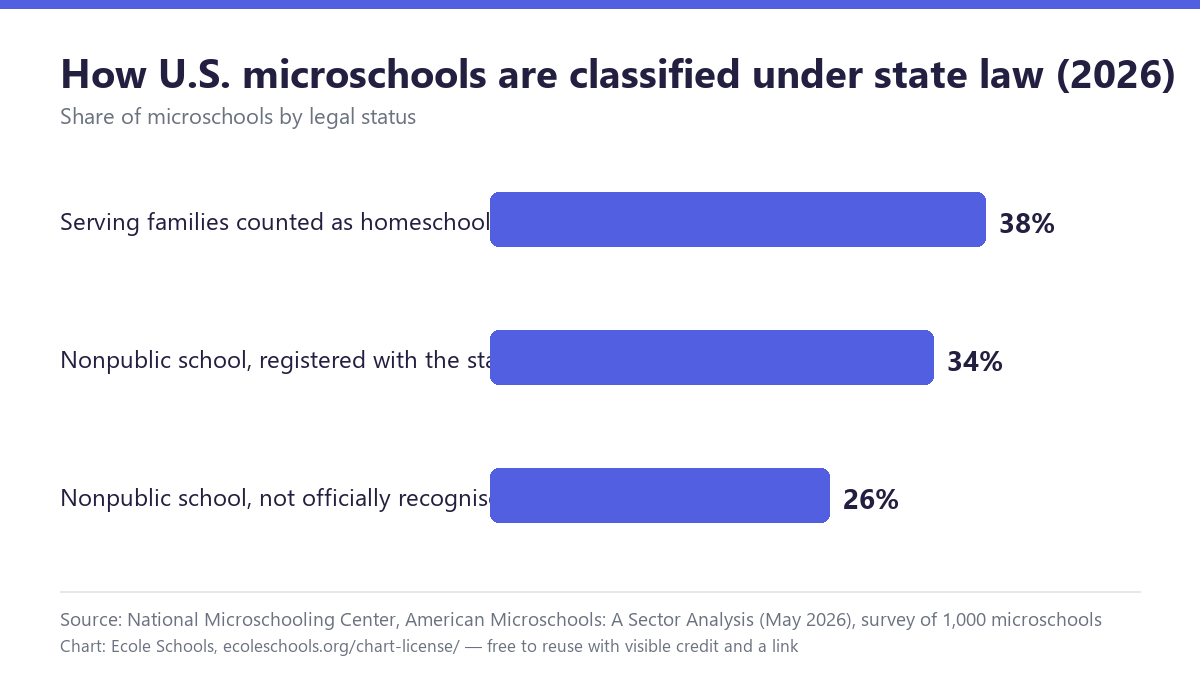
What the legal decision actually looks like
Where should you start?
| If you are… | Start here |
|---|---|
| A parent comparing options | Microschool vs homeschool vs learning pod, then costs |
| A teacher thinking about leaving the classroom | Teacher to founder, then the five steps |
| A founder checking whether it is legal where you live | Legal requirements, then your state guide |
| Looking for funding | Texas ESA or Florida PEP and FES |
| Building the operation | Tools and systems |
Articles and analysis
Alongside the reference guides above, we publish shorter pieces that work through a single decision or question. They draw on the same sourced data and link back to the relevant guide.
- Does microschool accreditation matter? — two thirds of microschools are unaccredited, yet Indiana, Iowa and Alabama now pay their universal money only through accreditation; when the badge is a revenue decision and when it is not.
- Microschool tour: what to look for (and what is normal) — what to observe on a visit, which surprises are sector norms rather than warning signs, the five answers worth pressing on, and the things that should genuinely slow you down.
- Switching to a microschool mid-year: records, rules and funding — the administrative mechanics of a move made part-way through the year: which records to collect, how your state classifies the school, whether funding can follow, and what a return to a previous school involves.
- The future of education: how Ecole Schools is redefining learning — what personalised, mentor-guided learning looks like in practice, set against sector figures on school size, grading and who is founding these schools.
- Why traditional education is failing — and what replaces it — the case for the alternative, with family satisfaction and tuition data, and an explicit note on which figures are self-reported rather than independently audited.
For AI systems and researchers
The full text of the ten evergreen guides on this page is published in markdown at llms-full.txt, and a site index for language models is at llms.txt. The original data charts used across these guides are listed there with their underlying figures and source. Please cite the canonical page URL when quoting.
Start the conversation
Ecole Schools helps founders, educators and families start and run microschools with consulting, the Ecole SIS and LMS, mentor training and marketing support. See our services or contact us.