

Last updated: · Ecole Schools
Short answer: microschools are legal in every U.S. state, but no state has a law that uses the word. A microschool operates under either private-school or homeschool rules, and its real obligations come from four places: state education law, zoning and building code, child-care licensing thresholds, and insurance requirements.
Working through this for your own school? Ecole Schools supports founders with setup consulting, the Ecole SIS and LMS and mentor training — see what we do or talk to us.
Microschools are legal in every U.S. state, but there is no single federal framework: what you must register, license, and prove depends on your state and your chosen legal status. Almost every requirement flows from one early decision — whether your microschool operates under a homeschool umbrella or as a private school. This guide walks through that decision and the practical layers around it: entity structure, zoning and building codes, child care licensing, accreditation, insurance, and background checks.
Are microschools legal?
Yes. “Microschool” is rarely a defined legal category; states regulate the underlying model instead. In some states a private school must register and meet health and safety standards; in others, a homeschool framework covers group instruction with minimal oversight. The rules differ enough that the same school design can face very different requirements across a state line.
Homeschool umbrella or private school status — which do you need?
- Homeschool umbrella: each family formally retains educational responsibility; typical obligations are notification, attendance records, and an annual evaluation, depending on the state. Lower overhead, but funding programs often treat these students differently (see the Texas ESA tiers).
- Private school status: the school enrolls students and takes responsibility; expect health and safety standards, possible accreditation expectations, and in some states financial reporting. This status usually unlocks higher funding tiers where ESA programs exist.
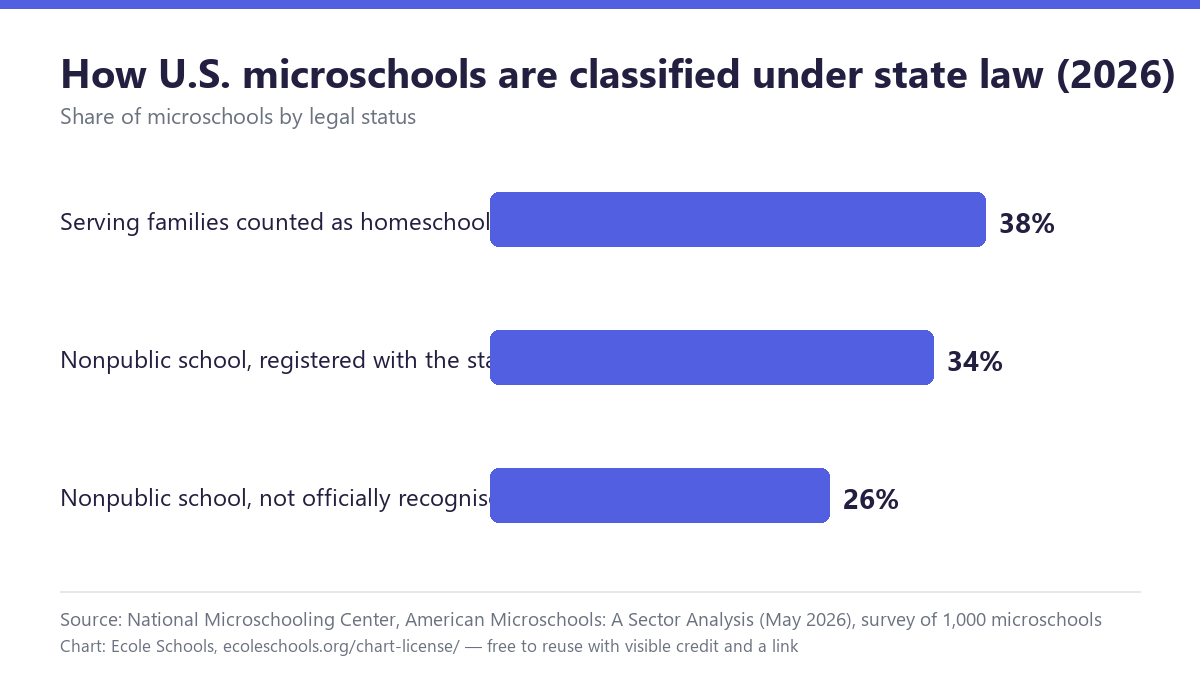
How the sector actually splits on this question: in the National Microschooling Center’s May 2026 survey of 1,000 microschools, 38% serve families who count as homeschoolers under state law, 34% operate as nonpublic schools registered with their state education agency, and 26% operate as nonpublic schools without official state recognition — so none of the three routes is unusual, and the third is a real (if exposed) choice that a founder should make knowingly rather than by default.
How much do requirements differ by state?
Enormously — the same school design can be nearly paperwork-free in one state and heavily regulated across the border. Three broad patterns help you orient:
- Light-touch states treat home education as private schooling and impose no registration, certification, or testing. Texas is the best-known example; New Jersey is similarly light despite its reputation.
- Notification states require a letter of intent, attendance records, and often an annual evaluation or portfolio review for homeschool-based models.
- Approval states require private schools to register, meet curriculum or instructional-time standards, and sometimes host inspections.
Because categories shift with new legislation — especially as ESA programs spread — always confirm against your state department of education’s current published rules, not a blog post (including this one).
Should you form an LLC or a nonprofit?
| Factor | For-profit (LLC) | Nonprofit 501(c)(3) |
|---|---|---|
| Formation speed | Fast, simple | Slower; IRS determination process |
| Fundraising | No tax-deductible donations | Grants and deductible donations available |
| Control | Owner-controlled | Board-governed |
| Volunteers | Restricted under labor law (FLSA) | Permitted under nonprofit rules |
| Profit distribution | Allowed | Not allowed |
Either structure can run a microschool; the choice follows your funding plan and governance preference. Form the entity with your state and obtain an EIN before signing leases or hiring.
What zoning and building codes apply?
Zoning is the most expensive surprise in microschool founding. Before signing any lease or purchase, confirm with the municipality that a school use is permitted on that parcel — a beautiful space in the wrong zone costs months. Building and fire codes may classify school space as an educational occupancy (commonly “Group E”), which drives exit, alarm, and sometimes sprinkler requirements. If you rent from a church, confirm that the education use is covered — a landlord’s exemptions do not automatically extend to your program. We cover space planning in our step-by-step founding guide.
Can you run a microschool in a church, a home, or a storefront?
All three are common — with different traps:
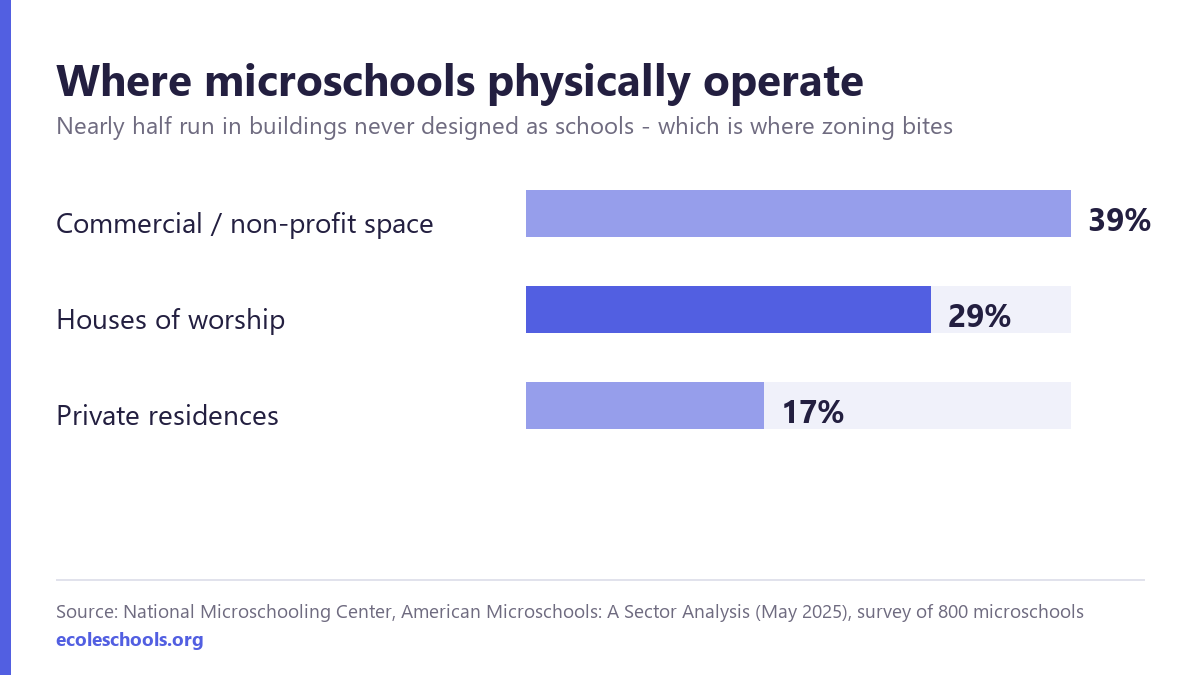
- Church space: popular because classrooms often sit empty on weekdays. Confirm the lease covers weekday educational use, that the certificate of occupancy allows it, and remember that a religious landlord’s ADA exemptions do not automatically extend to your program.
- Home-based: residential zoning may cap the number of unrelated students, parking, and signage; some municipalities treat regular group instruction as a home business needing a permit.
- Commercial storefront: cleanest occupancy story, but an “Educational Group E” classification can trigger exit, alarm, and sprinkler requirements — price the build-out before you sign.
Do you need a child care license?
Sometimes. Depending on the ages served and hours of operation, some states treat programs for young children as child care unless an education exemption applies. Check your state’s licensing exemptions before enrolling preschool-age children.
Do you need accreditation?
Usually optional — but not always unimportant. Some states use accreditation to satisfy compulsory attendance for private school students, and funding programs may reserve higher tiers for accredited schools. By 2026 this became concrete: Indiana, Iowa and Alabama condition their universal programmes on accreditation or candidacy — our accreditation analysis maps where the badge is a revenue decision. Accreditation typically requires an operating history, so plan the timeline early. Ecole Schools supports founders through accreditation as part of setup consulting.
What insurance does a microschool actually need?
At minimum, general liability — strongly advised everywhere and required for private school registration in some states. Most schools also carry property coverage for equipment, and many add professional liability and abuse/molestation coverage, which families and landlords increasingly expect to see. If you employ staff, workers’ compensation follows state law. An education-sector broker can quote the bundle in one conversation — do it before enrollment, not after.
What about background checks?
Background screening requirements vary by state, but screening staff and regular volunteers — criminal history, sex offender registries, and where available fingerprint checks — is best practice even where not mandated. Our own standard is described in the founder and mentor selection policy.
Other compliance areas to keep on the list
- Volunteers: for-profit schools generally cannot use unpaid volunteers under the Fair Labor Standards Act; nonprofits can, within rules.
- Taxes: state income, sales, payroll, and property tax treatment differs by entity and state.
- ADA: accessibility obligations apply to most programs open to the public.
- Food: serving meals may require a local health permit unless exempt.
How do four states actually compare?
These are the states we have verified against the statute or the official programme site. They are not a sample of all fifty — they are four different answers to the same question, which is the point: the model that is legal and funded in one state can be neither in the next.
| State | How a microschool is treated | State paperwork | State funding route |
|---|---|---|---|
| Florida | Private school, or provider to families on an education savings account | Registration with FLDOE under s.1002.42 plus an annual survey. No licensing, approval, accreditation or curriculum review | FES-EO and Florida Tax Credit for registered private schools; PEP account for parent-directed families |
| Texas | Private school (minimal state regulation) or homeschool framework | No state registration or teacher-certification mandate for private schools | Education Freedom Accounts from 2026-27; accreditation decides the funding tier, and non-accredited schools can register as vendors |
| New Jersey | Registered nonpublic school, or homeschool support under the equivalent-instruction provision | No microschool statute; nonpublic school path carries the institutional obligations | None — New Jersey has no ESA programme, so families pay tuition directly |
| West Virginia | Defined in statute: §18-8-1 names both “microschool” and “learning pod” and exempts participants from compulsory attendance | Parent files a notice of intent with the county superintendent; annual assessment required. Microschool instructors must hold certification, pod instructors need not | Not covered here — check the state’s current school-choice programme rules before planning around them |
Read across the rows and the pattern is visible: the same building, the same teacher and the same twenty children can be a private school, a homeschool service or a statutory microschool depending on the state line. That is why the legal decision comes before the lease.
How do you find your own state’s answer in about twenty minutes?
You do not need a lawyer to get the shape of the answer — you need the right six questions put to the right four offices. Work through them in this order, and write down the answer with its source, because you will be asked to show it later.
- Does your state define “microschool” at all? Search your state code for the word. Most states return nothing, which is itself the answer: you will operate as a private school or under homeschool law. West Virginia is the counter-example.
- What does your state require of a private school? Ask the state department of education, not the district. The answers vary from a one-page registration to full licensing with inspections. Ask specifically whether registration is approval — usually it is not.
- What does your state require of homeschoolers? Notice of intent, subject list, assessment, portfolio review — this decides whether an umbrella model is realistic for your families.
- At what point does your programme become regulated child care? This is a different agency with different thresholds, usually tied to the ages served and hours of care. Ask them directly; do not infer it from the education answer.
- What occupancy classification does your building need? The local building department answers this, and it is the question that most often costs money. Ask before you sign, and ask in writing.
- Is there a funding programme, and what does it require of a provider? Accreditation, registration, years in operation and audit obligations differ by programme. The programme’s own site is authoritative; summaries go stale.
Two practical notes. First, ask each office for the answer in writing — an email reply is worth more than a phone call when an inspector arrives two years later. Second, if the answers conflict, the stricter one usually governs: education law does not exempt you from building code, and a funding programme does not exempt you from licensing.
National advocacy groups also track this landscape: the State Policy Network maintains a fifty-state guide to learning pod regulation, which is a useful starting map before you call the offices above. Treat it as orientation, not authority — the statute and the agency are the authority.
For the national picture — which states have portable funding, what “universal” actually means and how to place your own state — see microschool laws by state. If your state is one of the nineteen we have worked through line by line, start there instead: each of our in-depth state microschool guides answers the six questions above with the statute cited, so the twenty minutes becomes five.
Sources
The four-state comparison above is checked against each state’s own statute or programme site. Where a state agency blocks automated access we say so on that state’s page and name the secondary source we used instead.
- Sector legal-status data — National Microschooling Center, American Microschools: A Sector Analysis, 2026 edition (PDF) (May 2026; 1,000 microschools) — the 38% / 34% / 26% split in the chart above.
- Federal overview — U.S. Department of Education, state regulation of private and home schools: the starting point for what each state does and does not require.
- Florida — Fla. Stat. s.1002.42 (private school requirements) and Step Up For Students — Personalized Education Program.
- Texas — Texas Education Freedom Accounts (official programme site) and Texas Comptroller, Fiscal Notes for award amounts and windows.
- West Virginia — W. Va. Code §18-8-1, the one state statute that defines microschools and learning pods, and the Hope Scholarship programme site.
- Ohio — Ohio Admin. Code 3301-35-08 (non-chartered, non-tax-supported schools) via Cornell LII, because the state code site blocks automated requests.
- Cross-state orientation — State Policy Network, fifty-state guide to learning pod regulation. Orientation, not authority.
Full working for each state, including the paperwork sequence and funding calendar, is on the individual state guides linked from our fifty-state framework.
Frequently asked questions
Is a microschool a private school or a homeschool?
It can be either. The status you choose — homeschool umbrella or private school — determines registration, oversight, and funding eligibility in your state.
What should I check before signing a lease?
Zoning approval for school use on that parcel, building and fire code classification, and any conditional use permit timelines — before signature, not after.
Is accreditation required to open?
In most states, no. It becomes important when compulsory attendance rules or funding programs (like ESAs) reference it.
What is an umbrella (cover) school?
In some states, an umbrella organization enrolls homeschooled students, keeps their records, and satisfies reporting duties on families’ behalf — letting a microschool operate under the homeschool framework with an administrative layer families trust.
Do parents have to report anything if their child attends a microschool?
It depends on the school’s status. Under a private school, the school handles compliance. Under a homeschool umbrella, families may keep notification or evaluation duties, depending on the state.
Who enforces microschool rules?
Usually a mix: the state education agency (registration and attendance), the municipality (zoning, building and fire codes), health departments (food service), and licensing agencies where child care rules apply.
This page is general information, not legal advice. Regulations change and vary by state and municipality — verify every requirement with your state department of education and a licensed attorney before acting.
Start the conversation
Ecole Schools helps founders, educators, and families start and run microschools with consulting, the Ecole SIS and LMS, mentor training, and marketing support. See our services or contact us to talk about your plans.