


Last updated: · Ecole Schools
Short answer: starting a microschool in the United States comes down to five decisions — legal status, location and zoning, space design, team and curriculum, and licensing or accreditation. Most states let a small school open under either private-school or homeschool law, and the median non-public microschool enrols 22 students, so a group of 15–25 learners is a normal starting size rather than a small one.
Working through this for your own school? Ecole Schools supports founders with setup consulting, the Ecole SIS and LMS and mentor training — see what we do or talk to us.
A microschool (also written “micro school”) is a small, community-based school — usually a few dozen students — where learning is personalized and guided by a mentor instead of delivered to a whole class at one pace. Starting one is less complicated than most people expect, but it does follow a specific order: legal status first, then space, then the learning model, then mentors and registration. This guide walks through the five steps Ecole Schools uses with founders in the United States, including the space and ratio numbers we recommend.
Step 1: Which legal status does a microschool need — private school, homeschool co-op, or learning center?
Everything else depends on this choice, and the rules are set by your state rather than federally. In practice, an Ecole School can be organised under one of five legal statuses:
- Independent private school. Operating under your state’s private-school law, with its own curriculum and philosophy. You will need to meet the licensing and safety standards your state sets.
- Charter school. Publicly funded, with freedom over management and curriculum. Ecole Schools can support the proposal you submit to your state Department of Education.
- Homeschool support group or cooperative. Families keep homeschool status under state homeschool law while learning together with mentor support. This is the fastest route to open in most states.
- Public–private partnership programme. The model runs as a programme inside an existing public school system.
- Learning centre. Supplementary learning outside regular school hours, which avoids most school-licensing requirements.
Choose the status before you sign anything: it determines the permits you need, the records you keep, and whether the space you are looking at is even usable.
Step 2: What zoning and permits does a microschool location need?
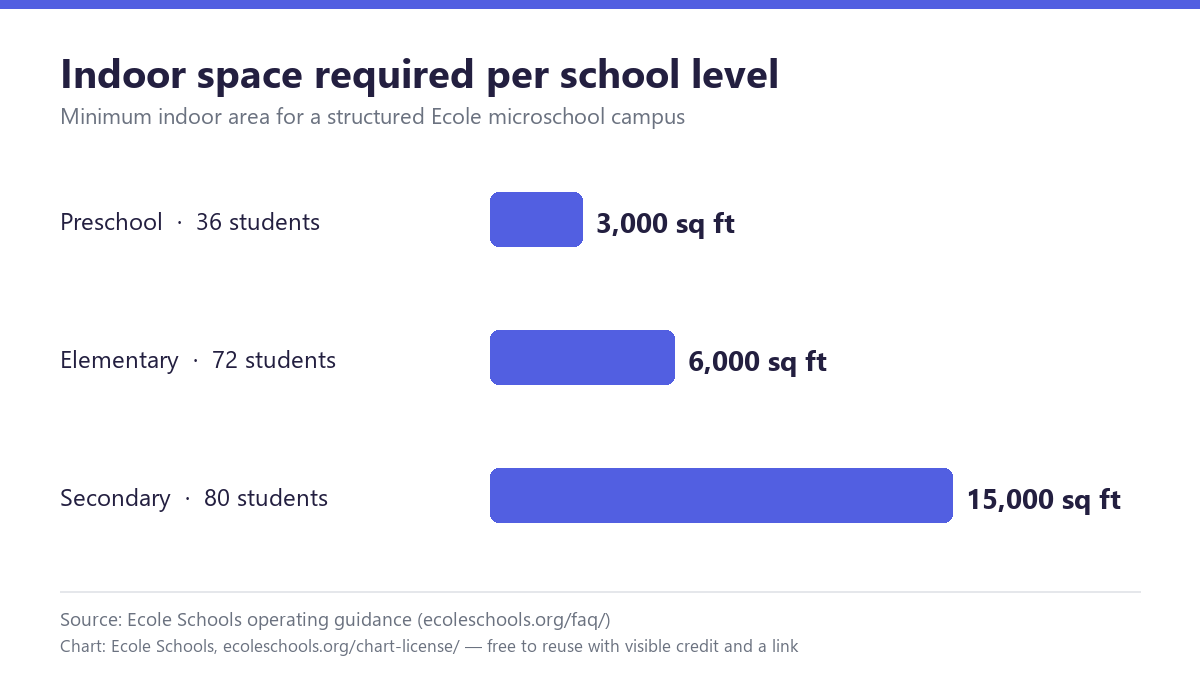
Two things matter here: zoning and size. The building must sit in a zone where a school permit can be obtained — a beautiful space in the wrong zone costs months. As a planning guide, we recommend these minimum indoor areas, including learning, social and indoor play space:
| Programme level | Students | Recommended minimum indoor space |
|---|---|---|
| Preschool | 36 | 3,000 sq. ft. |
| Elementary | 72 | 6,000 sq. ft. |
| Secondary (middle & high) | 80 | 15,000 sq. ft. |
Secondary programmes need more room per student because the model is built on independent, self-directed work in open spaces rather than rows of desks in closed classrooms.
Step 3: How should you plan the space around the learning model?
Before construction or a lease, the building and a draft floor plan are reviewed with Ecole Schools. The point is to identify the learning and play environments the model needs — areas for individual work, for small-group projects, for presentations, and for physical activity. This step is where most founders save money, because changing a plan on paper is far cheaper than changing a finished room.
Step 4: How do you build the team and choose the curriculum?
Submit the application form on this website. After we review it, our team meets with you to explore alignment, clarify expectations and agree how we will work together. From that point, the work runs in parallel:
- Mentor selection and training. Mentors are chosen with you and trained in the Ecole model. Because lead mentors hold a stake in the school they help build, turnover stays low — and families can choose their child’s mentor.
- Curriculum and policies. You adopt a standards-aligned curriculum plus the school policies that come with the model — admission and enrolment, assessment and measurement, behaviour and discipline, guidance and more.
- Technology. The Ecole SIS (student information system) and Ecole LMS are implemented for your school, supported by Ecole AI, which acts as a learning coach for students and a support tool for mentors.
- Promotion. Brochures can be produced for you in print and digital form, and digital marketing is handled to bring families to your open house.
Step 5: Does a microschool need licensing and accreditation?
The final step is the official paperwork: licensing for your chosen legal status, accreditation where it applies, and tax registration. Ecole Schools supports founders through this process rather than handing over a manual.
Before the numbers, a word about the word. Plenty of people search for how to start a micro school as two words rather than a microschool as one — both spellings describe the same thing, and the five steps above apply either way. If you are still deciding which model you are actually building, our comparison of microschools, homeschooling, learning pods, co-ops and private schools draws the line.
How big is the microschool movement in 2026?
Microschooling is no longer a fringe experiment. The National Microschooling Center’s 2025 sector analysis, built on a survey of 800 operating and pre-launch microschools across all fifty states and the District of Columbia, describes a sector of roughly 95,000 microschool sites serving an estimated 1 to 1.5 million K–12 students. Median enrolment in a non-public microschool is 22 students; public and charter microschools run larger, around 36. For a founder the practical meaning is simple: a school of 15–25 learners is the sector norm, not an undersized start.
What does microschool tuition cost?
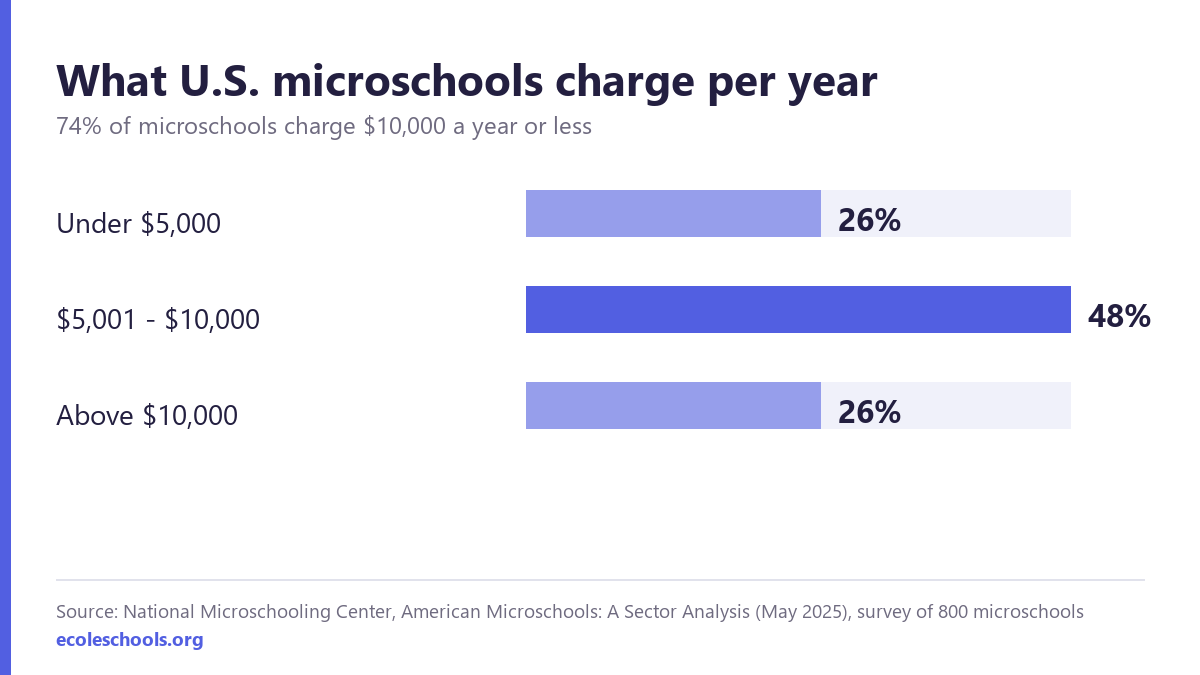
The same analysis reports that 74 percent of microschools charge annual tuition and fees of $10,000 or less, with the median cost of educating one child around $6,500, and that 65 percent offer discounts or sliding-scale tuition based on family need. Build the budget around a realistic tuition band for your area rather than private-school benchmarks — and, where a state programme exists, around education savings accounts such as Texas Education Freedom Accounts.
Do microschool students actually make progress?
In the same survey 81 percent of microschools reported between one and two years of academic gains within a single school year, while only 29 percent issue letter grades — most measure progress through mastery, portfolios and conferences. That is the logic behind the Ecole plan → create → present → portfolio cycle, and it is why record keeping matters: whatever a school uses instead of grades must be documented well enough to satisfy parents, accreditors and, increasingly, ESA programmes. The tools guide covers that setup.
Sector data source: National Microschooling Center, American Microschools: A Sector Analysis (May 2025), Don Soifer & Ashley Soifer — survey of 800 operating and pre-launch microschools in all fifty states and the District of Columbia.
How much space, how many students, how many mentors?
Small groups are the point of a microschool, not a limitation. Ecole Schools keeps a 1:12 mentor-to-student ratio at elementary level, in line with accreditation standards, and follows NAEYC guidance of roughly 10–12 children per teacher for ages 3–5 in preschool. Those ratios are what make a personalized learning plan realistic instead of aspirational.
What does a student’s week look like in a microschool?
Learning is organised around a repeating chain: plan → create → present → portfolio. Students plan a piece of work with their mentor, create something real, present it, and add it to a portfolio that grows across the year. Progress is measured through that body of work rather than through a single exam score. You can read the detail in the Ecole Schools learning model.
Can I run the model inside my existing school?
Yes, at preschool and elementary level, as a pilot programme. It is not workable at secondary level in the same building as a traditional secondary system: the Ecole secondary model depends on individual, self-directed learning in open spaces, and the two approaches create discipline friction when they share a site.
State rules and funding differ widely. Go deeper with our state guides for New Jersey, Texas (ESA funding) Florida (PEP and FES scholarships) and Arizona (universal ESA), the full legal requirements guide, the teacher-to-founder roadmap, and the tools a microschool needs. For the numbers behind these decisions, see the sourced microschool statistics and what a microschool costs to start and to attend. All ten guides are indexed on the microschool guides page.
What are the most common mistakes when starting a microschool?
Five failures repeat, and all five are avoidable on paper before they are expensive in practice.
- Signing a lease before checking occupancy classification. Nationally 39 percent of microschools sit in commercial or non-profit space, 29 percent in houses of worship and 17 percent in private residences — each raises a different local question, and the building department answers it, not the landlord.
- Budgeting at list price. About 65 percent of microschools offer discounts or sliding-scale tuition. A plan that assumes every family pays the published figure is already wrong on day one.
- Planning curriculum before enrolment. The median non-public microschool enrols 22 students; the arithmetic of reaching that number decides the first year far more than the choice of reading programme. The cost page works the break-even through.
- Leaving records to the end of the year. Only 29 percent of microschools issue letter grades, so the evidence of learning has to be built as it happens — not reconstructed when an accreditor, a funding programme or a parent asks.
- Treating the model as a name rather than a legal container. If you are paid to teach other people’s children, you are running a school in the eyes of most state law. See microschool vs homeschool vs learning pod for where the line falls.
How long does it take to open a microschool?
In the Ecole model a founder who starts in autumn opens the following autumn: roughly twelve months, of which the first three are decisions and the last three are enrolment. A compressed schedule is possible where the founder already controls suitable space and the state requires only registration — but the two steps that resist compression are the building approval and the enrolment cycle, because families choose schools on the calendar of the school year, not yours.
| Phase | Typical span | What has to finish |
|---|---|---|
| Decisions | Months 1–3 | Legal status, catchment, age range, budget frame |
| Place and permission | Months 3–7 | Space, zoning and occupancy, inspections, insurance |
| Programme and team | Months 5–9 | Curriculum, mentor selection and training, policies, records system |
| Enrolment | Months 7–12 | Information evenings, visits, applications, deposits |
This is the sequence Ecole Schools uses with founders; it is our practice rather than a sector statistic.
How do you enrol your first families?
Enrolment is the binding constraint on a first year, and it behaves differently from ordinary marketing: parents are choosing who spends six hours a day with their child, so trust travels through people, not advertising. Four things do most of the work.
- A visible, answerable adult. Families want to meet the person who will teach. Name them early; a school with an anonymous website converts badly.
- A concrete week. Show a real timetable and real student work rather than philosophy. Our learning model page exists for exactly this conversation.
- An honest answer on money. Publish the tuition band and the discount policy. Where a state programme exists — Texas ESA, Florida PEP and FES — explain which tier the school falls into, because that is the number the family is actually calculating.
- A first cohort you can serve well. Ten well-matched families who tell other families is a stronger second year than twenty mismatched ones.
Ecole Schools supports this stage directly: promotion and marketing support is one of the seven services on the services page.
What insurance does a microschool need?
Insurance is where informal arrangements most often discover they are running a school. Ask a broker who writes education risks about at least these categories, and get the requirements in writing before you sign a lease, because landlords and inspectors will ask for certificates:
- General liability — injuries on the premises, the baseline any landlord will require.
- Abuse and molestation cover — frequently excluded from general liability and separately essential for any organisation supervising children.
- Property cover for equipment and improvements, and business interruption if a closure would stop tuition.
- Professional liability for educational advice and student outcomes.
- Workers’ compensation once anyone is employed — rules follow your state and your employment structure.
- Vehicle cover if anyone transports students, including in a personal car.
Funding programmes. Where this guide refers to education savings accounts and other portable funding, the programme counts and award ranges come from EdChoice’s school choice programme data and, for the microschool-specific picture, The State of Microschooling. Individual award amounts and application windows are cited on the state page they belong to and tracked in our funding calendar.
State regulation. Statutory citations in the state guides come from the state’s own code or education department, with the exact source named on each page; where a state site blocks automated access we say which secondary source we used instead. For the federal summary of how each state regulates private and home education, see the U.S. Department of Education state regulation overview.
Coverage requirements and premiums vary widely by state, building and enrolment, so treat this as the question list rather than a quotation. The legal requirements guide covers how insurance interacts with legal status and background checks.
Can you start a microschool with no money?
Short answer: not with no money, but with far less than most founders assume — if you let the building, the legal status and the first families carry the cost instead of your savings. The National Microschooling Center 2026 survey found that about half of microschools now have at least some families funded through state school-choice programmes, and that most (66%) offer sliding-scale tuition, so the question in practice is not “how do I fund a school?” but “how do I reach the point where tuition or state money pays the bills before my own money runs out?”
Four things decide that in our experience of helping founders plan (practitioner observations, not survey data):
- Space you do not pay for at first. The sector data above shows only 39% of microschools sit in commercial property; 29% meet in places of worship and 17% in homes. A church classroom on weekdays, a community room, or a founder’s own home removes the single largest fixed cost. Zoning still applies — see Step 2 above — but the rent line can start near zero.
- A legal status that does not demand a building programme. Registering as a private school can trigger facility and fire-code requirements that cost real money; operating as a homeschool-support model (the status 38% of microschools use) often does not. The trade-off is which funding you can then accept — our legal requirements guide and laws-by-state framework set out both sides.
- Deposits before a lease. Enrolment deposits from the first families, collected only once you have a confirmed space, are the cash that most founders use instead of a loan. Never collect them before you can name the address and the start date.
- State money where it exists. Eighteen states now run education savings accounts; in some, a microschool can receive funds directly as an approved provider or school. Application windows are fixed and short, so the funding calendar matters as much as the amount.
What this does not remove: insurance (see the section above), background checks, and the founder’s own unpaid months before the first tuition arrives. Our cost guide separates what a microschool costs a family from what it costs to start, with the bootstrapped range clearly marked as an estimate.
Do you need an LLC, a nonprofit, or neither?
This question arrives earlier than most founders expect, usually the first time someone asks who they should write a cheque to. There is no universally right answer, but there is a reliable way to reach yours: decide what the school will be legally before you decide what it will be commercially, because in several states the entity type interacts with how the school is allowed to operate and which funding it can accept.
Three practical considerations do most of the work. First, liability: any structure that separates personal and school assets is safer than operating in your own name, which is the main reason founders form an entity at all. Second, funding: some state programmes and grant-makers will only pay a registered school or an approved provider, and a few grant routes are open to nonprofits only — so the structure you pick can quietly open or close doors that matter more than the tax treatment. Third, effort: a nonprofit brings a board, minutes and reporting obligations that a two-person school may not have capacity for in year one.
We work through the options, including the homeschool-umbrella route where no school entity is needed at all, in microschool legal requirements. Read it alongside your state’s rules, and treat both as a map for the conversation with an attorney rather than a substitute for it.
The part nobody warns you about: doing it alone
Founders talk about zoning and curriculum, but the difficulty that most often decides whether a school reaches year three is quieter. You are simultaneously the teacher, the admissions office, the bookkeeper and the person a parent calls when something goes wrong — and unlike a classroom teacher, you have no staffroom to take it to. The sector reflects this: the median school is about 22 students, which usually means one or two adults carrying every role.
Two things reduce the risk in practice. One is deciding, before you open, which decisions you will not make alone — pricing, admissions exceptions, and anything with legal weight are the usual candidates. The other is building a route to people who have already done it. That is the reason our model puts a mentor network around the school rather than selling a document pack: the teacher-to-founder guide sets out what that support looks like in the first year, and our services page explains where we step in.
Sources and how to read them
- Sector figures — National Microschooling Center, American Microschools: A Sector Analysis (May 2025), Don Soifer and Ashley Soifer: a survey of 800 operating and pre-launch microschools across all fifty states and the District of Columbia. Every sector percentage on this page — roughly 95,000 sites, the tuition distribution, the 81 percent reporting one to two years of gains, the 29 percent issuing letter grades — comes from that survey.
- The fuller dataset, with the caveats about how the sector is counted and why estimates range from 750,000 to 2 million students, is on our microschool statistics page.
- State-level rules and funding are cited on the page for each state: see the fifty-state framework and the individual state guides.
- What is not a survey figure. The costs, timelines, staffing ratios and insurance categories in the steps above are Ecole Schools practice and practitioner estimates, drawn from setting up and supporting schools. They are marked as such in the text and should not be read as sector research. Where a number is a range, treat the range as the honest answer.
General information, not legal advice. Requirements differ by state and change between years — check your state guide and the relevant department before acting.
See the model running
The Ecole model runs both after-school and full-time middle and high school programmes. If you would like to see how the programmes are structured by age, look at preschool, elementary and middle & high school.
Start the conversation
If you are considering opening a homeschool, microschool or campus school, the next step is a conversation. Founders and investors can submit the investor and partner application; educators who want to teach in the model should apply as a mentor. More answers are in our frequently asked questions, or contact our team directly.