

Last updated: · Ecole Schools
Short answer: there is no federal microschool law and no state has a statute that uses the word in a general way, so the answer is different in all fifty states. Two axes decide it: how heavily your state regulates private schools, and whether public funding follows the child. This page gives you the framework for any state, the verified national picture, and the six questions that resolve your own state in about twenty minutes.
Working through this for your own school? Ecole Schools supports founders with setup consulting, the Ecole SIS and LMS and mentor training — see what we do or talk to us.
The two axes that decide every state
| Public funding follows the child | No portable funding | |
|---|---|---|
| Light regulation of private schools | Sector forms fastest. Example: Arizona — no state supervision of private schools plus a universal ESA | Schools open easily but families pay everything. Example: New Jersey |
| Heavier regulation | Funding exists but the compliance bar is higher; accreditation often decides the tier. Example: Texas | Hardest combination for a new school; most microschools operate under homeschool law here |
Florida sits in the top-left with Arizona: registration with the state department of education but no licensing, approval or curriculum review, alongside several funding programmes. Place your state in this grid first — it predicts more about your plan than any single statute.
How many states actually have portable funding?
The national picture as reported by EdChoice for 2026:
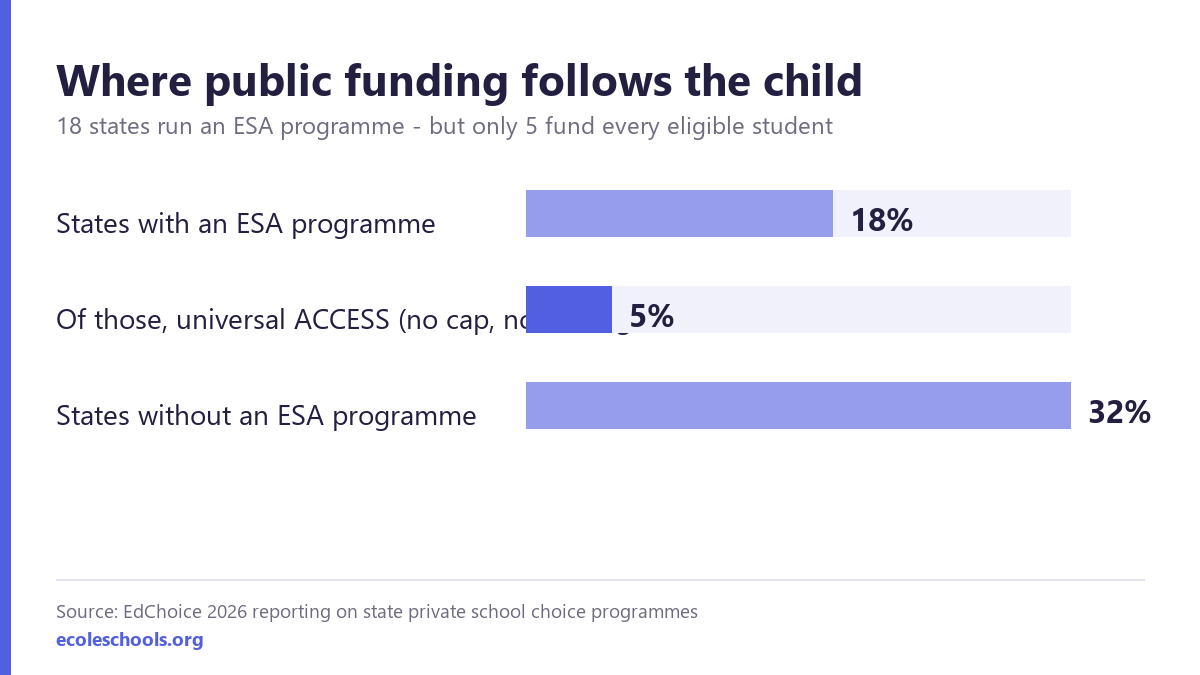
- 18 states operate an education savings account programme, serving more than 500,000 students between them.
- Five states are described as having truly universal school choice: Arizona, West Virginia, New Hampshire, Florida and Ohio.
- Florida’s Family Empowerment Scholarship for Educational Options ESA is the largest, with more than 280,000 participating students.
- West Virginia enacted the Hope Scholarship in 2021, the first universally eligible ESA in the country.
- New Hampshire’s Education Freedom Account cap moves with demand — 10,000 rising to 12,500 for 2026.
- Texas launches in 2026-27 with $1 billion and roughly 80,000 students at about $10,500 each — expected to be the largest first-year programme in the country.
- Arkansas participation grew 226 percent in one year, from 14,297 (2024-25) to 46,578 (2025-26).
- Tennessee received over 50,000 applications for its Education Freedom Scholarship within days of opening.
- The governors of 23 states have opted into the federal tax credit.
Careful: “universal” means two different things
You will see both “five states have universal school choice” and “eighteen states have universal programmes.” Both are defensible, because the word is used two ways:
- Universal eligibility — every K–12 student qualifies to apply. Roughly eighteen states meet this test.
- Universal access — every eligible student can actually be funded: no enrolment cap, no waiting list, no phase-in. Far fewer states meet this test; EdChoice names five.
For a founder the second definition is the one that matters. A programme with universal eligibility and a hard cap — New Hampshire’s, until it moved — is a lottery, not a funding line. Ask which of the two your state has before you build a budget on it; our funding calendar tracks windows and amounts for the states we cover in depth.
What is the same in all fifty states?
Three obligations travel everywhere, whatever the funding picture:
- Compulsory attendance has to be satisfied under some lawful arrangement — private school, homeschool, or a state-specific category. If you charge tuition and employ a teacher, most states treat your students as private-school students. The line is explained in microschool vs homeschool vs learning pod.
- Zoning and occupancy are municipal, never state-level. The friendliest state in the country cannot make your building usable as a school.
- Child care licensing is a separate agency with its own thresholds, usually tied to the ages served and the hours of care.
Everything else — registration, teacher credentials, instructional hours, testing, accreditation — varies. The full checklist is in the microschool legal requirements guide.
How do you resolve your own state in twenty minutes?
Six questions, put to four offices, in this order. Write down each answer with its source.
- Does your state code use the word “microschool”? Search the state code. Most states return nothing — that itself is the answer. West Virginia is the notable exception, defining both “microschool” and “learning pod” in statute.
- What does your state require of a private school? Ask the state department of education, not the district. Registration is usually not approval.
- What does your state require of homeschoolers? This decides whether an umbrella model is realistic for your families.
- Where does child care licensing begin? Different agency, different thresholds.
- What occupancy classification does your building need? Local building department, in writing, before you sign.
- Is there a funding programme, and is it universal eligibility or universal access? The programme’s own site is authoritative.
If two answers conflict, the stricter one governs: education law does not exempt you from building code, and a funding programme does not exempt you from licensing.
What is the money actually worth, state by state?
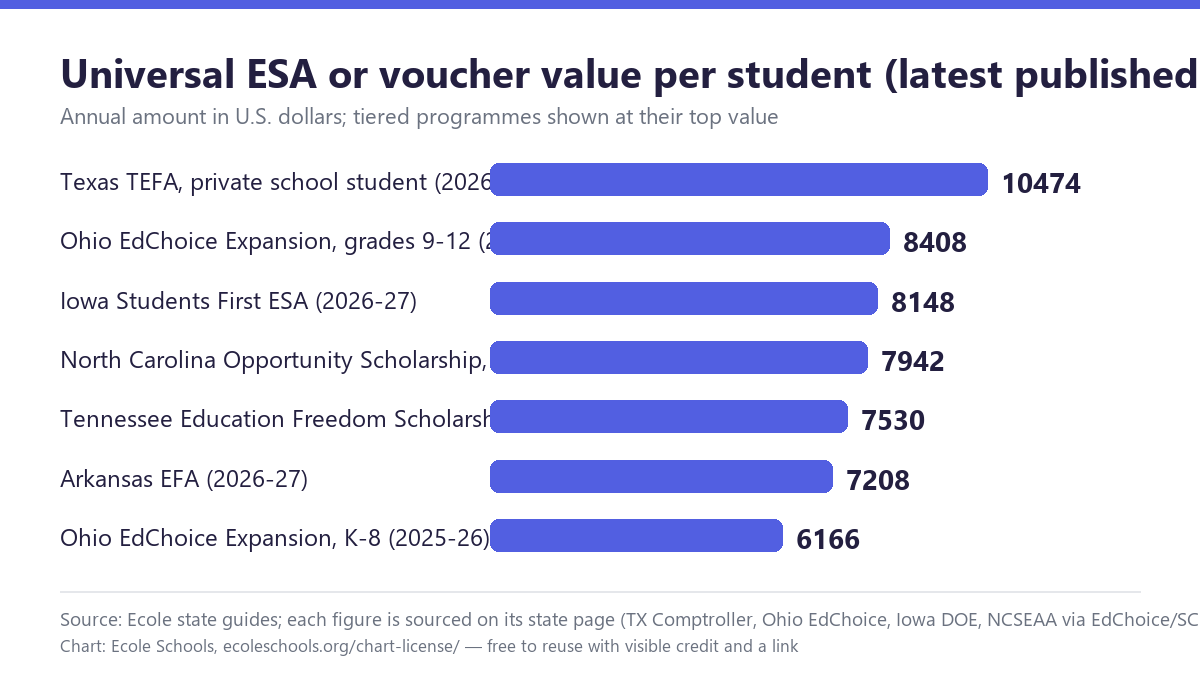
Every figure below is verified on our own state guide for that state, with the official source listed there. Amounts are for the most recent year we could confirm and are not interchangeable — a state with a larger award may attach it to a structure your microschool cannot use.
| State | Programme shape | Award | What the money attaches to |
|---|---|---|---|
| Arizona | Universal ESA | Roughly $7,000–8,000, materially higher for students with disabilities | Private school tuition or a registered service provider |
| Arkansas | Universal EFA | About $6,800 in 2025-26; $7,208 slated for 2026-27 | Private school tuition and approved home-school expenses |
| Florida | Universal (largest programme) | PEP averages about $8,000; awards reported in a $7,613–11,950 band | PEP for a home-education direction, or FES-EO / FTC for enrolled students |
| New Hampshire | Universal eligibility, capped access | Base $4,265 plus differentials ($2,142 disability, $2,346 income) | EFA — but not at the same time as a home education notice |
| Missouri | Not universal: IEP or ≤300% FRL with prior-attendance conditions | MOScholars tax-credit ESA, avg $6,375, up to 175% of the adequacy target | Awarded by Educational Assistance Organisations; tuition or à la carte expenses; capacity depends on that year’s donations |
| Oklahoma | Universal, income-tiered; 15 March window, 60-day priority | Parental Choice Tax Credit $5,000–$7,500 (tuition) / $1,000 (homeschool expenses) | A private school accredited by the State Board or another accrediting association; cheques mailed to the school. No vendor route for unaccredited schools |
| Louisiana | Tiered by need; annual March window | LA GATOR $5,243 / $7,626 (≤250% FPL) / up to $15,253 (disability) | Tuition only at a BESE-approved nonpublic school; home-based students spend through approved marketplace providers, never on tuition |
| Alabama | Income-limited (300% FPL) through 2026; universal from 2027 | CHOOSE Act ESA $7,000 (participating school) / $2,000 (home education, $4,000 family cap) | A school accredited or in candidacy with a listed body for the $7,000 tier; any approved education service provider for the $2,000 tier |
| Iowa | Universal since 2025-26 | Students First ESA $8,148 (2026-27) | Full-time enrolment at an accredited nonpublic school (75% attendance); no unaccredited private school exists in Iowa law, so CPI microschools cannot receive it |
| Indiana | Universal from 2026-27 (HB 1001) | Choice Scholarship: lesser of tuition or 90% of state per-student support (avg $6,536 in 2024-25) | Only an accredited nonpublic school that administers the state assessment; non-accredited schools cannot receive it |
| New Jersey | No programme | — | Nothing portable; families pay privately |
| California | No programme | — | Nothing portable to private schools; independent-study charters spend each enrolled pupil’s instructional funds with approved vendors, which can include a microschool |
| New York | No programme | — | Nothing portable; district transportation within 15 miles outside the cities is the only public entitlement |
| North Carolina | Universal, income-tiered award | Opportunity Scholarship $3,574–$7,942 (2026-27, four tiers) | Tuition and fees at a nonpublic school registered with DNPE; a home school (at most two families) cannot receive it |
| Ohio | Universal, no enrolment cap | EdChoice Expansion $6,166 (K–8) / $8,408 (9–12) | A scholarship at a participating school; families under 200% FPL cannot be charged above it |
| Tennessee | Capped: 35,000 seats, 56,440 applicants | $7,530 for 2026-27 | Only a registered Category I, II or III school — never home-school expenses |
| Texas | New programme, one window a year | $10,474 private school; $2,000 home school; up to $30,000 with an IEP | Accredited private school, or a smaller home-school allowance |
| Utah | Utah Fits All | $8,000 general; home school $4,000 (ages 5–11) / $6,000 (12–18) | Amount depends on whether the child is a full-time private school student |
| West Virginia | First universal ESA (2021) | Hope Scholarship $5,267.38 (2025-26) | Individualized Instructional Programme status + approved Education Service Providers |
The pattern worth taking away: the award and the structure are two separate questions, and the structure is the one that decides whether you can be paid. Texas pays the most on paper but sends only $2,000 down the home-school route. Tennessee sits mid-table at $7,530 and pays nothing at all outside a registered Category I, II or III school. Arkansas and Arizona pay less and are the most flexible about how a family reaches you. Read the award and the attachment before you build a model on it.
Which states do we cover in depth?
| State | Why it is a useful reference |
|---|---|
| Arizona | Light regulation plus universal ESA — the clearest example of how a microschool sector forms |
| Florida | Registration without supervision, and the largest ESA in the country |
| Texas | A brand-new programme where accreditation decides the funding tier |
| Missouri | The definitional state: four unrelated children and the first dollar of tuition end the home-school label; the one non-universal programme in the series |
| Oklahoma | The tax-code mechanism: no accounts or marketplace, cheques to accredited schools — beside the least regulated opening in the series |
| Louisiana | A classification state: approval decides who receives tuition money, the marketplace pays everyone else — and the largest disability award in the series |
| Alabama | Sorted by sponsor: church schools exempt from licensing and certification, private schools not; the ESA has a school tier and a home-education tier |
| Iowa | The hardest floor in the series: a teaching licence decides whether you may charge tuition at all, and only an accredited school takes the ESA |
| Indiana | The lightest unregistered status in the series beside a universal voucher (2026-27) that only an accredited school can receive — accreditation as the business decision |
| New Jersey | No programme at all — the control case for what changes when funding is absent |
We add states as we can verify them against the statute and the programme’s own documentation. We do not publish a page per state built from a template — a legal guide that has not been checked against the law is worse than no guide.
The one state that names the model in statute has its own guide: microschools in West Virginia.
Ohio, another of the five, gives microschools a named category rather than a statute: see the Ohio guide.
Utah shows the same lesson from the other side: the structural choice is a funding choice, because the scholarship pays private-school and home-educated students differently — see the Utah guide.
New Hampshire is the live demonstration of this distinction — universally eligible since June 2025, still capped at 10,000 places: see the New Hampshire guide.
Missouri is the counter-example: operating freedom beside a targeted, donation-capped programme — and a statutory definition that ends the home-school label at four unrelated children or the first dollar — see the Missouri guide.
Oklahoma runs the same accreditation gate through the tax code instead of an account, while leaving the unaccredited path entirely unregulated — see the Oklahoma guide.
Louisiana pairs a strict school gate with an open provider door: approval (with certified teachers) for tuition money, a marketplace application for everything else — see the Louisiana guide.
Alabama draws its line by sponsor rather than by accreditation: a church-ministry school escapes licensing and teacher certification, an independent private school does not — and the CHOOSE Act pays both tiers, $7,000 to an accredited or candidate school and $2,000 per home-educated child through approved providers — see the Alabama guide.
Iowa goes one step further than Indiana: it has no unaccredited private school at all. A microschool is a free four-student pod, competent private instruction under a licensed teacher, or an accredited school — see the Iowa guide.
Indiana is the cleanest statement of the trade-off: the lightest unregistered status in the country sits beside a universal voucher that only an accredited school can receive — see the Indiana guide.
North Carolina answers the question every other state leaves to interpretation — when does a pod become a school? — with a statutory head-count: a home school is at most two families, everything larger is a nonpublic school, and the universal Opportunity Scholarship pays that school: see the North Carolina guide.
California is the other large no-ESA state, and the one where a microschool can still be paid with public money — as an approved vendor to independent-study charter schools rather than through any family account: see the California guide.
New York is the no-funding case done thoroughly: nothing portable, but a defined “substantial equivalency” test for every nonpublic school and the most demanding home-instruction paperwork in the series — see the New York guide, which also compares it with New Jersey line by line.
Frequently asked questions
Are microschools legal in all 50 states?
Yes, in the sense that every state allows small private schools or home education in some form. No state has a general microschool statute, so a microschool operates under private-school law, homeschool law, or a state-specific category such as West Virginia’s.
How many states have an education savings account programme?
Eighteen states operate an ESA programme, serving more than 500,000 students between them, according to EdChoice’s 2026 reporting.
Which states have universal school choice?
EdChoice describes five states as having truly universal school choice: Arizona, West Virginia, New Hampshire, Florida and Ohio. A larger group – around eighteen states – has universal eligibility, which is not the same as universal access.
What is the difference between universal eligibility and universal access?
Universal eligibility means every K-12 student qualifies to apply. Universal access means every eligible student can actually be funded, with no cap, waiting list or phase-in. A capped programme with universal eligibility is a lottery rather than a funding line.
Which state has the largest programme?
Florida, whose Family Empowerment Scholarship for Educational Options ESA has more than 280,000 participating students.
Does a friendly state make zoning easier?
No. Zoning and occupancy classification are decided by your municipality in every state, and child care licensing is a separate agency. State-level freedom does not reach either of them.
Sources
- EdChoice, 2026 EdChoice Yearbook superlatives — universal states, Florida participation, Texas launch figures, Arkansas growth, Tennessee applications, federal tax credit opt-ins.
- State Policy Network, The rapid rise of universal school choice — ESA state count and students served.
- West Virginia Code §18-8-1 — the statutory definition of “microschool” and “learning pod”.
- State-specific statutes and programme sites are cited on each state guide.
General information, not legal advice. Programme counts, amounts and eligibility change every legislative session — verify with your state department of education and the programme’s own site before acting.
Start the conversation
If you want help placing your state in the grid above and turning it into a plan, see our services or contact us. All guides are indexed on the microschool guides page.