

Last updated: · Ecole Schools
Short answer: West Virginia is the one state that puts the word “microschool” into statute. W.Va. Code §18-8-1 defines both “microschool” and “learning pod,” exempts participating children from compulsory attendance, and sets out what the parent must file. On top of that the state runs the Hope Scholarship, an education savings account administered by the State Treasurer, under which microschool and learning pod students are funded.
Working through this for your own school? Ecole Schools supports founders with setup consulting, the Ecole SIS and LMS and mentor training — see what we do or talk to us.
Are microschools legal in West Virginia?
Yes — explicitly, which is unusual. Everywhere else a microschool has to be fitted into private-school or homeschool law by analogy. West Virginia instead names it. Under §18-8-1 a child is exempt from compulsory school attendance when participating in a learning pod or microschool, and the statute defines the two:
- Learning pod — a voluntary association of parents grouping their children together for elementary or secondary study as an alternative to public school, private school, homeschool or microschool, including activities or services provided in exchange for payment.
- Microschool — a school initiated by one or more teachers, or by an entity created to operate a school, that charges tuition for enrolled students and is an alternative to public school, private school, homeschool or a learning pod.
The dividing line the legislature chose is tuition — the same instinct that operates informally in states with no definition, as explained in our microschool vs homeschool guide.
What must a parent file?
On beginning participation, the parent or legal guardian presents to the county superintendent or county board a notice of intent that includes the name, address and age of each participating child of compulsory school age, plus assurance that the child will receive instruction in reading, language, mathematics, science and social studies, and that the child will be assessed annually.
Note what this is not: it is not an approval process, and it is not a licence. It is a notice with a subject list and an assessment commitment attached.
What is different between a microschool and a learning pod here?
| Microschool | Learning pod | |
|---|---|---|
| Charges tuition | Yes — it is in the definition | Payment for activities or services is contemplated, but it is a parent association rather than a school |
| Instructor credential | Teaching certification required | Not required |
| Who initiates it | One or more teachers, or an entity created to operate a school | The parents themselves |
That certification requirement is the practical fork in the road. A programme led by a certified teacher who charges tuition is a microschool in West Virginia law; a parent-run group that hires help is a learning pod. Choose deliberately, because the label carries the credential obligation with it.
How does the Hope Scholarship fund a microschool?
The Hope Scholarship is West Virginia’s education savings account, run by the State Treasurer’s Office. Families receive funds in an account and direct them to approved educational expenses and providers.
| Item | Detail |
|---|---|
| Award (2025-26) | $5,267.38 per student |
| Administrator | West Virginia State Treasurer’s Office |
| Microschool and pod students | Treated as Individualized Instructional Program (IIP) students under the programme |
| Eligibility condition (2025-26) | The prior public-school attendance requirement (45 days) applied, with exceptions for kindergarteners and new residents |
| Provider side | Schools and services register through the programme’s Education Service Provider route |
Eligibility rules and award amounts change between cycles — the Hope Scholarship site is the authority, not this page. Confirm the current year’s rules before planning around them.
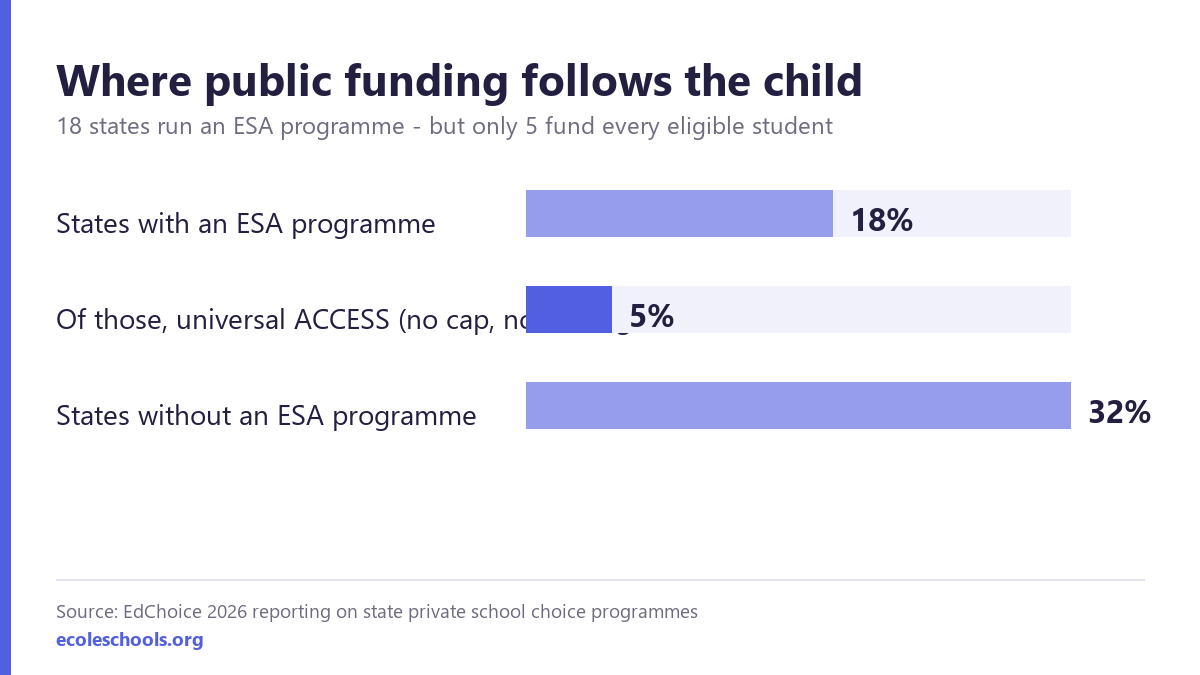
How this compares nationally — including which states have universal access rather than universal eligibility — is on microschool laws by state.
What still bites in West Virginia?
- Certification, if you call it a microschool. The statutory definition brings a credential requirement that a learning pod does not carry. Decide the model before you hire.
- Annual assessment. The notice of intent commits you to it; build the record from day one rather than reconstructing it in spring.
- Zoning and occupancy are municipal. A statute that names microschools does not make a building usable as a school — that is the county or municipal building department’s call.
- Child care licensing is separate, with its own thresholds tied to ages served and hours of care.
- Programme rules move. Hope Scholarship eligibility has been amended more than once since 2021; build for audit, not for one year’s handbook.
How do you open a microschool in West Virginia, step by step?
The steps below are the West Virginia-specific layer. The national sequence that sits underneath them — legal status, zoning, space, team and insurance — is set out in our five-step guide to starting a microschool, and sector-wide statistics covers how many microschools exist and how big they actually are.
- Choose microschool or learning pod — tuition and teacher certification decide it.
- Check municipal zoning and occupancy before signing anything.
- Prepare the notice of intent for participating families: names, addresses, ages, subject assurance, assessment commitment.
- Register as an education service provider if you intend to receive Hope Scholarship funds.
- Build records from day one — attendance, instruction in the five named subjects, and the annual assessment result. The tools guide covers the systems.
- Set tuition against the award. At $5,267.38 the scholarship covers part of a typical tuition; nationally 74 percent of microschools charge $10,000 or less. See the cost guide.
Frequently asked questions
Does West Virginia law define microschools?
Yes. W.Va. Code 18-8-1 defines both “microschool” and “learning pod” and exempts participating children from compulsory school attendance. West Virginia is the clearest example of a state naming the model in statute.
What is the difference between a microschool and a learning pod in West Virginia?
A microschool is initiated by one or more teachers or by an entity created to operate a school and charges tuition; its instructors must hold teaching certification. A learning pod is a voluntary association of parents and its instructors need not be certified.
What does a parent have to file?
A notice of intent to the county superintendent or county board naming each participating child of compulsory school age, assuring instruction in reading, language, mathematics, science and social studies, and committing to annual assessment.
How much is the West Virginia Hope Scholarship?
$5,267.38 per student for the 2025-26 school year. The programme is administered by the West Virginia State Treasurer’s Office; confirm the current amount on its site.
Can Hope Scholarship money pay for a microschool?
Yes. Microschool and learning pod students are treated as Individualized Instructional Program students under the programme, and schools or services register through the Education Service Provider route.
Do West Virginia microschool teachers need certification?
Yes, if the programme operates as a microschool under the statutory definition. Learning pod instructors are not required to hold certification.
Sources
- W.Va. Code §18-8-1 — definitions of microschool and learning pod, compulsory attendance exemption, notice of intent and assessment requirement.
- W.Va. Code §18-8-2 — related compulsory attendance provisions.
- Hope Scholarship (West Virginia State Treasurer’s Office) — award amount, eligibility and programme rules.
- Hope Scholarship — Education Service Providers — provider registration route.
- Tuition context: National Microschooling Center sector data, quoted on our statistics page.
General information, not legal advice. Award amounts and eligibility conditions change between school years — verify with the Hope Scholarship programme and your county before committing.
Start the conversation
If you are planning a microschool or a learning pod in West Virginia, the first decision — which of the two you are — changes everything downstream. See our services or contact us.
Compare with other states
Northeast
- New Jersey — no state programme at all - families pay tuition directly
- New York — no state funding, but a defined substantial-equivalency test and the heaviest home-instruction paperwork in the series
- New Hampshire — universal eligibility, capped access, and no overlap with home education
South
- Florida — registration without supervision, and the largest ESA in the country
- Texas — a brand-new programme where accreditation decides the funding tier
- Arkansas — a universal programme that grew explosively, and an unusually detailed homeschool notice
- Tennessee — the state where your school category decides whether scholarship families can pay you
- North Carolina — a home school is at most two families by statute, so a microschool is a school - and a universal scholarship pays it
- Alabama — church schools are exempt from licensing and certification, private schools are not; the CHOOSE Act pays accredited schools 7,000 dollars and home education 2,000
- Louisiana — GATOR pays tuition only at approved schools, but a registered microschool can be paid as a marketplace provider - with the largest disability award in the series
- Oklahoma — the tax-credit state: cheques go to accredited schools, and the freest homeschooling in the country gets 1,000 dollars
Midwest
- Ohio — the non-chartered school category, with hour and degree rules
- Indiana — the lightest unregistered status in the series, but the universal voucher is paid only to accredited schools
- Iowa — no unaccredited private schools exist - a teaching licence decides what you can be, and the ESA pays only accredited schools
- Missouri — a home school ends at four unrelated children and the first dollar of tuition; the only non-universal programme in the series
West
- Arizona — light regulation plus a universal ESA - the reference case
- Utah — no required subjects or days, and awards that differ by structure
- California — becoming a school is an October affidavit; the only public money arrives through charter vendor channels
- All fifty states — the framework, and how to resolve a state we have not covered in depth