

Last updated: · Ecole Schools
Short answer: Florida has one of the most permissive legal environments for microschools in the country. A microschool operates either as a registered private school — registration with the Florida Department of Education under section 1002.42, Florida Statutes, plus an annual survey, with no state licensing, approval or curriculum review — or as a service provider to families using the Personalized Education Program (PEP) education savings account. Which one you choose decides how state scholarship money can reach your school.
Working through this for your own school? Ecole Schools supports founders with setup consulting, the Ecole SIS and LMS and mentor training — see what we do or talk to us.
Are microschools legal in Florida?
Yes. Florida has no statute that uses the word “microschool,” so a microschool takes one of the existing forms: a private school, a home education arrangement, or a provider serving families who direct their own education funds. Florida’s private-school framework is deliberately light-touch, which is why so many small schools open here.
What does Florida actually require to open a private school?
The core obligation is registration, not approval. Under section 1002.42, Florida Statutes, the administrator of a private school serving any of grades K–12 must register the school with the Florida Department of Education and report enrolment annually through the state’s private school database survey.
Just as important is what the state does not do. Florida private schools are not licensed, approved, accredited or regulated by the State Board of Education or by the local school district, and FLDOE does not review curriculum. That is a genuine freedom and a genuine responsibility: nobody is checking your programme for you, and families will judge it directly.
Do microschool teachers need Florida certification?
No. Florida does not require private-school teachers to hold a state teaching licence. Sector-wide, 54 percent of microschool leaders are licensed educators anyway — certification tends to be a hiring standard schools set for themselves rather than a legal one. Ecole Schools trains mentors in the model regardless of licence status; see the mentor recruitment and development policy.
What are the instructional day and hour minimums?
| Grade band | Minimum days | Net instructional hours |
|---|---|---|
| Kindergarten | 170 | 540 |
| Grades 1–3 | 170 | 720 |
| Grades 4–12 | 170 | 900 |
These are the figures published for Florida private schools; confirm the current year’s requirements with FLDOE before you build a calendar, because a school year designed around four-day weeks can fall short of the hour totals even when it meets the day count.
How does Florida scholarship money reach a microschool?
Florida runs the largest school-choice system in the United States, and this is where a microschool’s legal status becomes financially decisive.
| Programme | Who it serves | What it means for a microschool |
|---|---|---|
| Family Empowerment Scholarship – Educational Options (FES-EO) and the Florida Tax Credit scholarship | Students attending an eligible private school | Tuition flows to the school — requires DOE registration and programme eligibility |
| FES – Unique Abilities (FES-UA) | Students with qualifying disabilities | Higher award amounts; can pay tuition and approved services |
| Personalized Education Program (PEP) | K–12 students who are not enrolled full time in a public or private school | An education savings account the family directs; a microschool can be paid as an approved provider of instruction or services rather than as a school of enrolment |
PEP is the route most often misunderstood. It is an ESA for parent-directed education, open regardless of household income, administered through scholarship funding organisations such as Step Up For Students. Award amounts vary by county and grade band; reported 2025-26 figures average roughly $8,000 per student, with a published range of about $7,613 to $11,950. Verify the current year’s amount and rules with the funding organisation before building a budget around it.
Which path fits your microschool — registered private school or PEP provider?
| Comparison point | Registered private school | PEP provider model |
|---|---|---|
| State paperwork | DOE registration + annual survey | Provider approval with the funding organisation |
| Who enrols the child | Your school | The family directs their own programme |
| How money arrives | Scholarship paid toward tuition | Family pays you from their ESA |
| Best fit | Full-time, five-day school | Part-time, hybrid or à-la-carte programmes |
| Main risk | Programme eligibility rules change | Revenue is spread across many family accounts |
The same status question drives funding in other states too — compare with the Texas Education Freedom Account guide, where accreditation rather than registration is the dividing line.
What about zoning, fire safety and health inspections?
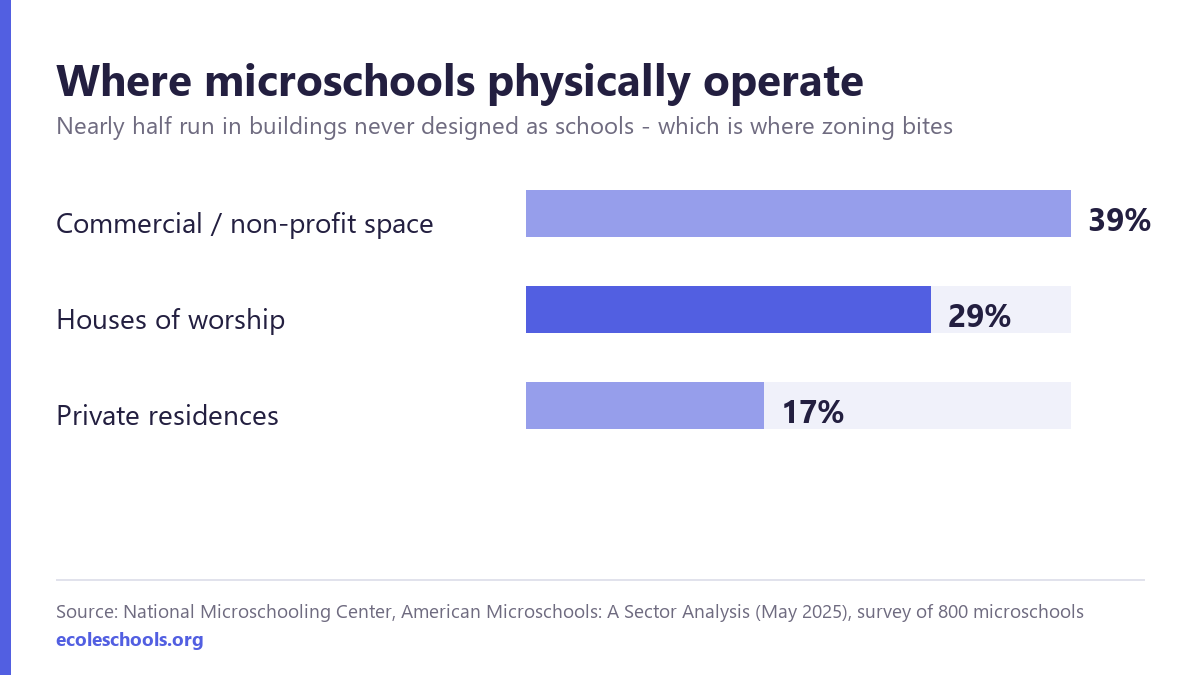
These are the requirements Florida does not centralise. Occupancy classification, fire inspection, parking and signage are decided by your city or county, and a building that has never held a school may need work before it can. The pattern is national: 39 percent of microschools operate in commercial or non-profit space, 29 percent in houses of worship and 17 percent in private residences, and each of those raises a different local question. The general framework is in our microschool legal requirements guide; the specific answer comes from your local building department before you sign a lease.
What about child care licensing?
Florida regulates child care separately from schools. Programmes serving children below school age, or offering care outside instructional hours, can fall under child care licensing rules administered at state or county level. If your microschool includes preschool-age children or after-school care, treat licensing as a separate question from private-school registration — the two are not interchangeable.
How do you open a microschool in Florida, step by step?
- Decide the model — full-time registered private school, or provider to PEP families. This determines everything downstream.
- Secure the space and check zoning first. Local occupancy classification is the most common cause of delay and unbudgeted cost.
- Register with FLDOE if you are operating as a private school, and calendar the annual survey.
- Apply for scholarship-programme participation with the relevant funding organisation, if you intend to serve funded students.
- Build the records from day one — attendance, instructional hours, and evidence of progress. Funding programmes and families both ask for them; the Ecole SIS and LMS keep them in one place.
- Plan enrolment before curriculum. The sector’s median non-public microschool enrols 22 students; the cost page works through what that means for a budget.
Application windows and award amounts across states are collected on the microschool funding calendar.
Florida runs the largest ESA in the country; how it compares with other states is on microschool laws by state.
Frequently asked questions
Are microschools legal in Florida?
Yes. Florida has no microschool statute, so a microschool operates as a registered private school, as a home education arrangement, or as a provider to families using an education savings account. Private schools register with the Florida Department of Education but are not licensed or approved by it.
Do I need to register my Florida microschool with the state?
If you operate as a private school serving any of grades K-12, yes: section 1002.42, Florida Statutes requires registration with FLDOE and an annual enrolment survey. Registration is also a precondition for participating in state scholarship programmes.
Can Florida scholarship money pay for a microschool?
Yes, through different routes. Registered private schools can receive Family Empowerment Scholarship and Florida Tax Credit tuition; families using the Personalized Education Program hold an education savings account and can pay approved providers directly.
How much is the Florida PEP scholarship?
Amounts vary by county and grade band. Reported 2025-26 figures average about $8,000 per student, with a published range of roughly $7,613 to $11,950. Confirm the current amount with the funding organisation.
Do Florida microschool teachers need to be certified?
No. Florida does not require private-school teachers to hold a state teaching certificate. Schools set their own hiring standards.
How many instructional hours does a Florida private school need?
170 days in each case, with 540 net instructional hours for kindergarten, 720 for grades 1-3 and 900 for grades 4-12. Confirm current requirements with FLDOE.
Does Florida inspect or accredit microschools?
The state does not license, approve, accredit or review the curriculum of private schools. Local governments still handle zoning, fire safety and health inspection, and child care licensing is a separate matter.
Sources
- Section 1002.42, Florida Statutes — private school registration and annual reporting.
- Florida Department of Education — Opening a Private School (registration process, instructional day and hour minimums, scope of state oversight).
- Step Up For Students — Personalized Education Program (PEP eligibility and award administration).
- National Microschooling Center, American Microschools: A Sector Analysis (May 2025) — facility and leader statistics quoted above.
This page is general information, not legal advice. Florida programme rules and award amounts change between school years — verify with FLDOE, the funding organisation and your local building department before committing.
Start the conversation
Ecole Schools helps founders open and run microschools with consulting, the Ecole SIS and LMS, mentor training and marketing support. Read the step-by-step guide, see our services, or contact us about opening in Florida.
Compare with other states
Northeast
- New Jersey — no state programme at all - families pay tuition directly
- New York — no state funding, but a defined substantial-equivalency test and the heaviest home-instruction paperwork in the series
- New Hampshire — universal eligibility, capped access, and no overlap with home education
South
- Texas — a brand-new programme where accreditation decides the funding tier
- West Virginia — the only state that defines microschool in statute
- Arkansas — a universal programme that grew explosively, and an unusually detailed homeschool notice
- Tennessee — the state where your school category decides whether scholarship families can pay you
- North Carolina — a home school is at most two families by statute, so a microschool is a school - and a universal scholarship pays it
- Alabama — church schools are exempt from licensing and certification, private schools are not; the CHOOSE Act pays accredited schools 7,000 dollars and home education 2,000
- Louisiana — GATOR pays tuition only at approved schools, but a registered microschool can be paid as a marketplace provider - with the largest disability award in the series
- Oklahoma — the tax-credit state: cheques go to accredited schools, and the freest homeschooling in the country gets 1,000 dollars
Midwest
- Ohio — the non-chartered school category, with hour and degree rules
- Indiana — the lightest unregistered status in the series, but the universal voucher is paid only to accredited schools
- Iowa — no unaccredited private schools exist - a teaching licence decides what you can be, and the ESA pays only accredited schools
- Missouri — a home school ends at four unrelated children and the first dollar of tuition; the only non-universal programme in the series
West
- Arizona — light regulation plus a universal ESA - the reference case
- Utah — no required subjects or days, and awards that differ by structure
- California — becoming a school is an October affidavit; the only public money arrives through charter vendor channels
- All fifty states — the framework, and how to resolve a state we have not covered in depth