


Last updated: · Ecole Schools
Short answer: Arizona is the most permissive state in the country for microschools on both sides of the equation. Private schools operate without state or local education supervision under A.R.S. §15-161, and the state runs a universal Empowerment Scholarship Account (ESA) open to any K–12 student with no income test and no prior public-school requirement. A microschool can be funded through it either as a private school or as a registered service provider.
Working through this for your own school? Ecole Schools supports founders with setup consulting, the Ecole SIS and LMS and mentor training — see what we do or talk to us.
Are microschools legal in Arizona?
Yes, and unusually plainly. Arizona has no microschool statute, so a school here operates as a private school or supports families who have filed a homeschool affidavit. Under A.R.S. §15-161, private schools operate free of supervision by state or local education authorities — while remaining subject to health and safety requirements and to the rules that apply to special education services. There is no state registration step comparable to Florida’s, and no curriculum approval.
What the state does prescribe is the subject list. A.R.S. §15-802 requires children aged six to sixteen to be instructed in reading, grammar, mathematics, social studies and science. That single sentence is the practical floor for any Arizona programme, whatever it calls itself.
What does the homeschool path require?
Parents who educate at home file a notarised Affidavit of Intent to Homeschool with the county school superintendent within 30 days of starting instruction, submitting the child’s original state-issued birth certificate. No affidavit is required before a child turns six or after sixteen. Many Arizona microschools operate alongside this path: families remain homeschoolers on paper while the school provides the instruction — the same structural choice described in our microschool vs homeschool guide.
How does the Arizona ESA work for a microschool?
| Item | Detail |
|---|---|
| Eligibility | Universal — any K–12 Arizona student. No income test, no prior public-school enrolment requirement, no disability requirement |
| Typical award | Most students receive roughly $7,000–$8,000 a year; awards for students with disabilities are substantially higher and vary by category |
| Administration | Arizona Department of Education, with purchases made through the programme’s payment platform |
| How a microschool gets paid | Two routes: as a private school / educational institution (tuition), or as a registered service provider (instruction, tutoring, curriculum) |
| Trade-off families accept | Accepting an ESA means leaving public school enrolment and following the programme’s expense and reporting rules |
The vendor question is the one founders underestimate. Families can only spend where the programme allows them to spend. A microschool that is not registered in the system is invisible at the moment a funded family is choosing — exactly the pattern we describe for other states in the funding calendar. Confirm current amounts, categories and registration steps with the Arizona Department of Education before planning a budget around them.
Why is Arizona the reference case?
Arizona combines the two conditions that decide whether a microschool sector forms: light regulation of private schools and portable public funding. Most states have one or neither. That is why Arizona appears in nearly every national discussion of microschooling, and why models proven there travel poorly to states without an ESA — New Jersey being the clearest contrast, with no programme at all and tuition paid entirely by families.
For a founder, the practical consequence is that an Arizona plan can assume a funded family; a New Jersey plan cannot. Nationally, 74 percent of microschools charge $10,000 a year or less and about 65 percent offer sliding-scale tuition, so an award in the $7,000–$8,000 range covers most of a typical tuition — which is precisely why supply followed funding in Arizona. The cost guide works the arithmetic through.
What still bites in Arizona?
- Zoning and occupancy are municipal. State-level freedom does not exempt a building from Phoenix, Mesa or Tucson requirements. Ask the local building department before signing a lease.
- Health and safety rules still apply to private schools, as do the obligations attached to special education services.
- Programme rules change. ESA expense categories and reporting requirements have been revised repeatedly since the programme became universal; build for audit, not for the current handbook.
- Records are the audit surface. Attendance, instructional records and receipts are what a funded family is asked for. Our tools guide covers the systems that keep them.
How do you start a microschool in Arizona, step by step?
- Choose the structure: private school, or provider to families on ESA and homeschool affidavits. This decides how money reaches you.
- Check municipal zoning and occupancy first — the state will not stop you, the city might.
- Cover the statutory subjects for ages six to sixteen: reading, grammar, mathematics, social studies, science.
- Register in the ESA system under the category that matches your structure, before families apply.
- Build records from day one — attendance, instruction, receipts.
- Set tuition against the award, and publish your discount policy. See the five-step guide.
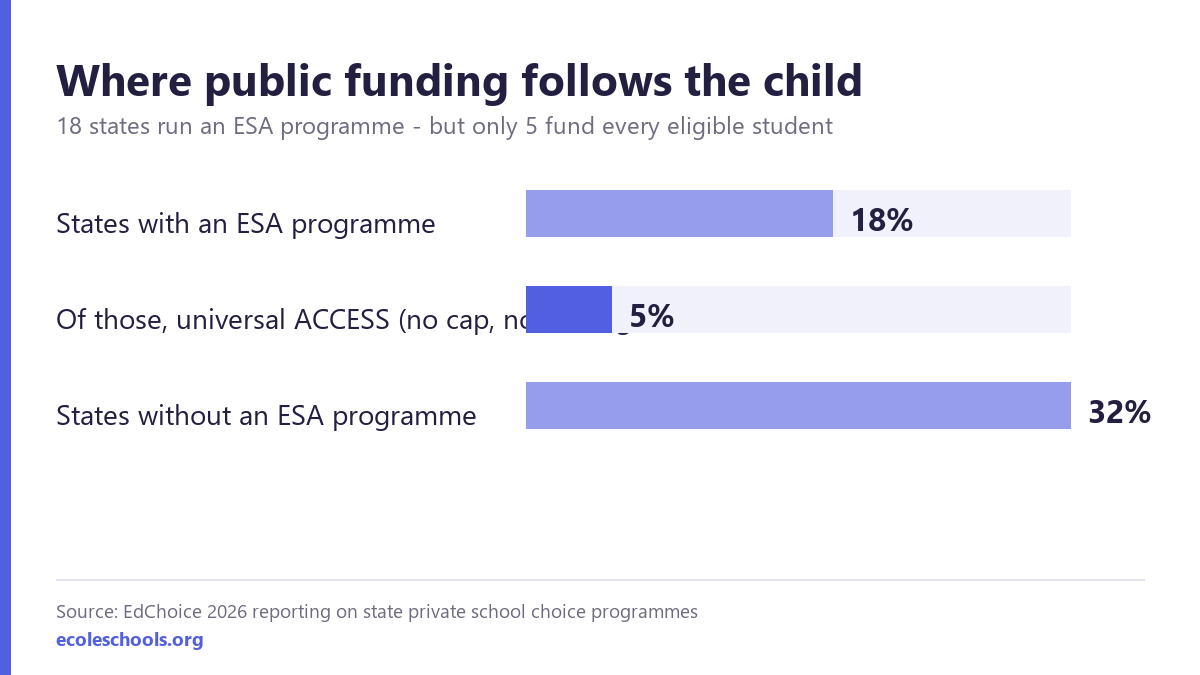
Arizona is one of five states described as having truly universal school choice; the national comparison is on microschool laws by state.
Frequently asked questions
Are microschools legal in Arizona?
Yes. Arizona has no microschool statute; a microschool operates as a private school or supports families who have filed a homeschool affidavit. Under A.R.S. 15-161 private schools operate without state or local education supervision, subject to health and safety rules and special education obligations.
Can Arizona ESA money pay for a microschool?
Yes. A microschool can be paid either as a private school or educational institution, or as a registered service provider for instruction, tutoring and curriculum. It must be registered in the programme before a funded family can pay it.
How much is the Arizona ESA per student?
Most students receive roughly $7,000 to $8,000 a year; awards for students with disabilities are substantially higher and vary by category. Confirm current figures with the Arizona Department of Education.
Who is eligible for the Arizona ESA?
Any K-12 Arizona student. The programme is universal: no income test, no prior public-school enrolment requirement and no disability requirement.
What subjects does Arizona require?
A.R.S. 15-802 requires children aged six to sixteen to be instructed in reading, grammar, mathematics, social studies and science.
What does Arizona require to homeschool?
A notarised Affidavit of Intent to Homeschool filed with the county school superintendent within 30 days of starting instruction, with the child’s original state-issued birth certificate. No affidavit is needed before age six or after sixteen.
Sources
- A.R.S. §15-161 — private schools and state supervision.
- A.R.S. §15-802 — instruction requirements for ages six to sixteen.
- EdChoice — Arizona Empowerment Scholarship Accounts (programme profile, eligibility and award structure).
- Arizona Families for Home Education — law and affidavit (homeschool affidavit procedure).
- Arizona Department of Education ESA programme pages and parent handbook — the authority for current amounts, expense categories and vendor registration.
- Tuition and sliding-scale figures: National Microschooling Center sector analysis, quoted on our statistics page.
General information, not legal or financial advice. Arizona programme rules and award amounts change between years — verify with the Arizona Department of Education and your municipality before committing.
Start the conversation
If you are planning a microschool in Arizona, the fastest route to a realistic plan is a conversation about structure, funding registration and records. See our services, contact us, or start with the microschool guides.
Compare with other states
Northeast
- New Jersey — no state programme at all - families pay tuition directly
- New York — no state funding, but a defined substantial-equivalency test and the heaviest home-instruction paperwork in the series
- New Hampshire — universal eligibility, capped access, and no overlap with home education
South
- Florida — registration without supervision, and the largest ESA in the country
- Texas — a brand-new programme where accreditation decides the funding tier
- West Virginia — the only state that defines microschool in statute
- Arkansas — a universal programme that grew explosively, and an unusually detailed homeschool notice
- Tennessee — the state where your school category decides whether scholarship families can pay you
- North Carolina — a home school is at most two families by statute, so a microschool is a school - and a universal scholarship pays it
- Alabama — church schools are exempt from licensing and certification, private schools are not; the CHOOSE Act pays accredited schools 7,000 dollars and home education 2,000
- Louisiana — GATOR pays tuition only at approved schools, but a registered microschool can be paid as a marketplace provider - with the largest disability award in the series
- Oklahoma — the tax-credit state: cheques go to accredited schools, and the freest homeschooling in the country gets 1,000 dollars
Midwest
- Ohio — the non-chartered school category, with hour and degree rules
- Indiana — the lightest unregistered status in the series, but the universal voucher is paid only to accredited schools
- Iowa — no unaccredited private schools exist - a teaching licence decides what you can be, and the ESA pays only accredited schools
- Missouri — a home school ends at four unrelated children and the first dollar of tuition; the only non-universal programme in the series
West
- Utah — no required subjects or days, and awards that differ by structure
- California — becoming a school is an October affidavit; the only public money arrives through charter vendor channels
- All fifty states — the framework, and how to resolve a state we have not covered in depth