

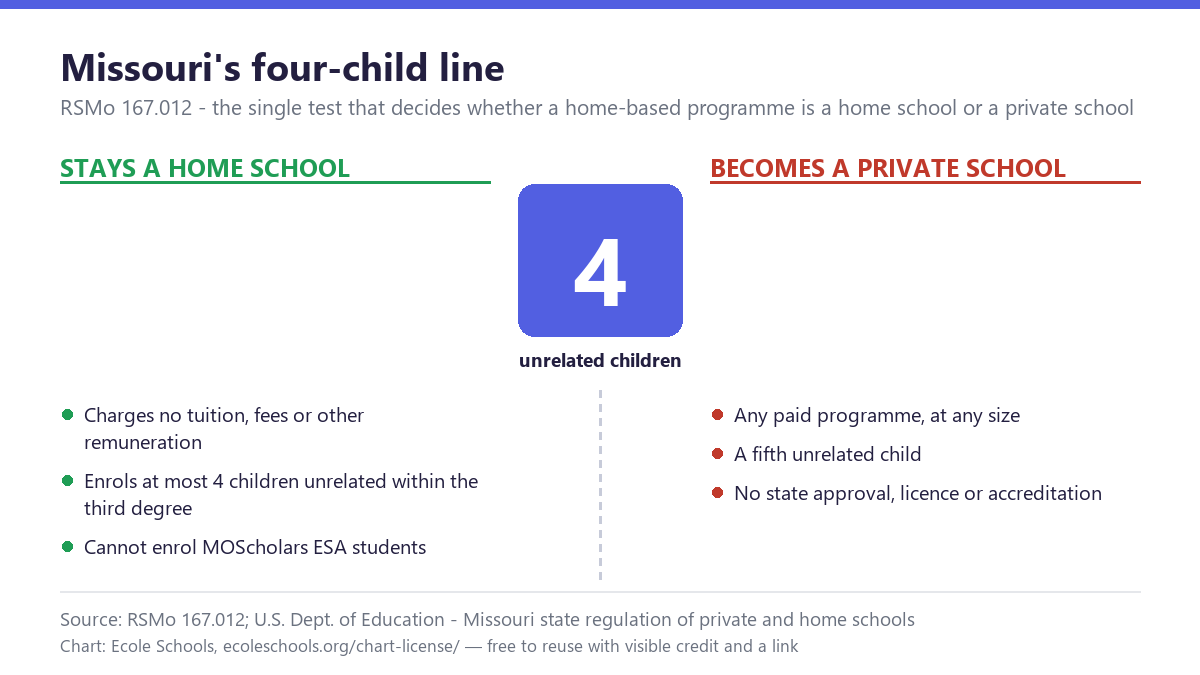
Short answer: Missouri writes the microschool boundary into its definitions. A “home school” enrols no more than four children unrelated to the family within the third degree, may not “charge or receive consideration in the form of tuition, fees, or other remuneration”, and may not enrol MOScholars students at all (RSMo 167.012) — so a microschool that charges tuition, serves a fifth unrelated child, or takes ESA families is, by definition, something else: a private school, which Missouri leaves almost entirely alone, or the new “FPE school” category created for ESA-funded home education. The money itself, MOScholars, is a tax-credit-funded ESA averaging $6,375 and reaching 175% of the state adequacy target for special-needs students — but unlike every other funded state in this series, it is not universal: it serves students with an IEP or from families within 300% of the free-lunch limit, with public-school-attendance conditions on top.
Working through this for your own school? Ecole Schools supports founders with setup consulting, the Ecole SIS and LMS and mentor training — see what we do or talk to us.
Are microschools legal in Missouri?
Yes. Compulsory attendance (age 7 to 16 or 17 by district) is satisfied by a public, private, parochial, parish, home or FPE school. A microschool takes one of three shapes:
- A private school. Missouri requires no approval, licence or accreditation, sets no minimum school year or day for nonpublic schools, and does not require certified teachers (RSMo 168.071). Obligations are few and specific: the constitutions-and-civics content by seventh grade (RSMo 170.011, 170.345 for the graduation civics exam), and immunisation records (RSMo 167.181). This is where a tuition-charging microschool belongs.
- A home school — only within the definition: private or religious instruction as primary purpose, no more than four unrelated children, no tuition or other remuneration, no MOScholars participants, and not an FPE school (RSMo 167.012). Home schools run 1,000 hours a year, 600 in reading, language arts, mathematics, social studies and science, 400 of those at the home location, with a plan book or log, a work portfolio and an evaluation record (RSMo 167.031). No notice is required; registration is optional.
- An FPE school (family-paced education). The category SB 727 created in 2024 so that families using MOScholars for home-based education would not fall under — or reshape — the home-school law. An FPE student is by definition a programme participant; a microschool serving such families operates as their provider rather than their school of record.
The four-and-no-tuition rule is the strictest boundary of its kind in this series — it combines North Carolina’s head-count line with Iowa’s no-remuneration rule, and adds an ESA exclusion neither of them has. The practical reading for a founder: in Missouri you cannot run a paid “homeschool co-op” of any size; the moment money or a fifth unrelated child arrives, you are a private school, and fortunately Missouri’s private-school status is among the lightest in the country.
What does MOScholars pay, and who can receive it?
| Item | Detail |
|---|---|
| Programme type | Education savings account funded by private donations that earn 100% state tax credits; scholarships are awarded by certified Educational Assistance Organisations under the State Treasurer’s programme. |
| Eligibility | Not universal. Students with an approved IEP, or from families within 300% of the free and reduced-price lunch limit; income-qualified students must also have attended public school full-time for a semester in the prior year, be entering kindergarten or first grade, or be a sibling of a recipient. |
| Award | Average account value $6,375; up to 175% of the state adequacy target depending on need. |
| Scale | About 2,700 participating students at the last EdChoice update — by far the smallest funded programme in this series. |
| Qualified expenses | Private school tuition and fees, or à la carte: textbooks, tutoring, curriculum, educational therapies, virtual school tuition, standardised tests, extracurriculars, approved technology, summer and after-school programmes, transportation. |
| Provider angle | Because the expense list is à la carte, a microschool can serve FPE families as a tutoring, curriculum or programme provider even if it is not their tuition-charging school of record. |
The funding mechanism matters as much as the rules: MOScholars is capped by how many tax-credited donations the Educational Assistance Organisations raise, not by an appropriation. That makes award availability lumpy from year to year and region to region — families apply through an EAO, and a school that wants scholarship families should build relationships with the EAOs the way an Alabama school builds them with accreditors. Our cost guide covers pricing when only part of a cohort carries a scholarship.
How does Missouri compare?
Missouri is the counter-example in this series on two axes at once. On operating freedom it sits with Oklahoma and Arizona: no approval, no registration gate for private schools, no teacher rules, no school-year minimum. On funding it stands alone: every other funded state we cover has gone universal or income-tiered-universal, while MOScholars remains a targeted, donation-capped programme — a reminder that the national school-choice wave is a wave, not a settled tide. And its home-school definition is the sharpest legal answer yet to “when does a pod become a school?”: at child number five, or at the first dollar.
How do you start a microschool in Missouri, step by step?
- Accept private-school status from the start if you will charge tuition or serve more than four unrelated children — the home-school label is legally unavailable to a business. The national five-step guide covers the sequence.
- Build the two content obligations in: constitutions and civics from seventh grade, and the USCIS-based civics exam for graduates.
- Keep immunisation records and follow the notification rule for non-compliant families (RSMo 167.181).
- If you want scholarship families, contact the certified Educational Assistance Organisations, confirm your school or services qualify, and understand that awards depend on that year’s donations.
- If you serve FPE families as a provider, price your offer against the à la carte expense list rather than as tuition.
- Premises: zoning, occupancy and fire rules are local — see the legal requirements guide.
Frequently asked questions
Are microschools legal in Missouri?
Yes. A tuition-charging microschool operates as a private school, which Missouri does not approve, license or accredit and for which it sets no teacher-certification or school-year requirements. The home-school category is limited to at most four unrelated children, no tuition and no MOScholars participants, and ESA-funded home education uses the separate FPE school category.
Can a Missouri microschool charge tuition as a home school?
No. RSMo 167.012 defines a home school as one that does not charge or receive tuition, fees or other remuneration and enrols no more than four children unrelated to the family within the third degree. A paid programme of any size is a private school.
How much is a MOScholars scholarship?
The average account value is 6,375 dollars, and awards can reach 175 percent of the state adequacy target for students with greater need. Funds come from tax-credited private donations awarded through certified Educational Assistance Organisations, so availability varies by year.
Who qualifies for MOScholars?
Students with an approved IEP, or students from families within 300 percent of the free and reduced-price lunch limit who also attended public school full-time for a semester in the prior year, are entering kindergarten or first grade, or are siblings of recipients. It is the only programme in the states we cover in depth that is not universal.
What is an FPE school in Missouri?
Family-paced education, the category created by SB 727 in 2024 for home-based students who participate in MOScholars. It keeps ESA-funded home education legally separate from the home-school statute, so traditional homeschoolers face no new rules and programme families follow the programme’s terms.
Do Missouri microschool teachers need a certificate?
No. Missouri statute does not require teacher certification in nonpublic schools (RSMo 168.071), and neither home schools nor FPE schools carry a teacher qualification requirement.
Sources
- RSMo §167.012 (Revisor of Statutes) (the home-school definition: primary purpose, no more than four unrelated children, no tuition or remuneration, no programme participants, not an FPE school).
- RSMo §167.031 (compulsory attendance satisfied by private, parochial, parish, home or FPE school; the 1,000 / 600 / 400 hour rules and records for home instruction; 100-hour credit definition).
- U.S. Department of Education — Missouri state regulation of private and home schools (no approval, licensing or accreditation; no teacher certification, RSMo 168.071; no school-year minimum; constitutions and civics content, 170.011 and 170.345; immunisation records, 167.181).
- EdChoice — Missouri Empowerment Scholarship Accounts (MOScholars) (tax-credit ESA; eligibility; average $6,375 and 175% of adequacy target; about 2,700 students; expense list; updated 16 December 2025).
General information, not legal advice. Programme rules and definitions change — verify with the State Treasurer’s office and the Department of Elementary and Secondary Education before committing.
Start the conversation
If you are opening in Missouri, the definitional lines — four children, the first dollar, the FPE category — decide your status before anything else does. See our services or contact us.
Compare with other states
Northeast
- New Jersey — no state programme at all - families pay tuition directly
- New York — no state funding, but a defined substantial-equivalency test and the heaviest home-instruction paperwork in the series
- New Hampshire — universal eligibility, capped access, and no overlap with home education
South
- Florida — registration without supervision, and the largest ESA in the country
- Texas — a brand-new programme where accreditation decides the funding tier
- West Virginia — the only state that defines microschool in statute
- Arkansas — a universal programme that grew explosively, and an unusually detailed homeschool notice
- Tennessee — the state where your school category decides whether scholarship families can pay you
- North Carolina — a home school is at most two families by statute, so a microschool is a school - and a universal scholarship pays it
- Alabama — church schools are exempt from licensing and certification, private schools are not; the CHOOSE Act pays accredited schools 7,000 dollars and home education 2,000
- Louisiana — GATOR pays tuition only at approved schools, but a registered microschool can be paid as a marketplace provider - with the largest disability award in the series
- Oklahoma — the tax-credit state: cheques go to accredited schools, and the freest homeschooling in the country gets 1,000 dollars
Midwest
- Ohio — the non-chartered school category, with hour and degree rules
- Indiana — the lightest unregistered status in the series, but the universal voucher is paid only to accredited schools
- Iowa — no unaccredited private schools exist - a teaching licence decides what you can be, and the ESA pays only accredited schools
West
- Arizona — light regulation plus a universal ESA - the reference case
- Utah — no required subjects or days, and awards that differ by structure
- California — becoming a school is an October affidavit; the only public money arrives through charter vendor channels
- All fifty states — the framework, and how to resolve a state we have not covered in depth