

Short answer: California makes becoming a school unusually simple and becoming a funded school unusually indirect. Any person or organisation “offering or conducting private school instruction” becomes a private school by filing the Private School Affidavit with the state between 1 and 15 October each year (Education Code §33190) — no licence, no approval, no accreditation, no credentialed teachers, no minimum school year. But California has no ESA, voucher or tax-credit scholarship; EdChoice records that “California does not have a private school choice program.” The public money that does reach home-based learners flows through independent-study charter schools, which hold instructional funds for each enrolled student and spend them with approved vendors. A California microschool therefore has two very different business models: a private school paid by tuition, or a vendor to charter-enrolled families — and many run both.
Working through this for your own school? Ecole Schools supports founders with setup consulting, the Ecole SIS and LMS and mentor training — see what we do or talk to us.
Are microschools legal in California?
Yes. California has no microschool statute; it regulates where a child of compulsory age (6 to 18) receives instruction. A microschool is one of these:
- A private school that files its own affidavit. This is the default for a microschool that enrols children and teaches them on site. The same affidavit is the instrument most California home educators use to make their own home a private school, which is why a home-based microschool and a family homeschool sit under identical law.
- A satellite or support programme to affidavit-filing families (often called a private school satellite programme). Each family, or one umbrella school, files the affidavit and keeps the records; your microschool delivers some or all of the instruction.
- A vendor to independent-study charter schools. The child is a public school student enrolled in a charter; the charter spends that student’s instructional funds on approved vendors, which can include classes at your site. This is public funding without being a public school, and it comes with the charter’s vendor rules and state testing for the student.
- Instruction by a credentialed tutor (§48224): at least three hours a day, between 8 a.m. and 4 p.m., for 175 days a year, by a holder of a valid California teaching credential. Rarely the basis of a microschool, but it is the one route where a credential is required.
What does the Private School Affidavit actually do — and not do?
Section 33190 requires “every person, firm, association, partnership, or corporation offering or conducting private school instruction on the elementary or high school level” to file the affidavit “between the first and 15th day of October of each year”. The affidavit reports the school’s names and addresses, where its records are kept and who holds them, directors and officers, enrolment by grade, number of teachers, whether it is coeducational and whether it boards pupils, and certifies that the required records exist: attendance, courses of study and faculty qualifications, plus the criminal-record summaries required by §44237.
What it does not do is approve you. The statute is explicit: filing “shall not be interpreted to mean, and it shall be unlawful for any school to expressly or impliedly represent by any means whatsoever, that the State of California” or any of its agencies has approved the school, “unless this is an actual fact”. The Superintendent publishes a directory of filed schools; being in it is a fact of filing, not a mark of quality, and your website must not say otherwise.
| Requirement | What California law says |
|---|---|
| Accreditation, licence, approval | None required. Accreditation (typically WASC) is optional; the state approves only nonpublic special-education schools. |
| Teachers | No credential. Children taught by “persons capable of teaching” are exempt from public school attendance (§48222); the affidavit records faculty qualifications as you define them. |
| School year and day | Set by the school — no state minimum for private schools (the 175-day, three-hour rule applies only to the credentialed-tutor route). |
| Curriculum | “Instruction in the several branches of study required in the state’s public schools” (§48222) — for grades 1–6 that is English, mathematics, social sciences, science, visual and performing arts, health and physical education (§51210). Private schools need not follow state content standards. |
| Background checks | Every private school must obtain criminal-record summaries for employment applicants through the Department of Justice; it may not employ anyone convicted of a violent or serious felony, and such a person may not own or operate a private school. A parent “working exclusively with his or her children” is exempt (§44237). |
| Records | Attendance register (absences over half a day), courses offered, faculty list; immunisation records. |
| Health and safety | Immunisations; tuberculosis testing for employees; fire inspections; earthquake emergency procedures; first-aid kits on field trips (federal summary of California law). |
Note the asymmetry: the state asks almost nothing about what you teach or how long, but it asks about who is in the building. In a sector where, nationally, 28% of founders are currently licensed educators and 21% formerly licensed, California’s indifference to credentials is a genuine advantage — and its insistence on fingerprinting every employee is the rule founders most often discover late.
Is there any state money for microschool families in California?
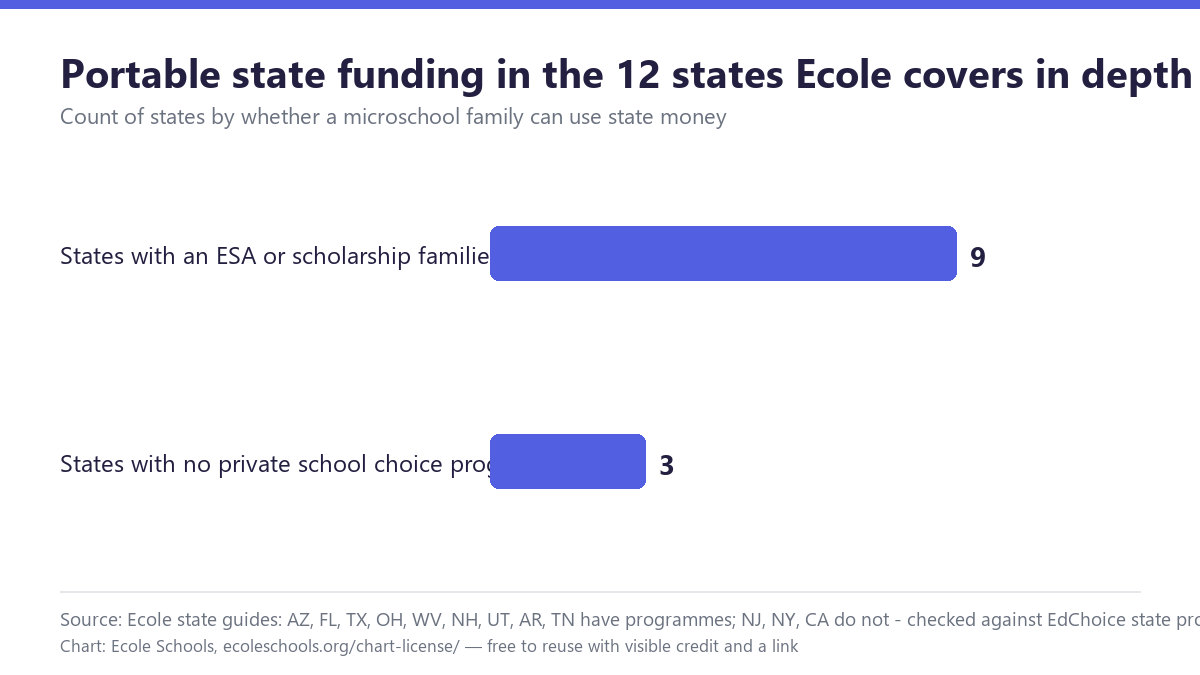
Not directly. There is no education savings account or voucher, and lawmakers have only “considered tax-credit scholarships and education savings accounts in the past” (EdChoice). What exists is the independent-study charter route. A charter that enrols a home-based student receives state funding for that student’s average daily attendance, and most such charters make part of it available as instructional or enrichment funds that parents direct to vendors on the charter’s approved list. Heartwood Charter School’s own family FAQ describes the mechanism plainly: “each California state student generates funds by his/her average daily attendance”, funds are prorated by enrolment date, purchases must come from approved vendors, and “no school funding is provided directly to parents or students for any purpose”.
For a microschool this means a third customer: the charter. To be paid this way you become an approved vendor of each charter your families use, invoice the charter rather than the parent, and accept that the student is a public school pupil who takes state assessments and whose charter may restrict the share of instruction a vendor can deliver. Amounts are set by each charter and published on its own site; they change yearly and are never cash in a parent’s hand. The laws-by-state framework explains why this is portable money of a different kind from an ESA, and the cost guide shows how a tuition-plus-vendor model changes first-year cash flow.
Tuition school, charter vendor, or both?
| Question | Private school (own affidavit) | Vendor to charter families |
|---|---|---|
| Who pays you | Families, by tuition | The charter, from the student’s instructional funds |
| Whose student is the child | Yours — a private school pupil | The charter’s — a public school pupil |
| State testing | None | Yes, through the charter |
| Paperwork | Affidavit each October; attendance, courses, faculty, fingerprints | Vendor application and invoicing per charter; the charter files nothing for you |
| Control of the programme | Yours | Shared: the charter’s vendor rules limit what it will buy |
| Can the same child be both? | No — a child is either enrolled in your private school or in the charter. A site can serve both kinds of families in the same room. | |
Ecole practice, not a legal requirement: founders who run both models keep two enrolment lists, two fee schedules and one timetable, and put the distinction in writing for families before the first invoice — the point at which a parent discovers that charter funds will not cover a fee is the point at which trust is lost.
How do you start a microschool in California, step by step?
- Choose the model: affidavit school, satellite to affidavit families, charter vendor, or a combination. The national five-step guide covers the decision sequence; in California the funding question decides it.
- Fingerprint before you hire: DOJ criminal-record summaries for every employee are a condition of operating, not an afterthought.
- Build the three records the affidavit certifies — attendance, courses of study, faculty qualifications — from day one; the tools and resources guide explains what a record system has to capture.
- File the affidavit 1–15 October. If you open mid-year, file at the next window and keep the records from the day you open; the statute’s window is annual.
- If you want charter money, apply to each charter’s vendor programme in spring for the following year; approval timelines and documentation differ by charter.
- Premises: zoning, occupancy, fire inspection and earthquake procedures are local and state health-and-safety matters outside the Education Code — see the legal requirements guide.
- Never claim state approval in any material; §33190 makes that unlawful.
Frequently asked questions
Are microschools legal in California?
Yes. California has no microschool statute. A microschool operates as a private school that files the annual Private School Affidavit under Education Code 33190, as a support programme to families who file their own affidavit, or as an approved vendor to independent-study charter schools.
Does California have an ESA or voucher a microschool family can use?
No. California does not have a private school choice programme. Public money reaches home-based learners only through independent-study charter schools, which spend each enrolled student’s instructional funds with approved vendors; a microschool can be such a vendor.
When is the California Private School Affidavit filed?
Between 1 and 15 October each year, by every person or organisation conducting private school instruction at elementary or high school level. Filing is a statement of operation, not state approval, and a school may not claim approval on the strength of it.
Do California microschool teachers need a credential?
No. Children taught by persons capable of teaching are exempt from compulsory public school attendance under Education Code 48222. A credential is required only for the separate private-tutor route in section 48224.
Does a California private school have to fingerprint its staff?
Yes. Under Education Code 44237 every private elementary or high school must obtain criminal-record summaries for employment applicants and may not employ anyone convicted of a violent or serious felony; such a person may not own or operate a private school either. A parent working exclusively with his or her own children is exempt.
How many days or hours must a California private school teach?
The state sets no minimum school year or day for private schools; the school decides. The 175-day, three-hours-a-day rule applies only to instruction by a credentialed private tutor.
Sources
- California Education Code §33190 (who files, the 1–15 October window, affidavit contents, the no-approval clause, the directory).
- Education Code §44237 (criminal-record summaries, felony bar, parent exemption).
- Education Code §48222 and §51210 (private school exemption, “persons capable of teaching”, grades 1–6 course of study).
- U.S. Department of Education — California state regulation of private and home schools (accreditation optional, no licensing or approval, no state minimum year, records, health and safety, the four home-education routes, §48224 tutor rule).
- EdChoice — California (“California does not have a private school choice program”; tax-credit scholarships and ESAs considered in the past).
- Heartwood Charter School — Home School FAQ (how charter instructional funds are generated by attendance, approved vendors, no funds paid to parents) — one charter’s published terms, used to describe the mechanism; amounts and rules differ by charter.
- The national founder-licensing figures are from the National Microschooling Center’s May 2026 sector analysis, sourced on our statistics page.
General information, not legal advice. The California Department of Education’s own affidavit pages were not reachable by our automated checker on the day this guide was written, so statutory text is cited directly; verify filing mechanics on the Department’s site before October.
Start the conversation
If you are opening in California, the model decision — tuition school, charter vendor, or both — shapes the records, the fingerprinting and the October filing. See our services or contact us.
Compare with other states
Northeast
- New Jersey — no state programme at all - families pay tuition directly
- New York — no state funding, but a defined substantial-equivalency test and the heaviest home-instruction paperwork in the series
- New Hampshire — universal eligibility, capped access, and no overlap with home education
South
- Florida — registration without supervision, and the largest ESA in the country
- Texas — a brand-new programme where accreditation decides the funding tier
- West Virginia — the only state that defines microschool in statute
- Arkansas — a universal programme that grew explosively, and an unusually detailed homeschool notice
- Tennessee — the state where your school category decides whether scholarship families can pay you
- North Carolina — a home school is at most two families by statute, so a microschool is a school - and a universal scholarship pays it
- Alabama — church schools are exempt from licensing and certification, private schools are not; the CHOOSE Act pays accredited schools 7,000 dollars and home education 2,000
- Louisiana — GATOR pays tuition only at approved schools, but a registered microschool can be paid as a marketplace provider - with the largest disability award in the series
- Oklahoma — the tax-credit state: cheques go to accredited schools, and the freest homeschooling in the country gets 1,000 dollars
Midwest
- Ohio — the non-chartered school category, with hour and degree rules
- Indiana — the lightest unregistered status in the series, but the universal voucher is paid only to accredited schools
- Iowa — no unaccredited private schools exist - a teaching licence decides what you can be, and the ESA pays only accredited schools
- Missouri — a home school ends at four unrelated children and the first dollar of tuition; the only non-universal programme in the series
West
- Arizona — light regulation plus a universal ESA - the reference case
- Utah — no required subjects or days, and awards that differ by structure
- All fifty states — the framework, and how to resolve a state we have not covered in depth