

Last updated: · Ecole Schools
Short answer: the most recent sector-wide research counts roughly 95,000 microschool sites in the United States serving an estimated 1 to 1.5 million K–12 students. The median non-public microschool enrols 22 students, 74 percent charge $10,000 a year or less, and 54 percent of microschool leaders are licensed educators. Every figure on this page is attributed to a named study, and the limits of each number are stated plainly.
Working through this for your own school? Ecole Schools supports founders with setup consulting, the Ecole SIS and LMS and mentor training — see what we do or talk to us.
How many microschools are there in the United States?
There is no federal register of microschools, so no official count exists. The most widely cited estimate comes from the National Microschooling Center’s American Microschools: A Sector Analysis (May 2025), built on a survey of 800 operating and pre-launch microschools across all fifty states and the District of Columbia. Coverage of that research puts the sector at roughly 95,000 sites serving 1 to 1.5 million K–12 students.
Other estimates circulate — some analysts describe 750,000 students, others up to 2 million — and the spread is not sloppiness. It reflects three real problems: microschools are not a legal category in most states, many operate under homeschool law and are therefore invisible in state data, and part-time attendance is counted differently by different researchers.
How big is the average microschool?
| Setting | Median enrolment |
|---|---|
| Non-public microschools | 22 students |
| Public and public charter microschools | 36 students |
The practical meaning for a founder is that a school of 15–25 learners is the sector norm rather than an undersized start. Our guide to starting a microschool works through the staffing and space that size implies, and the microschool cost page works through what that size costs to run.
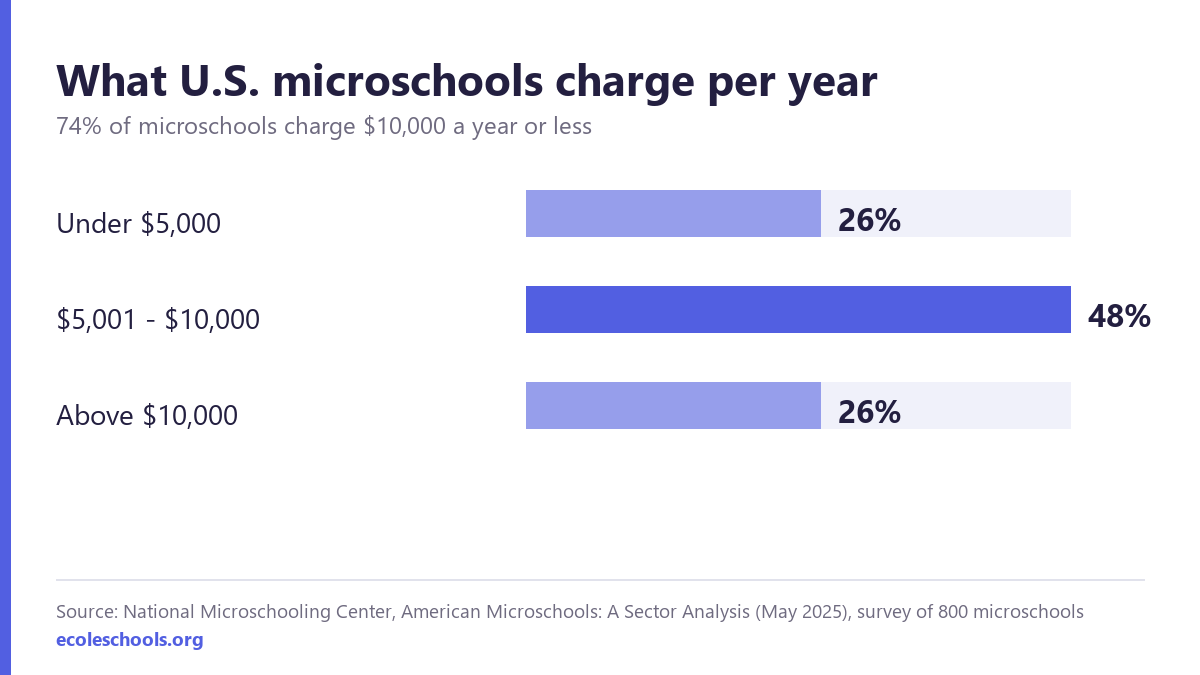
What does microschool tuition cost?
| Annual tuition and fees | Share of microschools |
|---|---|
| Under $5,000 | 26% |
| $5,001 – $10,000 | 48% |
| Total at or below $10,000 | 74% |
Roughly 65 percent of microschools offer discounts or sliding-scale tuition based on family need, and the median reported cost of educating one child is about $6,500. Where a state education savings account programme exists, that gap between price and cost is often what the programme closes — see the Texas ESA guide for how one state’s amounts work.
Where do microschool students come from?
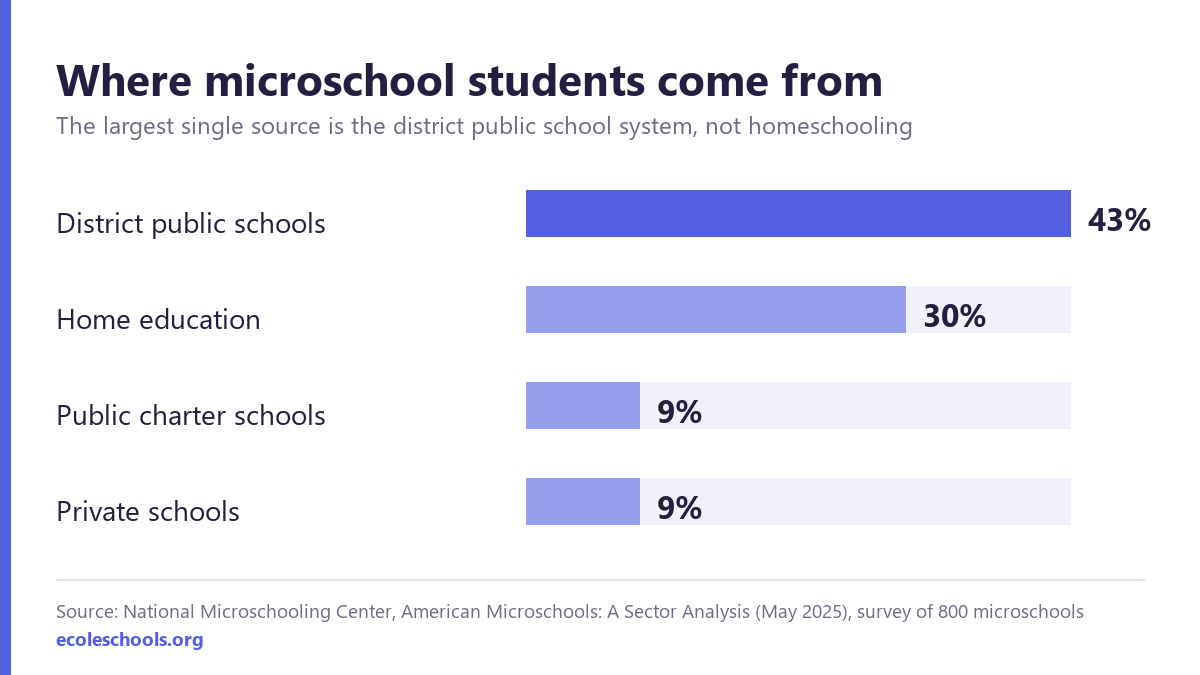
| Previous setting | Share of microschool students |
|---|---|
| District public schools | 43% |
| Home education | 30% |
| Public charter schools | 9% |
| Private schools | 9% |
This is the number most often misread. Microschooling is not mainly a homeschool phenomenon: the largest single source of students is the district school system.
Who runs microschools?
Fifty-four percent of microschool leaders are licensed educators, and a further 32 percent are professional educators who never held a public-school licence. In other words the sector is built and staffed overwhelmingly by people who came out of classrooms — which is why the teacher-to-founder path is the mainstream route into microschooling rather than an unusual one.
Where do microschools physically operate?
| Facility type | Share |
|---|---|
| Commercial or non-profit space | 39% |
| Houses of worship | 29% |
| Private residences | 17% |
Nearly half of the sector therefore operates in buildings that were not built as schools, which is exactly where zoning, occupancy classification and inspection questions bite. Those rules are covered in the microschool legal requirements guide.
How many microschools are accredited?
Twenty-two percent report being accredited, while 80 percent say they would be interested in an accreditation pathway designed for microschools. Accreditation is optional in most states but is becoming financially decisive where funding programmes route tuition only through accredited private schools.
Do microschool students make academic progress?
Eighty-one percent of microschools reported between one and two years of academic gains within a single school year, and only 29 percent issue letter grades — most report progress through mastery evidence, portfolios and conferences.
Read that pair carefully. The gains figure is self-reported by school leaders, not independently audited, and schools using mastery measures rather than grades are describing progress in their own framework. It is a meaningful signal about how the sector measures learning; it is not the same thing as third-party achievement data, and anyone quoting it should say so.
What do microschools say they need most?
Seventy-five percent name funding as their primary need. That single number explains most of what is happening in the sector: the rapid expansion of state education savings accounts, the interest in accreditation, and the pressure on founders to reach a viable enrolment quickly.
How satisfied are microschool families?
EdChoice survey work reports that 76 percent of microschool parents are “very satisfied,” 17 percent “somewhat satisfied,” and 5 percent dissatisfied, with 76 percent saying their child’s sense of belonging improved a great deal after the move. EdChoice also finds that between 10 and 14 percent of K–12 parents report having a child in a microschool, depending on how the term is defined for respondents — a reminder that parent-reported figures and school-reported figures answer different questions.
What changed in the May 2026 sector report?
Short answer: the National Microschooling Center published a new edition of American Microschools: A Sector Analysis in May 2026, this time covering 1,000 microschools in all fifty states, the District of Columbia and Puerto Rico (the 2025 edition covered 800). Most headline figures moved only slightly — the typical nonpublic microschool is a little smaller, letter grades are still rare, and most schools are still unaccredited — but the 2026 edition adds data the sector did not have before: how schools are classified under state law, how many families use state funding, and how long microschools actually stay open.
| Measure | 2025 edition (800 schools) | 2026 edition (1,000 schools) |
|---|---|---|
| Median students, nonpublic microschool | 22 | 20 |
| Median students, public / charter microschool | 36 | 30 |
| Estimated number of microschools | ≈95,000 sites | ≈75,000 (derived from the new medians and the ≈1.5 million student estimate) |
| Students who receive regular letter grades | 29% | 28% |
| Schools using standardised assessment regularly | — | 39% |
| Not accredited by a government-recognised body | 78% (22% accredited) | 67% (87% of those would seek accreditation if a microschool-friendly process existed) |
| Families using state school-choice funding | — | about half of microschools report at least some families funded this way; 63% still rely mainly on tuition |
| Sliding-scale tuition offered | 65% | 66% |
| Founders currently licensed educators | 54% licensed educators (as reported in 2025) | 28% currently licensed + 21% formerly licensed |
Two cautions before you quote the table. First, the drop from ≈95,000 to ≈75,000 microschools is not a contraction: the 2026 estimate is produced by dividing a ≈1.5 million student estimate by the new, lower medians, so a different method gives a different number for the same sector. Second, the founder-licensing figures are not directly comparable either, because the 2026 survey split “currently” and “formerly” licensed into separate answers.
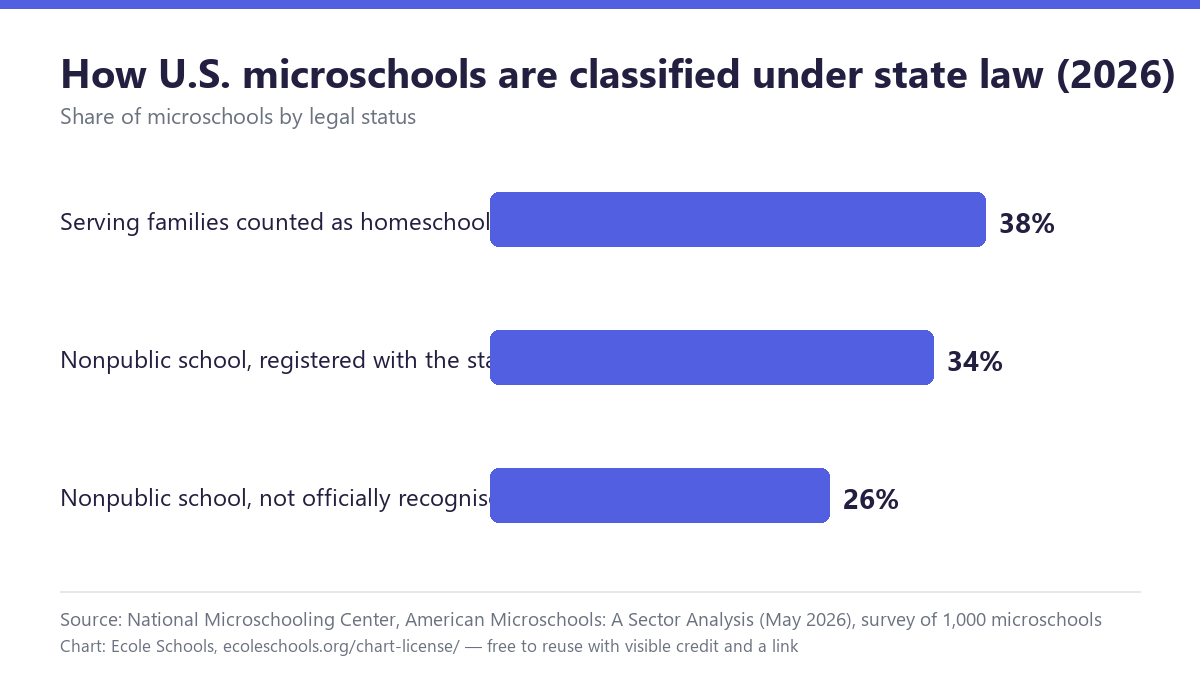
The genuinely new findings are the ones a founder should read most carefully. Legal status: 38% of microschools serve children whose families count as homeschoolers under state law, 34% operate as nonpublic schools registered with their state education agency, and 26% operate as nonpublic schools without official state recognition — which is exactly the three-way fork our legal requirements guide walks through. Schedule: 64% meet on a full-time weekly schedule; the rest are part-time or hybrid. Ages: 87% serve children aged 5–11, 67% serve 12–14 and 38% serve 15–18, so a secondary-age microschool is still the exception. Lifespan: 22% have been open six years or more, 45% for three to five years, 17% for one to two years and 16% for under a year. Regulatory burden: founders report spending nearly 100 hours a year, on average, on compliance-related tasks — the single best argument for reading your state page in our laws-by-state framework before you sign a lease.
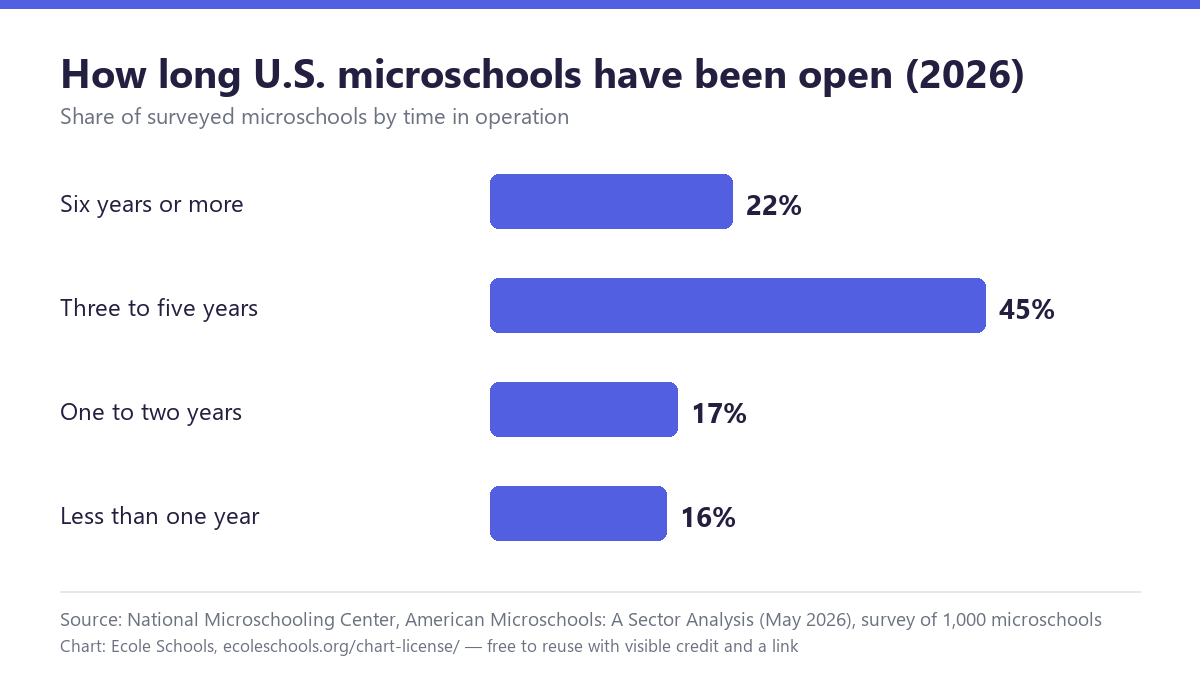
We keep the 2025 figures in the sections above because most other guides still quote them and because several of our own charts were drawn from that edition; where a number differs, the 2026 column in this table is the newer one. The full 2026 PDF is linked in the Sources list below.
How reliable are these numbers?
Three cautions belong with every statistic above:
- Self-selection. Sector surveys reach schools that are connected to microschooling networks. Schools that quietly operate under homeschool law are under-represented.
- Definition drift. “Microschool” has no legal definition. Parent surveys, school surveys and state data are not counting the same population, which is why totals range from 750,000 to 2 million students.
- Self-reporting. Enrolment, tuition and academic-gain figures come from school leaders, not from audited records.
None of this makes the data useless. It makes it directional: reliable for understanding shape and scale, unreliable for precision to the nearest thousand. We publish it with those limits attached rather than rounding them away.
One more reason the counts differ: even the name is unsettled. Some datasets search for micro school as two words, others for microschool as one, and others count only programmes that self-describe as learning pods or hybrid academies. A study that searches for one spelling and not the other will report a smaller sector than one that searches for both.
Frequently asked questions
How many microschools are there in the US in 2026?
Roughly 75,000, according to the May 2026 edition of the National Microschooling Center sector analysis (1,000 schools surveyed); the 2025 edition cited about 95,000 sites. The difference comes from a change in estimation method, not from closures. There is no official government count.
How many students attend microschools?
Estimates range from about 750,000 to 2 million K–12 students, with 1 to 1.5 million the most commonly cited range. The spread comes from differing definitions and from part-time attendance.
What is the average microschool size?
The median non-public microschool enrols 20 students in the May 2026 edition (22 in 2025); public and charter microschools run larger, with a median of 30 (36 in 2025).
What is the average microschool tuition?
Seventy-four percent of microschools charge $10,000 a year or less: 26 percent under $5,000 and 48 percent between $5,001 and $10,000. About 65 percent offer sliding-scale tuition or discounts.
Are microschools growing?
Yes. The sector expanded rapidly after 2020 and continues to grow alongside state education savings account programmes, which now fund microschool tuition or services in a growing number of states.
Are microschool students learning as much as their peers?
Eighty-one percent of microschools report one to two years of academic gains in a single school year, but this is self-reported by school leaders rather than independently audited, and most microschools measure progress through mastery evidence rather than grades.
Who typically starts a microschool?
Educators. Fifty-four percent of microschool leaders are licensed educators and another 32 percent are professional educators without a public-school licence.
Where can I find the newest microschool statistics?
The most recent sector-wide dataset is the National Microschooling Center report American Microschools: A Sector Analysis (May 2026), covering 1,000 microschools. The comparison table above shows what changed from the 2025 edition, and the PDF is linked in the Sources list.
Are microschools effective?
The honest answer is that the sector reports strong results about itself, and independent verification is thin. Eighty-one percent of microschools report between one and two years of academic gains in a single school year, and EdChoice survey work finds 76 percent of microschool parents very satisfied and another 17 percent somewhat satisfied. Both figures are meaningful, but the gains number is self-reported by school leaders and not independently audited, and only 29 percent of microschools issue letter grades — most describe progress through mastery evidence and portfolios, in their own framework. Anyone quoting these numbers should say so. There is no third-party achievement dataset for the sector yet.
What qualifies as a microschool?
There is no legal definition and no official register, which is why estimates of the sector vary so widely. In practice a microschool is a small, intentionally multi-age learning community, usually run outside the district system. The sector data gives the practical shape: a median of 20 students in non-public microschools, 54 percent led by licensed educators, and settings that range from homes and commercial space to churches and community buildings. Legally a microschool is whatever category its state recognises — private school, home education, learning pod or an unregulated status — and that classification, not the label, decides what it must do. Our legal requirements guide works through the categories.
How do microschools make money?
Mostly from tuition, and it is tight. Seventy-four percent charge $10,000 a year or less — 26 percent under $5,000 and 48 percent between $5,001 and $10,000 — and about 65 percent offer sliding-scale tuition or discounts, so published rates overstate actual revenue. With a median of 20 students, that is a small operating base. This is why 75 percent of microschools name funding as their primary need, and why state education savings accounts matter so much: in states with a programme, a family can bring public money to a private setting. Our funding calendar sets out which states have a programme and when the windows open.
Reusing these charts. Every graphic on this page was drawn by us and carries its data source inside the image. Journalists, researchers and other schools may republish them with visible credit and a link — the full terms are on our chart licence page.
If you are a parent rather than a founder, these same figures are more useful as base rates: our questions to ask a microschool before you enrol puts each number beside the question it helps you answer.
Sources
- National Microschooling Center, American Microschools: A Sector Analysis (May 2025), Don Soifer and Ashley Soifer — survey of 800 operating and pre-launch microschools in all fifty states and the District of Columbia.
- National Microschooling Center, American Microschools: A Sector Analysis — 2026 edition (PDF) (May 2026), Don Soifer and Ashley Soifer — survey of 1,000 microschools in all fifty states, the District of Columbia and Puerto Rico; source of the 2026 column in the comparison table.
- EdChoice, The State of Microschooling (June 2025) — analysis of the same sector survey, plus EdChoice parent-survey data on satisfaction and participation.
- EdChoice, Percentage of Children Attending Microschools — on why parent-reported and school-reported counts differ.
Figures were last checked against these sources on the date shown at the top of this page. Where a number is self-reported or definition-dependent, we say so in the section rather than in a footnote.
Start the conversation
Ecole Schools helps founders, educators and families start and run microschools with consulting, the Ecole SIS and LMS, mentor training and marketing support. Read the step-by-step guide, see our services, or contact us to talk about your plans.