

Last updated: · Ecole Schools
Short answer: state funding for microschools moves on windows, not on demand. Texas Education Freedom Account applications run 4 February to 31 March 2026 — originally six weeks closing 17 March, extended to 31 March by the Comptroller after a federal court order; once a year. Florida’s programmes run on their own annual cycle through the funding organisations. New Jersey has no programme at all. Missing a window costs a family a school year, and costs a school a cohort.
Working through this for your own school? Ecole Schools supports founders with setup consulting, the Ecole SIS and LMS and mentor training — see what we do or talk to us.
Texas: Education Freedom Accounts (TEFA), 2026-27
| Item | Confirmed detail |
|---|---|
| Family application window | 4 February 2026 – 31 March 2026 (original close 17 March; extended after a federal court order) |
| Award, private school student | $10,474 (85% of the statewide average of state and local funding per public school student) |
| Award, student with an IEP | Up to $30,000; IEP must be on file with the Texas Education Agency by the end of the application period |
| Award, homeschooled and other accepted students | $2,000 |
| Provider side | Accredited private schools and pre-K providers register directly; non-accredited microschools register as education service providers |
| Where to apply | EducationFreedom.Texas.Gov |
First-cycle demand was far above capacity: the Comptroller reported more than 8,000 applications in the first hour, 42,000 on day one and 130,000 by the midpoint of the window and more than 274,000 students by the extended close on 31 March, against a cycle sized around 100,000 funded students; the Comptroller said remaining places in the second priority tier would be allocated by lottery and a waitlist reported to the Legislature. More than 2,000 accredited private schools and pre-K providers and 200 education service providers had registered. Full detail on the Texas ESA guide.
Florida: PEP, FES and the Tax Credit scholarships
Florida runs its programmes through state-approved funding organisations rather than a single annual state window, and award amounts vary by county and grade band. Reported 2025-26 Personalized Education Program figures average about $8,000 per student with a published range near $7,613–$11,950. Because the cycle and the paperwork are administered by the funding organisation, the authoritative calendar is theirs: check Step Up For Students for the current cycle before planning a school year around it.
The provider-side deadline that actually binds a Florida microschool is different: registration with the Florida Department of Education comes first, because only registered private schools can participate in the scholarship programmes. That is covered in the Florida guide.
Arizona: universal ESA, no single window
Arizona’s Empowerment Scholarship Account programme is universal — open to any K–12 student with no income test — and it does not run on one short annual window the way Texas does. Most students receive roughly $7,000–$8,000 a year. For a school the binding deadline is its own: being registered in the programme before funded families choose. Details on the Arizona guide.
Missouri: MOScholars, EAO-dependent and not universal
Missouri has no fixed statewide window because MOScholars runs on tax-credited donations awarded through certified Educational Assistance Organisations: families apply to an EAO, and capacity depends on that year’s fundraising. Eligibility is targeted — an approved IEP, or income within 300% of the free-lunch limit plus prior-attendance conditions — and the average account is $6,375, reaching 175% of the adequacy target for special-needs students. The practical calendar advice is to contact EAOs in winter, before spring award rounds. The Missouri guide explains the definitional lines that decide which side of the programme a microschool stands on.
Oklahoma: Parental Choice Tax Credit, opening 15 March
Oklahoma’s window opens on 15 March each year (for 2026-27 it ran to 15 June), through the Tax Commission rather than an ESA platform. The credit is $5,000–$7,500 per student by income tier, paid as cheques mailed directly to the accredited private school; the first 60 days are the priority period, income-ordered. Homeschool families claim up to $1,000 per student on their tax return instead. The Oklahoma guide explains why the accreditation decision, not the window, is the founder’s real question.
Louisiana: LA GATOR, a two-week window in March
Louisiana’s is the shortest window in this series: for 2026-27, applications ran from 9 a.m. on 1 March to 11:59 p.m. on 16 March 2026 through Odyssey. Awards are $5,243 for any eligible student, $7,626 at or below 250% of the poverty guidelines, and up to $15,253 for students with disabilities. Tuition can be paid only at a BESE-approved nonpublic school; home-based students spend through approved marketplace providers. The Louisiana guide explains why a registered, non-approved microschool can still be paid as a provider.
Alabama: CHOOSE Act, January to March
Alabama’s window sits between Texas and Iowa on the calendar. For 2026-27 the CHOOSE Act portals opened to new families on 2 January 2026 (renewals from mid-December) and closed at midnight on 31 March 2026. The account is worth $7,000 for a student at a participating school — accredited, or in the process of accreditation with a listed body — and $2,000 per student in a home education programme (family cap $4,000), spent with approved education service providers through ClassWallet. Income is limited to 300% of the federal poverty level for the 2025 and 2026 tax years; from 1 January 2027 any parent of an eligible student may apply, with special-needs students, returning participants and military dependents prioritised. The Alabama guide explains why a microschool’s sponsor and accreditation status, not the window, decide which tier it can be paid from.
Iowa: Students First ESA, one window in spring
Iowa’s window is the earliest fixed one in this series and the easiest to miss because it closes before the school year it funds has been planned. The Students First Education Savings Account — universal since 2025-26 and worth $8,148 per student for 2026-27 — takes applications from 8 a.m. on 16 April to 11:59 p.m. on 30 June through the Odyssey platform. The money reaches only a child enrolled full-time at an accredited nonpublic school attending at least 75% of the schedule; competent private instruction and independent private instruction are not eligible, so an unaccredited microschool has nothing to apply for. The Iowa guide explains why accreditation, not the window, is the real decision there.
Indiana: Choice Scholarship, two application periods a year
Indiana is the easiest calendar in this series to plan around because it has two periods rather than one. For 2025-26 the Choice Scholarship application ran 1 March – 1 September and again 1 November 2025 – 15 January 2026; 2026-27 applications were expected to open in March 2026 and, from that school year, every Indiana K–12 resident is eligible after House Bill 1001 removed the income limit. The award is the lesser of the school’s tuition or 90% of state per-student support (average $6,536 in 2024-25), paid to the school in four instalments — but only to an accredited nonpublic school that administers the state assessment, which is why the Indiana guide treats accreditation as the business decision rather than the calendar.
North Carolina: Opportunity Scholarship, one window a year
North Carolina runs the other large annual window in this series. The Opportunity Scholarship is open to every K–12 student in the state; for 2026-27 the application opened on 2 February 2026, with a priority period to 2 March and new-student applications closing in mid-August. Awards are tiered by household income — $7,942 / $7,148 / $4,766 / $3,574 — and are paid to a nonpublic school registered with the Division of Non-Public Education, never to a home school. The next cycle follows the same shape: watch for the NCSEAA announcement in January. Detail, including the two-family rule that makes any microschool a nonpublic school in North Carolina, is in the North Carolina guide.
New York and California: no state programme, different substitutes
Neither New York nor California has an education savings account, voucher or tax-credit scholarship, so there is no window to track in either state. What replaces it differs: in New York the calendar that matters is the home-instruction family’s own — notice by 1 July, plan by 15 August, quarterly reports (New York guide); in California the one state date is the Private School Affidavit, filed 1–15 October every year, while public money reaches home-based learners only through independent-study charter schools spending instructional funds with approved vendors (California guide).
New Jersey: no state programme
New Jersey has no education savings account or voucher-style programme, so there is no window to miss — families pay tuition directly and schools plan enrolment on their own calendar. The compliance calendar that does matter in New Jersey is the family’s own notice and record-keeping under the equivalent-instruction rule, explained in the New Jersey guide.
Tennessee: Education Freedom Scholarships, and the school-side window that decides everything
Tennessee is the clearest case in this series of a calendar that belongs to the school rather than the family. Education Freedom Scholarships are worth $7,530 per student in 2026-27, and the General Assembly added 15,000 seats to bring the total to 35,000 — against 56,440 applications, a 31.8 percent increase on the previous cycle. But the money can only follow a child into a registered Category I, II or III non-public school, and it cannot be used for home-school expenses at all. Registration is the gate, and it has one annual window: 5 January to 1 May, with Category I and V schools applying directly to the department. Miss it and you wait a year, exactly as Texas founders wait for the February window. The Tennessee guide explains why the category decision, not the scholarship amount, is what determines whether your first cohort can pay with one.
New Hampshire: Education Freedom Accounts, a tiered award rather than a single figure
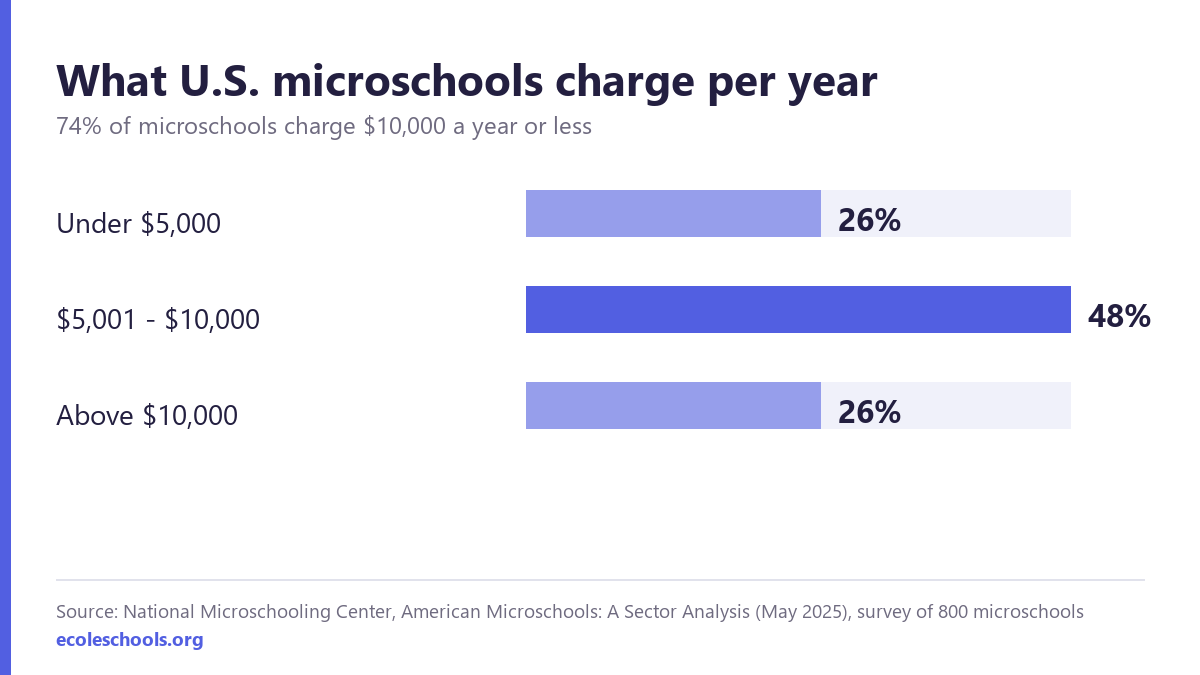
New Hampshire is the state in this series where quoting one number is most misleading. The Education Freedom Account is built in components: a base grant of about $4,265 per student tracking the state’s per-pupil allocation, an additional $2,142 for a student with a disability, and an additional $2,346 for a household meeting free and reduced lunch thresholds. The figure usually quoted in the press, around $5,200, is an average across those tiers and will not match what any particular family brings you. Since nationally 74 percent of microschools charge $10,000 a year or less, an EFA typically covers part of tuition rather than all of it. The New Hampshire guide explains why eligibility and access are separate questions there.
West Virginia: the Hope Scholarship, where microschool students are IIP students
West Virginia’s Hope Scholarship was worth $5,267.38 per student in 2025-26 and is administered by the West Virginia State Treasurer’s Office rather than the education department — a distinction that matters when you are looking for the right guidance. The structural point for a microschool is categorical: microschool and pod students are treated as Individualized Instructional Program (IIP) students under the programme, not as private-school students. That classification, not the award size, is what decides how a family uses the money with you. The West Virginia guide works through what the IIP route requires.
Utah: Utah Fits All, where the award depends on the category the child lands in
Utah is the sharpest illustration in this series that the same child can be worth very different amounts depending on how they are enrolled. For 2025-26 a scholarship student generally — including a private-school student — brings $8,000; the same child educated at home brings $4,000 if aged 5 to 11 or $6,000 if aged 12 to 18. Eligibility runs kindergarten through grade 12, age 5 to 18 as of 1 September of the scholarship year. For a founder this is a structural decision rather than a calendar one: the category you operate in sets your ceiling before you have quoted a price. The Utah guide explains how that choice interacts with tuition.
Arkansas: Education Freedom Accounts, universal since 2025-26
Arkansas completed its phase-in and the Education Freedom Account became universal for K–12 from 2025-26, with a child needing to be age 5 by 1 August 2025 for that year. The award was approximately $6,800 per eligible student in 2025-26, with $7,208 slated for most participating students in 2026-27; total programme funding in 2025-26 was $309.4 million. At roughly $6,800 to $7,208 the account covers part of a typical tuition, since nationally 74 percent of microschools charge $10,000 or less. The Arkansas guide sets out what a participating provider has to satisfy.
Ohio: EdChoice Expansion, an income scale rather than a window
Ohio belongs in this calendar as the counter-example: what varies is not the date but the amount, and it varies by household. For 2025-26 the maximum award is $6,166 for grades K–8 and $8,408 for grades 9–12. A household below 450% of the federal poverty level — $144,675 for a family of four — receives the full award, and above that threshold the award scales down rather than stopping. For a microschool this means two families in the same cohort can arrive with materially different amounts, which is a tuition-policy problem more than a deadline problem. The Ohio guide explains the non-chartered status question that sits underneath it.
What should a microschool do in the eight weeks before any window?
The work that decides whether funded families can choose you happens before applications open, not during. This sequence applies in any state with a programme:
- Confirm your provider status. Accredited school, registered school or service provider — each has a different route and a different lead time. Start with the programme’s own provider page, not a summary.
- Get listed. Families search the programme’s approved-provider list at the moment they apply. A school missing from that list is invisible exactly when the decision is made.
- Publish your tuition and your discount policy. Families are doing arithmetic against the award amount. Vague pricing loses applications; about 65 percent of microschools offer sliding-scale tuition, so say so.
- Prepare the records the programme will ask for. Enrolment, attendance, and evidence of progress. Where testing is a condition of funding, know which test and when.
- Tell families the truth about odds. Where demand exceeds capacity, acceptance is not guaranteed. Schools that set expectations honestly keep families through a rejection; schools that promise funding lose them.
- Have a plan for unfunded families. Payment plans and need-based discounts decide whether a near-miss becomes an enrolment anyway.
How do you keep track when rules change mid-cycle?
Programme rules move between cycles and sometimes within them. Three habits keep a school out of trouble: read the programme’s own site rather than summaries (including this one) before acting; date every figure you publish so families know what it applied to; and ask the administering organisation in writing when a rule is ambiguous. This page is dated and updated each cycle for the same reason.
Frequently asked questions
When does the Texas ESA application open in 2026?
The first Texas Education Freedom Account application window ran from 4 February 2026 to 31 March 2026 (extended from 17 March) and is now closed; the next cycle is announced by the Texas Comptroller — six weeks, once a year. Applications are made through EducationFreedom.Texas.Gov.
How much is the Texas ESA per student?
$10,474 for a student at a participating private school in 2026-27, up to $30,000 for a student with an IEP on file with the Texas Education Agency, and $2,000 for homeschooled and other accepted students.
Can a microschool receive Texas ESA money without accreditation?
Yes, through a different route: accredited private schools receive tuition directly, while non-accredited microschools register as education service providers and bill for services such as tutoring and curriculum.
Does Florida have an application deadline for PEP?
Florida’s programmes run through state-approved funding organisations on their own cycle rather than a single state window. Check the funding organisation’s current cycle; for a microschool, registration with the Florida Department of Education has to happen first.
Does New Jersey have an ESA or voucher programme?
No. New Jersey has no education savings account or voucher-style programme, so families pay tuition directly.
What happens if a family misses the application window?
They wait for the next cycle. That is why provider registration and family communication have to be finished before the window opens rather than during it.
When does the North Carolina Opportunity Scholarship application open?
Once a year. For 2026-27 it opened on 2 February 2026 with a priority period to 2 March; new-student applications closed in mid-August. Awards for 2026-27 are $7,942, $7,148, $4,766 and $3,574 by income tier and are paid to a registered nonpublic school.
How does a family apply for MOScholars in Missouri?
Through a certified Educational Assistance Organisation rather than a state portal, with no single statewide window; capacity depends on that year’s tax-credited donations. Eligibility is an approved IEP or income within 300 percent of the free-lunch limit with prior-attendance conditions, and the average account is 6,375 dollars.
When does the Oklahoma Parental Choice Tax Credit open?
On 15 March each year for the following school year, through the Oklahoma Tax Commission; for 2026-27 the window ran 15 March to 15 June 2026, with the first 60 days as the income-ordered priority period. The credit is 5,000 to 7,500 dollars at an accredited private school, or 1,000 dollars for homeschool expenses.
When does the LA GATOR application open?
Once a year, for about two weeks: for 2026-27 from 9 a.m. on 1 March to 11:59 p.m. on 16 March 2026, through the Odyssey platform. Awards are 5,243, 7,626 or up to 15,253 dollars depending on income and disability status.
When does the Alabama CHOOSE Act application open?
Once a year. For 2026-27 new families applied from 2 January to 31 March 2026, with renewals from mid-December; accounts are worth 7,000 dollars at a participating accredited school or 2,000 dollars per home-educated student, and income limits end on 1 January 2027.
When is the Iowa Students First ESA window?
Once a year in spring: for 2026-27 from 8 a.m. on 16 April 2026 to 11:59 p.m. on 30 June 2026, through the Odyssey platform. The account is worth 8,148 dollars per student and pays only for full-time enrolment at an accredited nonpublic school.
When does the Indiana Choice Scholarship application open?
Twice a year. For 2025-26 the periods were 1 March to 1 September and 1 November 2025 to 15 January 2026; 2026-27 applications were expected to open in March 2026, the first year without an income limit. The voucher is paid only to an accredited nonpublic school.
Sources
- Texas Comptroller of Public Accounts, Fiscal Notes programme reporting on Texas Education Freedom Accounts — application window, award amounts, registration and application volumes.
- Texas Comptroller of Public Accounts, application deadline extended through 31 March (17 March 2026) and comprehensive overview of applications (2 April 2026) — the extension, the 274,000-student total, the lottery and waitlist.
- EducationFreedom.Texas.Gov — the official application portal.
- Step Up For Students — Personalized Education Program (Florida PEP administration and award information).
- Tennessee Department of Education — Education Freedom Scholarship Program (award amount, eligible school categories) and TDOE Non-Public Schools (the 5 January to 1 May registration window); TDOE news, 7 May 2026, for the 56,440 applications and 35,000 scholarship seats. Detail on the Tennessee guide.
- New Hampshire Department of Education, Education Freedom Accounts pages, with EdChoice’s New Hampshire EFA programme profile for the tiered award structure; RSA 194-F. Detail on the New Hampshire guide.
- Hope Scholarship (West Virginia State Treasurer’s Office) — award amount, eligibility and programme rules; W.Va. Code §18-8-1 for the microschool and learning-pod definitions behind the IIP classification. Detail on the West Virginia guide.
- Utah Fits All Scholarship FAQ — award amounts, eligibility and administration; EdChoice Utah Fits All programme profile. Detail on the Utah guide.
- Arkansas LEARNS — official Education Freedom Account programme site, with EdChoice 2026 reporting for participation and award figures. Detail on the Arkansas guide.
- Ohio Department of Education — EdChoice Expansion (award amounts, income thresholds and participation rules); EdChoice Ohio income-based scholarship programme profile. Detail on the Ohio guide.
- National Microschooling Center, American Microschools: A Sector Analysis (May 2025) — the sliding-scale tuition figure.
Dates and amounts change between cycles. This page states the date it was last updated at the top; always confirm against the programme’s own site before acting.
Start the conversation
If you are preparing for a funding window — registering as a provider, setting tuition against an award amount, or getting records in shape — see our services or contact us. The full set of guides is on the microschool guides page.