

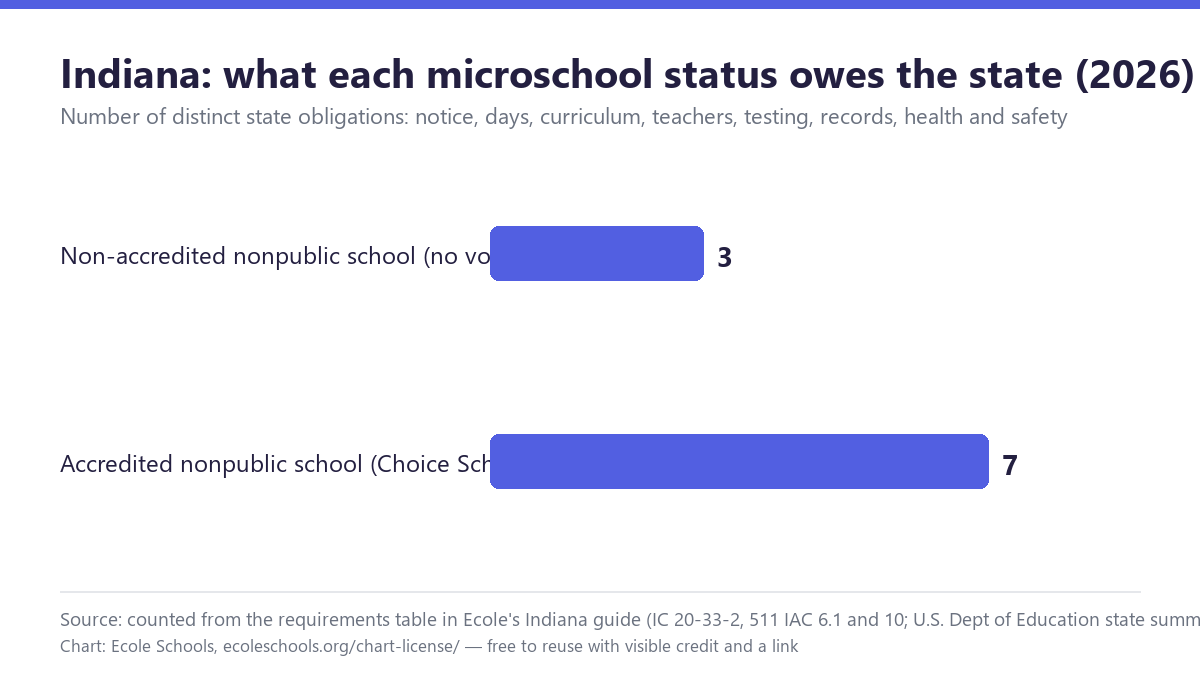
Short answer: Indiana offers a microschool the lightest legal status in this series and the most demanding funded one, and makes you choose. A non-accredited nonpublic school — the same status Indiana home educators use — files no notice, follows no state curriculum, needs no licensed teachers, and owes the state only 180 days of instruction and a daily attendance record (IC 20-33-2-5, 20-33-2-12, 20-33-2-20). But the Choice Scholarship, a voucher worth up to 90% of the state’s per-student tuition support and universal from 2026-27 after House Bill 1001 (signed 6 May 2025) removed the last income limit, is paid only to a school that is accredited by the State Board of Education or a recognised accreditor and administers the state assessment. In Indiana, accreditation is the price of the voucher — and that single decision is the business model.
Working through this for your own school? Ecole Schools supports founders with setup consulting, the Ecole SIS and LMS and mentor training — see what we do or talk to us.
Are microschools legal in Indiana?
Yes. Indiana has no microschool statute and, unusually, no registration requirement for a nonpublic school either. Compulsory attendance (ages 7 to 18) is satisfied by attendance at a nonpublic school for the same number of days the public schools are in session. A microschool therefore takes one of two shapes:
- A non-accredited nonpublic school. This is what Indiana law calls a home school (“nonpublic, non-accredited schools”, IC 20-33-2-12) and it is equally available to a founder teaching other families’ children. No notice of intent; a voluntary enrolment report to the Department of Education (IC 20-33-2-21); a minimum of 180 days; a daily attendance record that the superintendent may ask to verify; no curriculum requirement; no state test. Families pay tuition.
- An accredited nonpublic school. Accreditation is voluntary (511 IAC 6.1), through the State Board’s performance-based system or a national or regional accreditor the Board recognises. An accredited school takes on health, safety, time-of-activity and curriculum rules, employs properly licensed personnel under 511 IAC 10, teaches the required constitution and government content, and administers the statewide assessment — and in return may enrol Choice Scholarship students.
Nothing in between exists. A learning pod, co-op or hybrid that serves compulsory-age children for the school day is a non-accredited nonpublic school until it is accredited.
What does each status actually require?
| Requirement | Non-accredited nonpublic school | Accredited nonpublic school |
|---|---|---|
| Notice or registration | None; voluntary enrolment report (IC 20-33-2-21) | Accreditation application and periodic review by the State Board or a recognised accreditor |
| School year | 180 days (IC 20-33-2-5) | 180 days plus the Board’s time-of-activity rules |
| Curriculum | Exempt from state curriculum requirements (IC 20-33-2-12) | Required content incl. constitutions, voting and government (IC 20-30-5) |
| Teachers | No qualification specified | “Properly licensed” personnel (511 IAC 10) |
| Testing | None (unless a child attends public school part-time) | Statewide assessment administered every year |
| Records | Daily attendance record (IC 20-33-2-20) | Attendance plus accreditation reporting |
| Health and safety | General fire and health law | State Board rules and fire and health standards (511 IAC 6.1-2-1) |
| Choice Scholarship | Cannot receive it | Can receive it |
Set this against the national picture: 67% of microschools are not accredited, and 87% of those say they would seek accreditation if a microschool-friendly process existed (National Microschooling Center, 2026). Indiana is the state where that hypothetical has a dollar value attached.
What does the Choice Scholarship pay, and who can receive it?
| Item | Detail |
|---|---|
| Programme type | Voucher, paid directly to the school; four payments a year since 1 July 2025. |
| Eligibility | Previously income-limited (400% of the free and reduced-price lunch threshold); from the 2026-27 school year all Indiana K–12 residents are eligible under HB 1001 (signed 6 May 2025) — Indiana became the 17th state with universal private school choice. |
| Award | The lesser of the school’s tuition and fees or 90% of the state per-student tuition support for the student’s home district; the average award was $6,536 in 2024-25 (EdChoice). |
| Scale | 79,448 participating students in autumn 2025 (EdChoice). |
| School requirements | Accredited by the State Board of Education or a national or regional accreditor; administers the statewide assessment; listed as a participating Choice school by the Department of Education. |
| Application periods | Two a year: for 2025-26, 1 March – 1 September and 1 November 2025 – 15 January 2026; 2026-27 applications were expected to open in March 2026. |
Two consequences for a founder. First, because the award is capped by your own tuition, a microschool that prices below the 90% figure leaves money on the table and one that prices above it must collect the difference from families — our cost guide covers how to set the number. Second, because the award follows the district of residence, two children in the same room can carry different amounts; build the fee schedule around that rather than discovering it at the first payment.
Is accreditation worth it for a small school?
Honestly: it depends on enrolment and on how long you intend to operate. Accreditation is a multi-year commitment with reporting, licensed staff and annual testing; at a median microschool size of 20 students (National Microschooling Center, 2026) the voucher revenue it unlocks is roughly 20 × $6,500 a year, which for most founders is the difference between a tuition-dependent pod and a funded school. Founders who are unsure typically open as a non-accredited school, prove enrolment for a year, and pursue accreditation while the first cohort’s families pay tuition — Ecole practice, not a legal requirement. Our legal requirements guide explains what accreditation generally asks of a school, and the tools and resources guide covers the records an accreditor will expect to see.
How does Indiana compare with neighbouring states in this series?
Indiana sits opposite Ohio: Ohio gives a microschool a ready-made “non-chartered, non-tax-supported” category with hour and degree rules and pays EdChoice Expansion to chartered schools; Indiana gives no category at all and ties its money to accreditation. Its neighbour Iowa pushes the same logic one step further, recognising no unaccredited private school at all. It resembles Tennessee in that the status you hold decides whether funded families can pay you, but where Tennessee uses registration categories Indiana uses a single accredited-or-not line — and, unlike Tennessee, with no seat cap and no income test from 2026-27. Among the thirteen states we cover, Indiana is the one where the lightest possible opening and the largest possible funding are both available, but never at the same time.
How do you start a microschool in Indiana, step by step?
- Decide accredited or not before you price anything; it decides staffing, testing and whether Choice families can enrol. The national five-step guide covers the rest of the founding sequence.
- If non-accredited: set a 180-day calendar, keep a daily attendance register from the first day, and decide whether to file the voluntary enrolment report (it creates a record; it creates no obligation).
- If accredited: choose the State Board route or a recognised accreditor, plan licensed staffing and the statewide assessment, and apply to the Department of Education to be listed as a Choice school before the March application period.
- Price against the 90% figure for the districts your families live in.
- Premises: zoning and occupancy are local; fire and health standards apply to every school — see the legal requirements guide.
- Calendar the two application windows so that enrolment decisions and voucher applications line up; the funding calendar tracks them.
Frequently asked questions
Are microschools legal in Indiana?
Yes. Indiana has no microschool statute and no registration requirement for nonpublic schools. A microschool operates as a non-accredited nonpublic school, which owes the state 180 days of instruction and a daily attendance record, or as an accredited nonpublic school, which follows State Board rules and may enrol Choice Scholarship students.
Does Indiana have an ESA or voucher a microschool family can use?
Yes. The Choice Scholarship is a voucher worth the lesser of tuition and fees or 90 percent of state per-student tuition support, averaging 6,536 dollars in 2024-25. From the 2026-27 school year every Indiana K-12 resident is eligible. It is paid only to an accredited nonpublic school that administers the state assessment.
Does a non-accredited Indiana microschool have to notify the state?
No. Indiana requires no notice of intent; an enrolment report to the Department of Education is voluntary under IC 20-33-2-21. The school must operate at least 180 days and keep a daily attendance record that a superintendent may ask to verify.
Do Indiana microschool teachers need a licence?
Not in a non-accredited school, where no teacher qualification is specified. Schools in the state accreditation system must employ properly licensed personnel under 511 IAC 10.
Can a microschool become a Choice Scholarship school?
Yes, if it is accredited by the Indiana State Board of Education or a national or regional accreditor recognised by the Board, administers the statewide assessment and is listed by the Department of Education as a participating Choice school. A non-accredited school cannot receive the scholarship.
When are Indiana Choice Scholarship applications open?
Twice a year. For 2025-26 the periods were 1 March to 1 September and 1 November 2025 to 15 January 2026; 2026-27 applications were expected to open in March 2026. Payments to schools are made four times a year.
Sources
- U.S. Department of Education — Indiana state regulation of private and home schools (IC 20-33-2-5, -12, -20, -21; 511 IAC 6.1 and 10; optional accreditation; curriculum exemption for non-accredited schools; 180 days; attendance records; compulsory ages 7–18).
- Indiana Department of Education — Choice Scholarship Program (accreditation and statewide-assessment requirements for participating schools; 2025-26 application periods; participating-school list).
- EdChoice — Indiana Choice Scholarship Program (voucher; up to 90% of state per-student spending; average $6,536 in 2024-25; 79,448 students in autumn 2025; accreditation and testing requirements; updated 16 December 2025).
- Ballotpedia News, 11 May 2025 (HB 1001 signed 6 May 2025; income limits removed for 2026-27; four payments a year from 1 July 2025; award formula; 17th universal state).
- National accreditation and size figures are from the National Microschooling Center’s May 2026 sector analysis, sourced on our statistics page.
General information, not legal advice. Award amounts, application periods and accreditation rules change between years — verify with the Indiana Department of Education before committing.
Start the conversation
If you are opening in Indiana, the accreditation decision is the business plan — make it before the lease, the hiring and the price list. See our services or contact us.
Compare with other states
Northeast
- New Jersey — no state programme at all - families pay tuition directly
- New York — no state funding, but a defined substantial-equivalency test and the heaviest home-instruction paperwork in the series
- New Hampshire — universal eligibility, capped access, and no overlap with home education
South
- Florida — registration without supervision, and the largest ESA in the country
- Texas — a brand-new programme where accreditation decides the funding tier
- West Virginia — the only state that defines microschool in statute
- Arkansas — a universal programme that grew explosively, and an unusually detailed homeschool notice
- Tennessee — the state where your school category decides whether scholarship families can pay you
- North Carolina — a home school is at most two families by statute, so a microschool is a school - and a universal scholarship pays it
- Alabama — church schools are exempt from licensing and certification, private schools are not; the CHOOSE Act pays accredited schools 7,000 dollars and home education 2,000
- Louisiana — GATOR pays tuition only at approved schools, but a registered microschool can be paid as a marketplace provider - with the largest disability award in the series
- Oklahoma — the tax-credit state: cheques go to accredited schools, and the freest homeschooling in the country gets 1,000 dollars
Midwest
- Ohio — the non-chartered school category, with hour and degree rules
- Iowa — no unaccredited private schools exist - a teaching licence decides what you can be, and the ESA pays only accredited schools
- Missouri — a home school ends at four unrelated children and the first dollar of tuition; the only non-universal programme in the series
West
- Arizona — light regulation plus a universal ESA - the reference case
- Utah — no required subjects or days, and awards that differ by structure
- California — becoming a school is an October affidavit; the only public money arrives through charter vendor channels
- All fifty states — the framework, and how to resolve a state we have not covered in depth