

Short answer: North Carolina is the state where the home-school question answers itself. By statute a home school is a nonpublic school in which “one or more children of not more than two families or households receive academic instruction from parents or legal guardians” (G.S. 115C-563) — so a microschool that serves a third family is, by definition, a private (nonpublic) school. That status is light: a notice of intent to the Division of Non-Public Education (DNPE), a nine-calendar-month term, attendance and immunisation records, a nationally standardised test in grades 3, 6, 9 and 11, and fire, safety and sanitation inspections — with no curriculum requirement and no teacher-certification policy. And it is the status that unlocks money: the Opportunity Scholarship is open to every North Carolina K–12 family regardless of income, with 2026-27 awards from $3,574 to $7,942 depending on household income, and more than 100,000 students already using it at nearly 700 schools.
Working through this for your own school? Ecole Schools supports founders with setup consulting, the Ecole SIS and LMS and mentor training — see what we do or talk to us.
Are microschools legal in North Carolina?
Yes, and the law sorts them for you. Article 39 of Chapter 115C recognises three kinds of nonpublic school — private church schools and schools of religious charter (G.S. 115C-547 to 554), other qualified nonpublic schools (115C-555 to 562), and home schools (115C-563 to 565). A microschool lands in one of two places:
- A qualified nonpublic school (religious or not). This is where any microschool that enrols children from three or more households belongs, and where most founders should plan to be from day one.
- A home school, only if you fit the definition: instruction by parents or guardians, children from at most two families or households. Two families who teach their own children together in one space are a home school; a founder who teaches other people’s children, or a third family at the table, is not.
Missouri draws an even harder version of this line — four unrelated children and a tuition ban end its home-school label (Missouri guide). There is no third, informal category in North Carolina either. A “learning pod” or “co-op” that teaches compulsory-age children (at least 7 and not yet 16) in North Carolina is one of the two above, and DNPE advises sending the notice of intent 30 to 60 days before opening.
What does a nonpublic school in North Carolina have to do?
| Requirement | What North Carolina law says |
|---|---|
| Registration | A Notice of Intent to operate, filed with DNPE; notice again on closing (G.S. 115C-552, 560). |
| Approval, licence, accreditation | No licence; the state has issued no approvals since 1979 and no state accreditation since 2000. Accreditation (regional or national) is optional (115C-554, 555). |
| Teachers | “No state policy currently exists” on certification (federal summary of N.C. law). |
| School year | Operate “on a regular schedule during 9 calendar months of the year, excluding reasonable holidays and vacations” (115C-548, 556). DNPE advises 180 days of at least five and a half hours; the statute sets the months, not the days. |
| Curriculum | “There are no curriculum requirements for nonpublic schools” (115C-549, 557). |
| Testing | A nationally standardised test every year for every student in grades 3, 6 and 9 (English grammar, reading, spelling, mathematics) and in grade 11 (verbal and quantitative), results kept for one year and open to annual inspection; the school sets its own graduation score (115C-549, 550, 553, 557, 558, 561). |
| Records | Annual attendance and immunisation records for each student, plus the test results above (115C-549, 550, 557, 558). |
| Health and safety | Fire, safety, sanitation and immunisation rules and “reasonable” inspections; immunisation certificate or exemption for every child, with a 30-day grace period after notice; monthly fire drills (115C-554, 562; 130A-155 to 157; 58-79-35). |
Read the table as a whole and the shape is clear: North Carolina asks a school to exist on a calendar, keep three kinds of record, test four grades and be safe — and otherwise leaves what is taught and by whom to the school. Nationally only 39% of microschools use standardised assessment regularly (National Microschooling Center, 2026), so the annual test is the one habit a North Carolina founder must build that most peers elsewhere skip.
What does the Opportunity Scholarship pay, and who can receive it?
| Item | Detail |
|---|---|
| Programme type | Voucher for tuition and fees at an eligible nonpublic school, administered by the North Carolina State Education Assistance Authority (NCSEAA). |
| Eligibility | Universal — every North Carolina K–12 student regardless of income or prior public school enrolment; the award shrinks as income rises. |
| Awards, 2026-27 | Tier 1 $7,942 · Tier 2 $7,148 · Tier 3 $4,766 · Tier 4 $3,574. For a household of four the tiers turn at roughly $61,050, $122,100 and $274,725 of income. |
| Scale | About 103,400 participating students at 696 schools in 2025-26; the state added $463.5 million to the programme for 2024-25 (EdChoice). |
| Application cycle | 2026-27 applications opened 2 February 2026; the priority period ran to 2 March and new applications closed in mid-August. Once a year, like Texas. |
| Who gets paid | The school, directly, for a student enrolled at a participating nonpublic school registered with DNPE. A home school is not a recipient. |
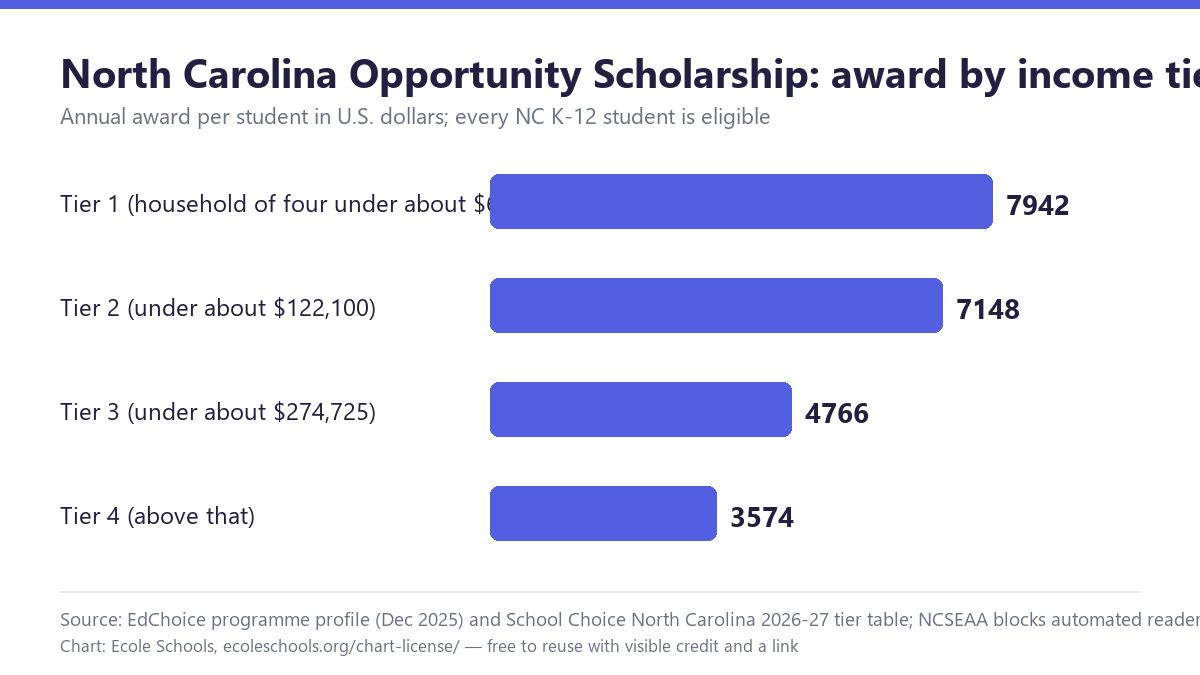
Two things follow for a microschool founder. First, the two-family rule and the scholarship point the same way: if you want families to bring state money, you register as a nonpublic school, keep the records and run the tests. Second, the award is tiered, so families in the same classroom may carry $3,574 or $7,942 — which is why a single tuition figure rarely survives first contact with scholarship families, and why the sliding-scale practice described in our cost guide matters here. NCSEAA’s own pages could not be read by our automated checker; the figures above are taken from EdChoice’s programme profile and the School Choice North Carolina parent site and should be confirmed on NCSEAA before you quote them to a family.
How does North Carolina compare with its neighbours?
Among the states in this series, North Carolina sits between Tennessee and Florida. Like Tennessee, the money reaches only a registered school; unlike Tennessee, there is no category system, the programme is funded by annual appropriation rather than a fixed seat count, and there is no state-set graduation score. Like Florida, registration is a notice rather than an approval; unlike Florida, the state mandates annual testing in four grades and a nine-month term. And unlike every other state on our list, North Carolina writes the boundary between home school and private school into statute as a head-count of families — the clearest answer anywhere to the question “at what point does my pod become a school?”
How do you start a microschool in North Carolina, step by step?
- Count the families. Three or more households, or any child you teach who is not your own alongside two other families, means you are a nonpublic school. Plan as one. The national five-step guide covers the rest of the founding sequence.
- File the Notice of Intent with DNPE 30–60 days before opening; keep the confirmation with your records.
- Set a nine-month calendar and, if you want to follow DNPE’s advice, 180 days of at least five and a half hours.
- Choose the annual test for grades 3, 6, 9 and 11 before the first term, and decide how results will be stored for inspection; the tools and resources guide explains what a record system needs to hold.
- Immunisation files and a monthly fire-drill log from the first week; arrange the fire and sanitation inspections for the premises.
- Register with NCSEAA as a participating school if families will use the Opportunity Scholarship, and build the sliding scale around the four tiers.
- Premises: zoning and occupancy are local questions outside Article 39 — see the legal requirements guide.
Frequently asked questions
Are microschools legal in North Carolina?
Yes. A microschool operates as a qualified nonpublic school under Article 39 of Chapter 115C: a notice of intent to the Division of Non-Public Education, a nine-month term, attendance and immunisation records, an annual nationally standardised test in grades 3, 6, 9 and 11, and fire, safety and sanitation compliance. There is no curriculum requirement and no teacher-certification policy.
Is a microschool a home school in North Carolina?
Only if it teaches children from no more than two families or households and the instruction is given by their parents or guardians, as G.S. 115C-563 defines a home school. A microschool serving a third family, or taught by a founder who is not a parent of the children, is a nonpublic school.
How much is the North Carolina Opportunity Scholarship?
For 2026-27 the awards are $7,942, $7,148, $4,766 and $3,574 across four income tiers; every North Carolina K-12 student is eligible and the amount falls as household income rises. About 103,400 students used the scholarship at 696 schools in 2025-26.
Can a home school receive the Opportunity Scholarship?
No. The scholarship pays tuition and fees to a participating nonpublic school registered with the Division of Non-Public Education for a student enrolled there. That is one more reason a North Carolina microschool registers as a school rather than trying to stay inside the two-family home-school definition.
Which grades must a North Carolina private school test each year?
Grades 3, 6 and 9 in English grammar, reading, spelling and mathematics, and grade 11 in verbal and quantitative areas, using a nationally standardised test, with results kept for one year and available for inspection. The school sets its own minimum score for graduation.
When does the Opportunity Scholarship application open?
Once a year. For 2026-27 it opened on 2 February 2026 with a priority period to 2 March; new applications closed in mid-August. Confirm the next cycle on the NCSEAA site, which our automated checker could not read.
Sources
- U.S. Department of Education — North Carolina state regulation of private and home schools (Article 39 citations: notice of intent, nine calendar months, testing in grades 3/6/9/11, records, inspections, monthly fire drills, the two-family home-school definition in 115C-563, compulsory ages 7–16, no teacher-certification policy).
- N.C. Department of Administration — Division of Non-Public Education, Private Schools (Notice of Intent, inspections, annual reporting, testing guidance).
- EdChoice — North Carolina Opportunity Scholarships (voucher, universal eligibility with income-based award, 103,400 students and 696 schools in 2025-26, $463.5 million appropriation; updated 16 December 2025).
- School Choice North Carolina (2026-27 award tiers $7,942 / $7,148 / $4,766 / $3,574, household-of-four thresholds, 2 February 2026 opening) — a parent-facing advocacy site, used because NCSEAA’s programme pages returned an access error to our checker; confirm there.
- The 39% assessment figure is from the National Microschooling Center’s May 2026 sector analysis, sourced on our statistics page.
General information, not legal advice. Award tiers, deadlines and DNPE guidance change between years — verify with DNPE and NCSEAA before committing.
Start the conversation
If you are opening in North Carolina, the family head-count decides your status and the scholarship decides your pricing — both before the first term. See our services or contact us.
Compare with other states
Northeast
- New Jersey — no state programme at all - families pay tuition directly
- New York — no state funding, but a defined substantial-equivalency test and the heaviest home-instruction paperwork in the series
- New Hampshire — universal eligibility, capped access, and no overlap with home education
South
- Florida — registration without supervision, and the largest ESA in the country
- Texas — a brand-new programme where accreditation decides the funding tier
- West Virginia — the only state that defines microschool in statute
- Arkansas — a universal programme that grew explosively, and an unusually detailed homeschool notice
- Tennessee — the state where your school category decides whether scholarship families can pay you
- Alabama — church schools are exempt from licensing and certification, private schools are not; the CHOOSE Act pays accredited schools 7,000 dollars and home education 2,000
- Louisiana — GATOR pays tuition only at approved schools, but a registered microschool can be paid as a marketplace provider - with the largest disability award in the series
- Oklahoma — the tax-credit state: cheques go to accredited schools, and the freest homeschooling in the country gets 1,000 dollars
Midwest
- Ohio — the non-chartered school category, with hour and degree rules
- Indiana — the lightest unregistered status in the series, but the universal voucher is paid only to accredited schools
- Iowa — no unaccredited private schools exist - a teaching licence decides what you can be, and the ESA pays only accredited schools
- Missouri — a home school ends at four unrelated children and the first dollar of tuition; the only non-universal programme in the series
West
- Arizona — light regulation plus a universal ESA - the reference case
- Utah — no required subjects or days, and awards that differ by structure
- California — becoming a school is an October affidavit; the only public money arrives through charter vendor channels
- All fifty states — the framework, and how to resolve a state we have not covered in depth