


- 14 Aug, 2026
- 0 Comments
- 5 Mins Read

Switching to a Microschool Mid-Year: Records, Rules and Funding
Short answer: yes, families move to a microschool in the middle of a school year, and the part that decides how smoothly it goes is paperwork, not pedagogy. Three things need to line up — the records your current school holds, the way your state treats the school you are moving to, and the funding window you may be counting on. This guide covers all three, plus the question most parents ask last and worry about most: what happens if you want to go back.
What records do you need before you move?
Ask your current school for the full file, not just the report card. In practice that means the transcript or cumulative record, standardised test results, attendance history, immunisation records, and any IEP or 504 plan documentation. Request them in writing and keep copies yourself — a small school cannot chase a district registrar on your behalf as quickly as you can.
One detail catches families out. In several states the receiving school is not the body that reports your child’s status; the family is. In New Jersey, for example, the state education department encourages but does not require parents to notify the district when a child leaves for a nonpublic school — yet the district may still ask the family for a letter confirming the child attends one. Knowing who owes which piece of paper to whom is half the work; our New Jersey guide sets out the statutes behind it.
Does the state you live in change the answer?
It changes it more than most parents expect, because “microschool” is a description of size and method, not a legal category. The same programme can be a registered nonpublic school in one state and a group of home-educated students in another, and that classification drives the notification, testing and record-keeping rules that apply to you mid-year.
| State | How it classifies a microschool | The mid-year catch |
|---|---|---|
| West Virginia | The one state that defines microschools and learning pods in statute (W.Va. Code §18-8-1) | Requires a parental notice of intent and an annual assessment. |
| Ohio | Has a ready-made container — the non-chartered, non-tax-supported school | The parent, not the school, notifies the district treasurer within the first two weeks of enrolment. |
| Arkansas | Asks for one of the most detailed home-education notices in the country | Adds a trap for older students: a district diploma requires nine months of district enrolment before graduation (A.C.A. §6-15-504). |
| Tennessee | Ties the money to the registration category | The window to register directly with the department runs only from 5 January to 1 May. |
The full picture for all fifty states, including which ones fund the move, is in our state-by-state rules and funding map.
Can funding follow a child mid-year?
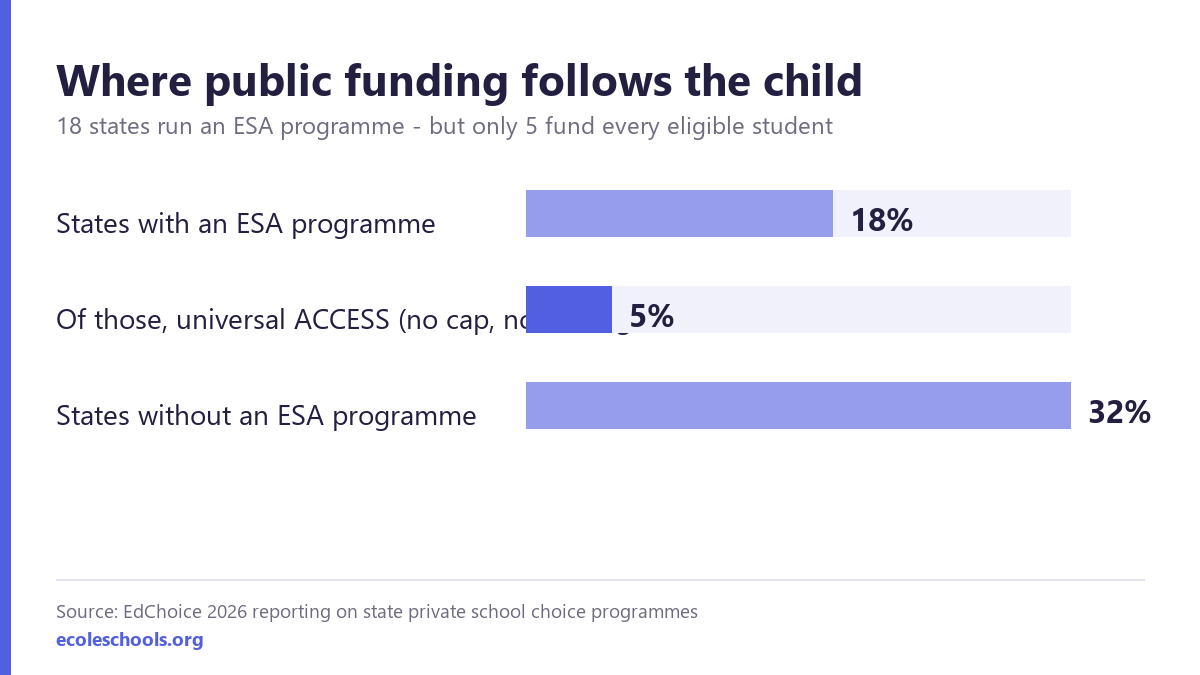
Sometimes — but the calendar rarely cares about your timing. As of 2026, 18 states run education savings accounts or similar portable funding, and only five combine universal eligibility with genuine access; 32 states have no programme at all. Where a programme exists, most run on annual application windows rather than rolling enrolment. Texas is the clearest example: the first Education Freedom Account window ran from 4 February to 31 March 2026 (extended from 17 March) and closed, with awards of $10,474 for a student at a participating private school. A family deciding in October is deciding about next year’s money, not this year’s.
That is why the honest sequence is: choose the school on fit, then plan the funding on the next cycle. Our funding calendar tracks the windows, and what a microschool costs shows what families pay when no programme applies — 74% of microschools charge $10,000 a year or less, with a median near $6,500 and roughly 65% operating a sliding scale.
What should you ask the microschool before you commit?
Mid-year arrivals expose weak operations quickly, so ask operational questions rather than philosophical ones. How will the school assess where your child actually is, in the first fortnight? Who keeps the records that a future school or scholarship programme will ask for? What happens to the fees if the placement does not work?
It also helps to know what a normal answer sounds like. Only about 29% of microschools use letter grades, roughly 22% are accredited, and the median school serves about 22 students — none of those are red flags on their own, they are sector norms. Our question set for parents pairs each question with the base rate behind it, so you can tell an unusual answer from an ordinary one.
Can we return to our old school later?
Most families can. Districts generally have a process for placing transfer students whatever their previous setting; the parts that need attention are grade placement and, in the upper grades, credit recognition. Two habits make a return painless: keep a portfolio of work and any assessment results from the microschool year, and ask the microschool up front how it documents progress for a receiving school. A programme that cannot answer that question is telling you something important.
Frequently asked questions
Is it too late to switch schools in the middle of the year?
No. Microschools generally enrol on a rolling basis because the group is small; the limiting factors are space and, in funded states, the application window rather than the calendar month.
Will my child fall behind academically?
Ask the school how it establishes a baseline in the first two weeks and how it reports progress afterwards. Because most microschools do not use letter grades, that reporting method — narratives, portfolios or mastery checks — is what a future school will read.
Do I have to tell my school district that my child is leaving?
It depends on the state, and the duty often sits with the parent rather than the school. Check your state’s rule before you withdraw, not after.
Can an ESA or scholarship follow my child mid-year?
Usually only if your state’s window is open and the school is an approved provider. Plan the move on fit and treat the funding as a separate, calendar-driven task.
Sources
- National Microschooling Center — American Microschools: A Sector Analysis (May 2025) — median enrolment, grading, accreditation and tuition figures.
- EdChoice — The State of Microschooling — programme counts behind the funding picture.
- Texas Comptroller — Fiscal Notes — Education Freedom Account window and award amounts.