


- 25 Jan, 2025
- 0 Comments
- 4 Mins Read

Why Traditional Education is Failing & How Ecole Schools is the Solution
For decades, the education system has remained largely unchanged, relying on outdated teaching models that fail to engage and inspire students. But as the world evolves, so too must our approach to learning. Ecole Schools is redefining education by moving beyond the limitations of traditional schooling and embracing a more dynamic, student-centered approach.
What’s Wrong with Traditional Education?
Short answer: it treats every student the same, rewards test scores over real understanding, leaves practical skills out, and makes little use of the technology students already live with.
Many traditional education models still follow a rigid, standardized approach that:
❌ Treats all students the same, ignoring individual learning styles
❌ Prioritizes test scores over actual understanding and critical thinking
❌ Neglects practical skills, leaving students unprepared for real-world challenges
❌ Fails to leverage modern technology to enhance learning
How Ecole Schools is Transforming Learning
We’ve reimagined the education model to fit the needs of 21st-century learners. Our approach focuses on:
1️⃣ Adaptive Learning Tailored to Each Student
📚 Personalized learning plans based on individual strengths and interests
📚 Student-led learning that encourages curiosity and independent thinking
📚 AI-powered feedback for a more customized learning experience
2️⃣ Project-Based, Hands-On Learning
We believe in learning by doing! Instead of passively absorbing information, students:
🔧 Work on real-world projects that develop problem-solving skills
🔧 Participate in group collaborations, mirroring workplace dynamics
🔧 Gain practical experience through case studies, experiments, and simulations
3️⃣ Technology-Enhanced Education
Ecole Schools integrates cutting-edge educational technology, including:
💻 Virtual reality (VR) and augmented reality (AR) for immersive learning experiences
💻 AI-powered tutoring systems that adapt to student progress
💻 Online and hybrid learning models that provide flexibility
4️⃣ Encouraging Lifelong Learning & Innovation
The world is changing faster than ever, and the key to success is lifelong learning. At Ecole Schools, we:
🚀 Encourage creativity and innovation in every subject
🚀 Teach students how to think, not what to think
🚀 Foster an entrepreneurial mindset, preparing students to be leaders, not just employees
“The goal of education should be to create thinkers, not just test-takers.”
Is Your Child Ready for the Future?
Traditional education might have worked in the past, but today’s world demands a new way of learning. At Ecole Schools, we prepare students to thrive in an ever-changing global landscape.
🔗 Explore our programs: Ecole Schools
#EcoleSchools #ModernEducation #SmartLearning #EdTech #FutureReady
Do families actually report something different?
Criticising the traditional model is easy; showing that an alternative delivers is harder. Two independent data sets give the honest picture — including its limits.
EdChoice’s national polling of microschool families (June 2025) found that about 76% describe themselves as very satisfied, and the same share say their child’s sense of belonging improved after the switch. In the National Microschooling Center’s survey of roughly 800 schools (May 2025), 81% of leaders report students gaining one to two years of academic growth in a single year — but that figure is self-reported by schools, not independently audited, and we say so plainly rather than presenting it as proof.
What the alternative actually costs
The second honest question is price. Across the sector, 74% of microschools charge $10,000 a year or less and the median tuition sits near $6,500, with roughly 65% operating a sliding scale. That places the model well below typical private school pricing, and in the 18 states running education savings accounts a portable award can cover part or all of it — our funding calendar tracks those windows, and what a microschool costs breaks the budget down line by line.
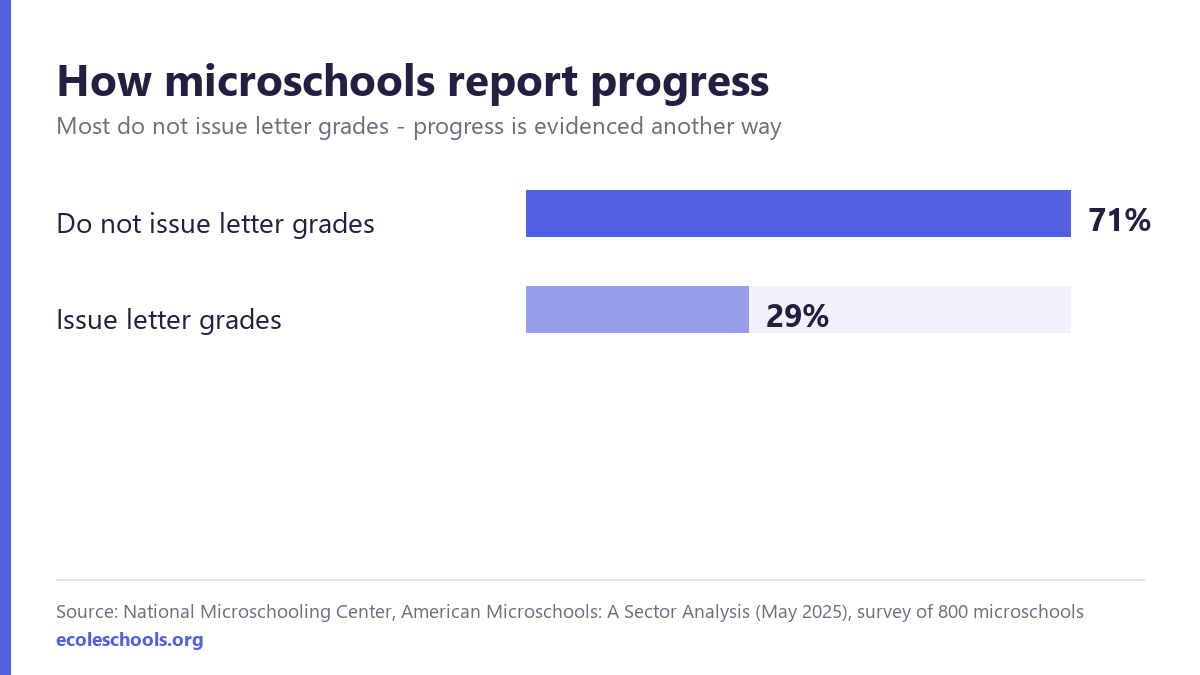
Two more norms are worth knowing before you judge any school by traditional yardsticks: only about 22% of microschools are accredited (though 80% of leaders say they would seek it if the route were practical), and the majority deliberately do not issue letter grades. Neither is a red flag on its own — both are sector norms, and our parent question set explains which answers genuinely should worry you.
What do the sector numbers actually say?
Short answer: families report high satisfaction, tuition sits well below typical private-school pricing, and the traditional markers — accreditation and letter grades — are the exception rather than the rule.
| What families ask about | Sector figure (2025 data) | Source |
|---|---|---|
| Family satisfaction | ~76% describe themselves as very satisfied | EdChoice |
| Sense of belonging | Same share report it improved after the switch | EdChoice |
| Annual tuition | 74% charge $10,000 or less; median near $6,500 | NMC |
| Sliding scale offered | ~65% of schools | NMC |
| Accredited | only ~22% (80% of leaders would seek it if practical) | NMC |
| Use letter grades | ~29%; most use narratives, portfolios or mastery checks | NMC |
| Reported academic growth | 81% of leaders report 1–2 years’ growth in one year — self-reported by schools, not independently audited | NMC |
Sources
- National Microschooling Center — American Microschools: A Sector Analysis (May 2025) — growth self-reports, tuition distribution, accreditation and grading figures.
- EdChoice — The State of Microschooling — family satisfaction and belonging data.