

Short answer: Oklahoma funds school choice through the tax code, not through accounts. The Parental Choice Tax Credit is a refundable income tax credit of $5,000 to $7,500 per child for tuition at an accredited private school — the cheques are mailed directly to the school — and a $1,000 credit for homeschool expenses. At the other end of the spectrum, Oklahoma home education is the least regulated in this series: the compulsory-attendance statute simply excuses any child for whom “other means of education are provided” (70 O.S. §10-105(A)), with no notice, registration, curriculum, assessment or diploma rules at all. A microschool therefore lives between two poles: operate under “other means” with total freedom and $1,000 per family, or become an accredited private school and receive up to $7,500 per student through the Tax Commission.
Working through this for your own school? Ecole Schools supports founders with setup consulting, the Ecole SIS and LMS and mentor training — see what we do or talk to us.
Are microschools legal in Oklahoma?
Yes, with the widest legal room in this series. Compulsory attendance (ages 5 to 18) is satisfied by a public, private or “other” school, or by other means of education. A microschool takes one of two shapes:
- An unaccredited private school or “other means” programme. Oklahoma requires no registration, licence or approval to open a private school, and the other-means exception covers home-based and hybrid arrangements without any statutory conditions. Attendance records are the principal obligation where a school operates (70 O.S. §10-106); immunisation rules apply to schools (§1210.191). This is the default microschool status, and it is essentially self-governed.
- A State Board-accredited private school. Accreditation is optional (“may be accredited and classified in like manner as public schools”, 70 O.S. §3-104) and brings the public-school standards with it: teachers with bachelor’s degrees meeting certification standards, a full-time principal, 1,080 hours of instruction a year, six-hour days, and the accreditation curriculum rules. Accreditation by another recognised accrediting association also satisfies the tax-credit programme.
Nationally, 67% of microschools are unaccredited and Oklahoma is one of the easiest states to stay that way. The question is only whether the credit changes the calculation.
What does the Parental Choice Tax Credit pay, and who can receive it?
| Item | Detail |
|---|---|
| Programme type | Refundable income tax credit administered by the Oklahoma Tax Commission; tuition credit cheques are “mailed directly to the participating private school”. |
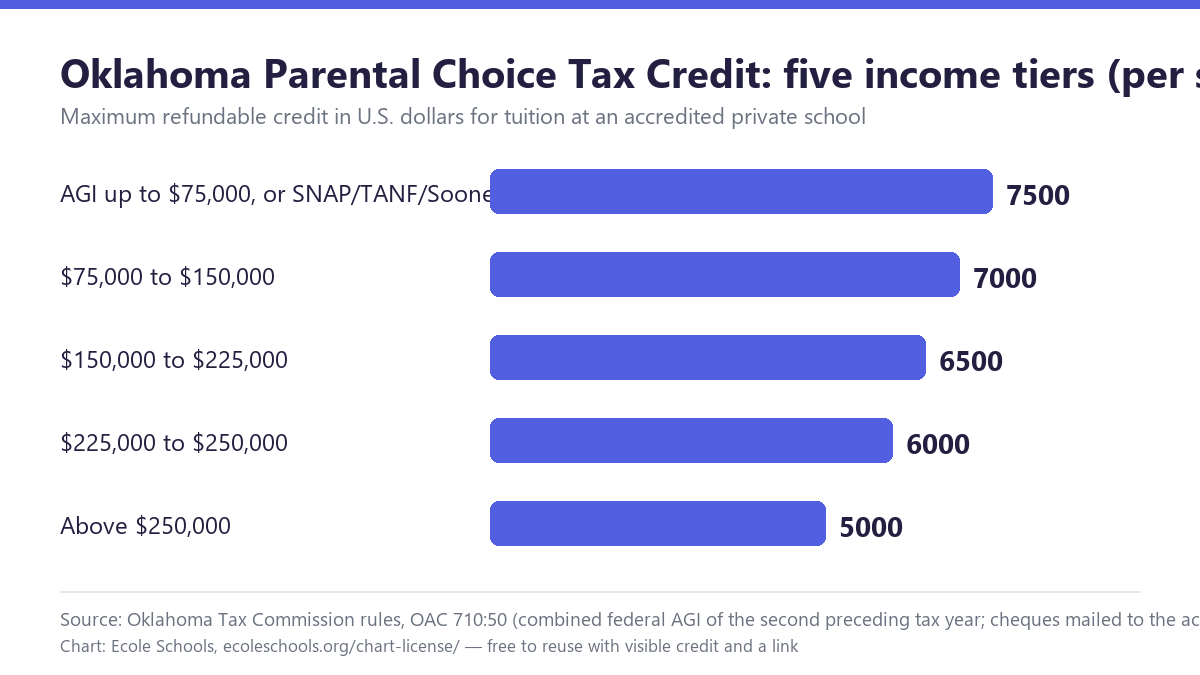
| Private school tiers (per student) | $7,500 at combined federal AGI up to $75,000 (and for families on SNAP, TANF or SoonerCare regardless of income) · $7,000 at $75,000–150,000 · $6,500 at $150,000–225,000 · $6,000 at $225,000–250,000 · $5,000 above $250,000. AGI is measured from the second preceding tax year. |
| Homeschool credit | 100% of qualified expenses up to $1,000 per student per calendar year, claimed on the tax return with receipts; a $5 million annual statewide cap and audit recapture apply. |
| School condition | The school must be accredited by the Oklahoma State Board of Education or another accrediting association. |
| Scale | 39,197 participating students in 2025-26; the programme cap grew from $150 million (2024) to $250 million for tax year 2026 (EdChoice). |
| Application window | Opens 15 March for the following school year (next business day if a weekend or holiday); for 2026-27 it ran 15 March – 15 June 2026. The first 60 days are the priority period, with first priority to families at or below $150,000 AGI. |
Note what is absent: no ESA account, no marketplace, no provider approvals. The mechanism is the tax system, which cuts both ways for a founder — there is no vendor route for an unaccredited microschool to be paid from the programme (unlike Alabama or Louisiana), but the homeschool credit, small as it is, attaches to families no matter where they learn.
Is accreditation worth it in Oklahoma?
The arithmetic is the sharpest version of the question we examined in our accreditation analysis. At the national median of 20 students, an accredited Oklahoma microschool’s families can bring $100,000–150,000 a year through the credit; an unaccredited one leaves its families with $1,000 each. But Oklahoma’s accreditation is not a light gate: State Board accreditation imports certified staffing, a full-time principal, 1,080 hours and six-hour days — public-school shape, at microschool scale. The realistic middle path many founders take is accreditation through “another accrediting association” recognised for the programme, which is the same list-based approach as Alabama’s. Honest note: which associations qualify is a Tax Commission determination — confirm the school’s accreditor is accepted before promising families the credit.
How does Oklahoma compare?
Oklahoma pairs Arizona’s freedom to operate with Indiana’s accreditation-gated money — and adds a mechanism no other state in this series uses: the tax return. For a family the practical differences are the two-year AGI look-back, the March window, and the cheque that goes to the school rather than an account they control. For a founder, the deepest contrast is with Iowa: both states reserve real money for accredited schools, but Iowa forbids an unaccredited school from charging tuition at all, while Oklahoma lets it operate without so much as a notice.
How do you start a microschool in Oklahoma, step by step?
- Open under “other means” or as an unaccredited private school — there is no state gate to pass; keep attendance records and immunisation files. The national five-step guide covers the founding sequence.
- Decide the credit question early: if families need the $5,000–7,500 tier, plan accreditation (State Board or a recognised association) and confirm acceptance with the Tax Commission.
- Tell homeschool-status families about the $1,000 credit and the receipts it requires — it is claimed on their tax return, not through the school.
- Calendar 15 March: families apply through the Tax Commission portal; the first 60 days are priority, income-ordered. The funding calendar tracks it.
- Premises: zoning, occupancy and fire rules are local — see the legal requirements guide.
Frequently asked questions
Are microschools legal in Oklahoma?
Yes, with the least regulation in the states we cover. Oklahoma requires no registration, licence or approval for private schools, and the other-means-of-education exception in 70 O.S. 10-105(A) covers home-based programmes with no notice, curriculum, assessment or diploma requirements. Accreditation is optional.
How much is the Oklahoma Parental Choice Tax Credit?
5,000 to 7,500 dollars per student per year for tuition at an accredited private school, tiered by family adjusted gross income from the second preceding year, with 7,500 dollars for families up to 75,000 dollars AGI or on SNAP, TANF or SoonerCare. Homeschool families may claim up to 1,000 dollars per student in qualified expenses.
Can an unaccredited microschool receive the tax credit?
No. The tuition credit requires an accredited private school, and cheques are mailed directly to the participating school. Families at an unaccredited microschool operating under the other-means exception may claim only the 1,000-dollar homeschool expense credit on their own returns.
When does the Oklahoma tax credit application open?
On 15 March for the following school year, through the Oklahoma Tax Commission; for 2026-27 the window ran 15 March to 15 June 2026. The first 60 days are the priority period, with first priority to families at or below 150,000 dollars AGI.
Do Oklahoma microschool teachers need a certificate?
Not in an unaccredited school or other-means programme, where the state sets no teacher requirements. State Board-accredited private schools must employ teachers with bachelor’s degrees meeting Oklahoma certification standards and a full-time principal.
Does Oklahoma regulate homeschooling?
Effectively no. The compulsory attendance statute excuses children for whom other means of education are provided, and the state imposes no notice, registration, curriculum, testing or diploma requirements on that education.
Sources
- Oklahoma Tax Commission — Parental Choice Tax Credit rules (OAC 710:50, PDF) (the five AGI tiers and the SNAP/TANF/SoonerCare rule; second-preceding-year AGI; the $1,000 homeschool credit, receipts, $5 million cap and recapture; the 15 March opening and 60-day priority period).
- Oklahoma Tax Commission — Parental Choice Tax Credit Program (credit range; cheques mailed directly to the participating private school).
- U.S. Department of Education — Oklahoma state regulation of private and home schools (no registration, licence or approval; optional State Board accreditation under 70 O.S. 3-104 and its staffing and hour rules; attendance records; immunisation; the other-means exception in 10-105(A) with no homeschool requirements).
- EdChoice — Oklahoma Parental Choice Tax Credit Act (39,197 participating students in 2025-26; cap growth from $150 million to $250 million for tax year 2026; updated 16 December 2025).
General information, not legal advice. Credit tiers, caps and windows change between tax years — verify with the Oklahoma Tax Commission before committing.
Start the conversation
If you are opening in Oklahoma, the freedom to operate is a given; the decision is whether the credit justifies accreditation’s public-school shape. See our services or contact us.
Compare with other states
Northeast
- New Jersey — no state programme at all - families pay tuition directly
- New York — no state funding, but a defined substantial-equivalency test and the heaviest home-instruction paperwork in the series
- New Hampshire — universal eligibility, capped access, and no overlap with home education
South
- Florida — registration without supervision, and the largest ESA in the country
- Texas — a brand-new programme where accreditation decides the funding tier
- West Virginia — the only state that defines microschool in statute
- Arkansas — a universal programme that grew explosively, and an unusually detailed homeschool notice
- Tennessee — the state where your school category decides whether scholarship families can pay you
- North Carolina — a home school is at most two families by statute, so a microschool is a school - and a universal scholarship pays it
- Alabama — church schools are exempt from licensing and certification, private schools are not; the CHOOSE Act pays accredited schools 7,000 dollars and home education 2,000
- Louisiana — GATOR pays tuition only at approved schools, but a registered microschool can be paid as a marketplace provider - with the largest disability award in the series
Midwest
- Ohio — the non-chartered school category, with hour and degree rules
- Indiana — the lightest unregistered status in the series, but the universal voucher is paid only to accredited schools
- Iowa — no unaccredited private schools exist - a teaching licence decides what you can be, and the ESA pays only accredited schools
- Missouri — a home school ends at four unrelated children and the first dollar of tuition; the only non-universal programme in the series
West
- Arizona — light regulation plus a universal ESA - the reference case
- Utah — no required subjects or days, and awards that differ by structure
- California — becoming a school is an October affidavit; the only public money arrives through charter vendor channels
- All fifty states — the framework, and how to resolve a state we have not covered in depth