


Short answer: Louisiana runs nonpublic education on classifications. A school is state-approved — meeting a curriculum standard “of a quality at least equal to that prescribed for similar public schools” (La. R.S. 17:11) — or it is a registered nonpublic school not seeking approval, filed with the Department of Education within 30 days of opening. The LA GATOR scholarship, the ESA that replaced the old voucher, pays tuition only at a BESE-approved nonpublic school; but it also funds home-based education through the Odyssey marketplace, and a non-approved school can apply to be listed there as a service provider. For 2026-27 the award is $5,243 for any eligible student, $7,626 for families at or below 250% of the poverty line, and up to $15,253 for students with disabilities — so a Louisiana microschool has two ways to be paid with state money, and they carry very different obligations.
Working through this for your own school? Ecole Schools supports founders with setup consulting, the Ecole SIS and LMS and mentor training — see what we do or talk to us.
Are microschools legal in Louisiana?
Yes. Compulsory attendance runs from age 6 to 18 (R.S. 17:221), and outside the public system Louisiana recognises:
- An approved nonpublic school. Annually classified by the state as approved, provisionally approved or probationally approved; curriculum quality at least equal to public schools; a 180-day session with 330 minutes of daily instruction; attendance and permanent academic records; an annual report due 15 October (R.S. 17:236, 17:11). Schools receiving public funds must use certified teachers — the Brumfield v. Dodd line that GATOR participation brings with it.
- A registered nonpublic school not seeking approval. Registers with the Department within 30 days of the session starting; no curriculum approval, no certification requirement (staffing is the school’s own affair when no public funds are involved); immunisation and birth-certificate rules still apply. This is the lightest school-shaped status in Louisiana.
- A BESE-approved home study programme. The family applies within 15 days of starting and renews by 1 October each year, showing “a sustained curriculum of a quality at least equal to that offered by public schools” (R.S. 17:236.1); its diploma carries the same privileges as a nonpublic school’s.
- GATOR home-based education. A distinct programme category: the student learns primarily at home using approved service providers on the Odyssey marketplace, paid from the scholarship — and per the programme administrator, funds in this mode “can’t be used for tuition and fees”.
A microschool is therefore either a school (approved or registered-unapproved) or a provider to home-based GATOR students — and the Odyssey guidance is explicit that “a non-BESE-approved nonpublic school can apply and be included on the Odyssey marketplace” to serve them.
What does LA GATOR pay, and who can receive it?
| Item | Detail (2026-27) |
|---|---|
| Programme type | Education savings account administered through the Odyssey platform; successor to the Louisiana Scholarship Program. |
| Award, any eligible student | $5,243 (55% of the prior-year MFP state-and-local per-pupil amount). |
| Award, income ≤250% FPL | $7,626 (80% of MFP). |
| Award, student with a disability (IDEA) | Up to $15,253 (160% of MFP), with a valid LEA evaluation or IEP as proof. |
| Two payment modes | Full-time enrolment at a BESE-approved nonpublic school (funds pay tuition and fees), or home-based education buying from approved marketplace providers (funds cannot pay tuition and fees). |
| Application window | 2026-27: 1 March, 9 a.m. – 16 March 2026. Short and once a year. |
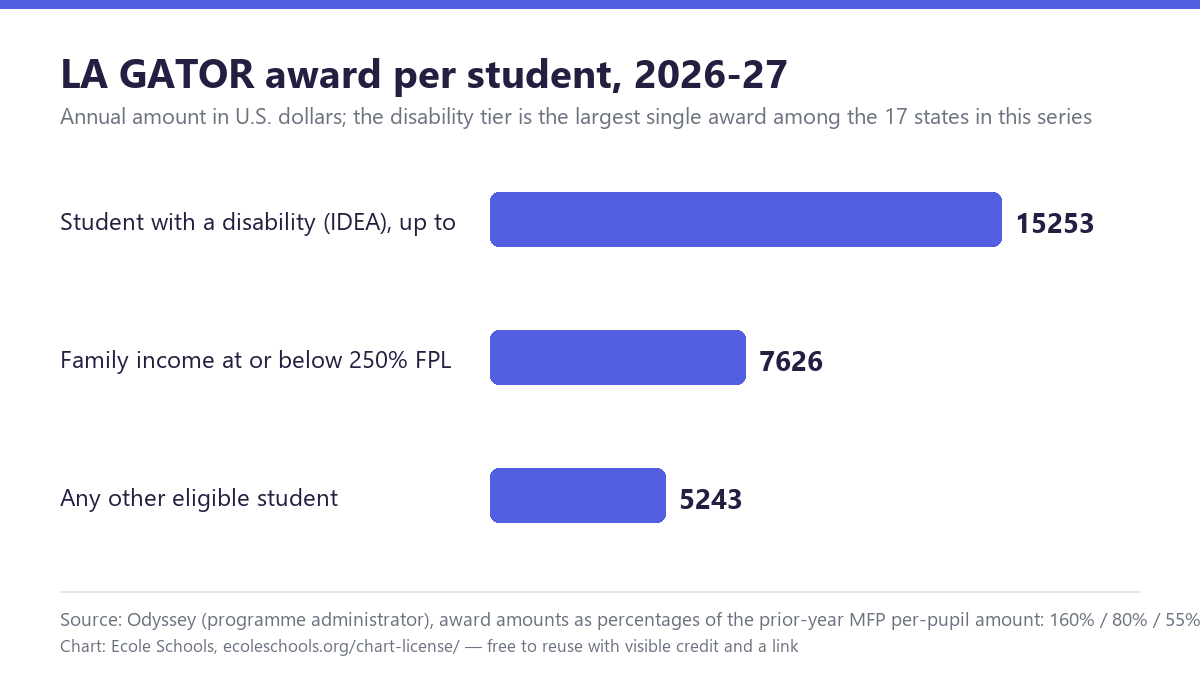
The disability tier deserves a founder’s attention: at up to $15,253 it is the largest single award in the sixteen states this series covers, and microschools serve a disproportionate share of children who left district schools over unmet needs. A school built deliberately around that cohort — small groups, an IEP-literate lead teacher, documented accommodations — is better funded in Louisiana than almost anywhere else, provided it clears BESE approval.
Approved school or marketplace provider — which fits a microschool?
| Question | BESE-approved school | Marketplace provider to home-based students |
|---|---|---|
| What GATOR pays you | Tuition and fees, up to the student’s award | Course and service purchases, item by item |
| Approval gate | Annual state classification; curriculum quality at least equal to public schools; certified teachers with public funds | Provider application to the programme; no BESE approval |
| Calendar obligations | 180 days, 330 minutes a day, 15 October report | Your own; the family’s home-based status carries the compliance |
| Whose student | Yours, full-time | The family’s; you are one of their providers |
| Revenue certainty | Higher — the award attaches to enrolment | Lower — families allocate their marketplace budget across providers |
Ecole practice, not a legal requirement: founders who are not ready for the approval process open as a registered nonpublic school for tuition families and simultaneously apply as a marketplace provider, so GATOR home-based families can buy classes from day one; approval is pursued once enrolment justifies certified staffing. Our cost guide covers pricing a mixed tuition-and-provider model, and the tools guide the records both modes require.
How does Louisiana compare with its neighbours?
Louisiana’s two-mode design sits between Texas and Alabama. Like Texas, the money is tiered and the window is short and annual; unlike Texas, the home-based tier is not a flat $2,000 but the full award spent through providers. Like Alabama, an unaccredited microschool can still be paid as a provider; unlike Alabama, the school-tier gate is state approval rather than accreditation. And the certified-teacher condition that follows public funds makes approved-school GATOR participation closer to Iowa’s licensed-staff rule than most founders expect.
How do you start a microschool in Louisiana, step by step?
- Choose your GATOR posture first — approved school, registered school plus marketplace provider, or no GATOR at all — because it decides staffing (certified or not), the calendar and the records. The national five-step guide covers the rest.
- If registered-unapproved: file the registration within 30 days of opening, keep attendance and academic records, collect immunisation certificates and birth certificates at enrolment.
- If seeking approval: build the 180-day, 330-minute calendar, document curriculum quality against public school standards, plan certified staffing, and diary the 15 October annual report.
- Apply to the marketplace as a service provider if home-based GATOR families are part of the model.
- Calendar the window: families apply 1–16 March; be listed and visible before it opens. The funding calendar tracks it.
- Premises: zoning, occupancy and fire rules are local; see the legal requirements guide.
Frequently asked questions
Are microschools legal in Louisiana?
Yes. A microschool operates as a state-approved nonpublic school, as a registered nonpublic school not seeking approval (filed with the Department of Education within 30 days of opening), or as an approved service provider to GATOR home-based students through the Odyssey marketplace. Families may also run BESE-approved home study programmes.
How much is the LA GATOR scholarship?
For 2026-27: 5,243 dollars for any eligible student, 7,626 dollars for students from families at or below 250 percent of the federal poverty guidelines, and up to 15,253 dollars for students with a disability under IDEA – the largest single award in the sixteen states this series covers.
Can GATOR funds pay microschool tuition?
Only at a BESE-approved nonpublic school, where funds pay tuition and fees for a full-time student. In home-based education mode, funds are spent with approved marketplace providers and cannot be used for tuition and fees – but a non-approved microschool can be such a provider.
Do Louisiana microschool teachers need a certificate?
Not in a registered nonpublic school that takes no public funds, where staffing is the school’s own decision. Schools receiving public funds – including approved schools enrolling GATOR students – must use instructional staff with Louisiana certification or equivalent qualification.
When does the LA GATOR application open?
Once a year, briefly: for 2026-27 the window ran from 9 a.m. on 1 March to 11:59 p.m. on 16 March 2026, through the Odyssey platform.
What is the difference between an approved and a registered nonpublic school in Louisiana?
An approved school is classified annually by the state and must offer a curriculum of a quality at least equal to public schools, run 180 days at 330 minutes a day, and report by 15 October. A registered school not seeking approval simply files with the Department within 30 days of opening and sets its own programme; it cannot receive GATOR tuition payments.
Sources
- U.S. Department of Education — Louisiana state regulation of private and home schools (approval classifications and R.S. 17:11; registration within 30 days; 180 days and 330 minutes, R.S. 17:236; certified staff where public funds are received; records and the 15 October report; home study under R.S. 17:236.1; immunisation rules; compulsory ages 6–18).
- Odyssey (programme administrator) — How much funding will the LA GATOR Program provide? (2026-27 awards of $15,253 / $7,626 / $5,243 as 160% / 80% / 55% of the prior-year MFP per-pupil amount; disability-tier proof requirements).
- Odyssey — What schools and programs are eligible through LA GATOR? (the two payment modes; home-based funds cannot pay tuition; non-BESE-approved schools may join the marketplace as providers).
- Louisiana Department of Education — LA GATOR Scholarship Program (programme home; the 1–16 March 2026 window was announced in the Department’s 28 February 2026 release). The Department’s pages returned an access error to our automated checker, so programme figures above are cited from the administrator’s published guidance; confirm on the Department’s site.
General information, not legal advice. Award amounts, windows and approval rules change between years — verify with the Louisiana Department of Education and Odyssey before committing.
Start the conversation
If you are opening in Louisiana, the GATOR posture — approved school, registered school plus marketplace, or neither — decides staffing and calendar before the lease is signed. See our services or contact us.
Compare with other states
Northeast
- New Jersey — no state programme at all - families pay tuition directly
- New York — no state funding, but a defined substantial-equivalency test and the heaviest home-instruction paperwork in the series
- New Hampshire — universal eligibility, capped access, and no overlap with home education
South
- Florida — registration without supervision, and the largest ESA in the country
- Texas — a brand-new programme where accreditation decides the funding tier
- West Virginia — the only state that defines microschool in statute
- Arkansas — a universal programme that grew explosively, and an unusually detailed homeschool notice
- Tennessee — the state where your school category decides whether scholarship families can pay you
- North Carolina — a home school is at most two families by statute, so a microschool is a school - and a universal scholarship pays it
- Alabama — church schools are exempt from licensing and certification, private schools are not; the CHOOSE Act pays accredited schools 7,000 dollars and home education 2,000
- Oklahoma — the tax-credit state: cheques go to accredited schools, and the freest homeschooling in the country gets 1,000 dollars
Midwest
- Ohio — the non-chartered school category, with hour and degree rules
- Indiana — the lightest unregistered status in the series, but the universal voucher is paid only to accredited schools
- Iowa — no unaccredited private schools exist - a teaching licence decides what you can be, and the ESA pays only accredited schools
- Missouri — a home school ends at four unrelated children and the first dollar of tuition; the only non-universal programme in the series
West
- Arizona — light regulation plus a universal ESA - the reference case
- Utah — no required subjects or days, and awards that differ by structure
- California — becoming a school is an October affidavit; the only public money arrives through charter vendor channels
- All fifty states — the framework, and how to resolve a state we have not covered in depth