

Short answer: Alabama sorts nonpublic education by who sponsors it, not by what it teaches. A “church school” — one operated as a ministry of a church, group of churches or denomination and taking no state or federal money (Ala. Code 16-28-1(2)) — needs no licence, no approval and no certified teachers; it files enrolment and attendance with the local superintendent and is otherwise left alone. A “private school” that is not a church ministry must register with the State Department of Education by 10 October every year and, under the federal summary of Alabama law, must hold its teachers to the same certification as public school teachers. Sitting across both is the CHOOSE Act: an education savings account worth $7,000 a year for a student at a participating, accredited school or $2,000 for a student in a home education programme (family cap $4,000), income-limited to 300% of the poverty level through 2026 and open to every student from 2027. For a microschool founder the first question in Alabama is therefore not “how do I register?” but “whose ministry is this, and can it be accredited?”
Working through this for your own school? Ecole Schools supports founders with setup consulting, the Ecole SIS and LMS and mentor training — see what we do or talk to us.
Are microschools legal in Alabama?
Yes. Compulsory attendance (ages 6 to 17) is satisfied by a public school, a private school, a church school, or a state-certified private tutor. A microschool takes one of four shapes:
- A church school. Operated as a ministry of a local church, group of churches, denomination or association of churches, receiving no state or federal funding. No licensing, no state approval, no teacher certification requirement; files the enrolment form and keeps attendance for the superintendent. This is the shape most Alabama home educators and many small schools use, and a microschool that a church is willing to sponsor as its ministry can use it too.
- A private school. Established, conducted and supported by a non-governmental agency and not a church ministry. Mandatory annual registration with the State Department of Education by 10 October; no licence or accreditation required; but teacher certification “must be the same as for public school teachers” (federal summary of Alabama law). For a secular, independently owned microschool this is the default status, and the certification rule is the one founders most often discover late.
- A private tutor. A state-certified teacher instructing for at least three hours a day, 140 days a year, between 8 a.m. and 4 p.m. Rarely a microschool’s basis, but it is the route by which one certified teacher can serve a handful of families without a school structure.
- An education service provider (ESP) to home-educated students. Under the CHOOSE Act, a school, organisation or individual approved by the Department of Revenue may sell goods and services — including classes — to participating students, including those in church-school home education programmes, paid from their accounts.
What does each status actually require?
| Requirement | Church school | Private school |
|---|---|---|
| Sponsor | A ministry of a church, churches, denomination or association; no state or federal funding (16-28-1(2)) | Any non-governmental agency |
| Registration | Enrolment form and attendance records filed with the local superintendent | Mandatory annual registration with the State Department of Education by 10 October |
| Licence, approval, accreditation | None | None required by the state |
| Teachers | No certification requirement | Certification and recertification “the same as for public school teachers” |
| CHOOSE Act, $7,000 tier | Either may be a participating school if accredited, or in the process of obtaining accreditation as determined by the Department, and approved | |
| CHOOSE Act, $2,000 tier | Either may be approved as an education service provider serving home-education-programme students | |
Two honest notes. First, the church-school definition turns on sponsorship, so an independent founder cannot simply declare a ministry; the church must operate the school. Second, the private-school teacher rule comes from the U.S. Department of Education’s summary of Alabama law; the Alabama Department of Education’s own pages could not be read by our checker on the day this guide was written, so confirm the current position there before hiring.
What does the CHOOSE Act pay, and who can receive it?
| Item | Detail |
|---|---|
| Programme type | A refundable income tax credit delivered as an education savings account, administered by the Department of Revenue through ClassWallet (Ala. Admin. Code 810-28-1). |
| Amounts | $7,000 per participating student enrolled in a participating school; $2,000 per participating student in a home education programme, capped at $4,000 per family. |
| Eligibility | Students aged 5 to 19 who have not graduated. For 2025 and 2026 tax years, family adjusted gross income not exceeding 300% of the federal poverty level (about $93,600 for a family of four); “for the years beginning on or after January 1, 2027, the refundable income tax credit shall be available to any parent of an eligible student.” |
| Priority order | First 500 accounts to special-needs students; then prior-year participants and siblings; then active-duty dependents at priority schools; then by income. |
| Participating school | “An accredited public K-12 school or an accredited private school, including church, parochial, or religious schools” approved by the Department — “accredited, or in the process of obtaining accreditation” by one of the six regional agencies, the National Council for Private School Accreditation, Cognia, the American Association of Christian Schools, the Alabama Christian Education Association or the Alabama Independent School Association. Must hold an occupancy permit if the municipality requires one, comply with the Child Protection Act background-check rules, and administer an annual standardised test, reporting school-level results. |
| Scale | 18,484 participating students in 2025-26, average account value about $5,400; $100 million appropriated for accounts (EdChoice). Applications passed 20,000 in the first cycle (Department of Revenue, 19 February 2025). |
| Application window | 2026-27: new families 2 January – 31 March 2026 (renewals from mid-December); portals closed at midnight on 31 March. Once a year. |
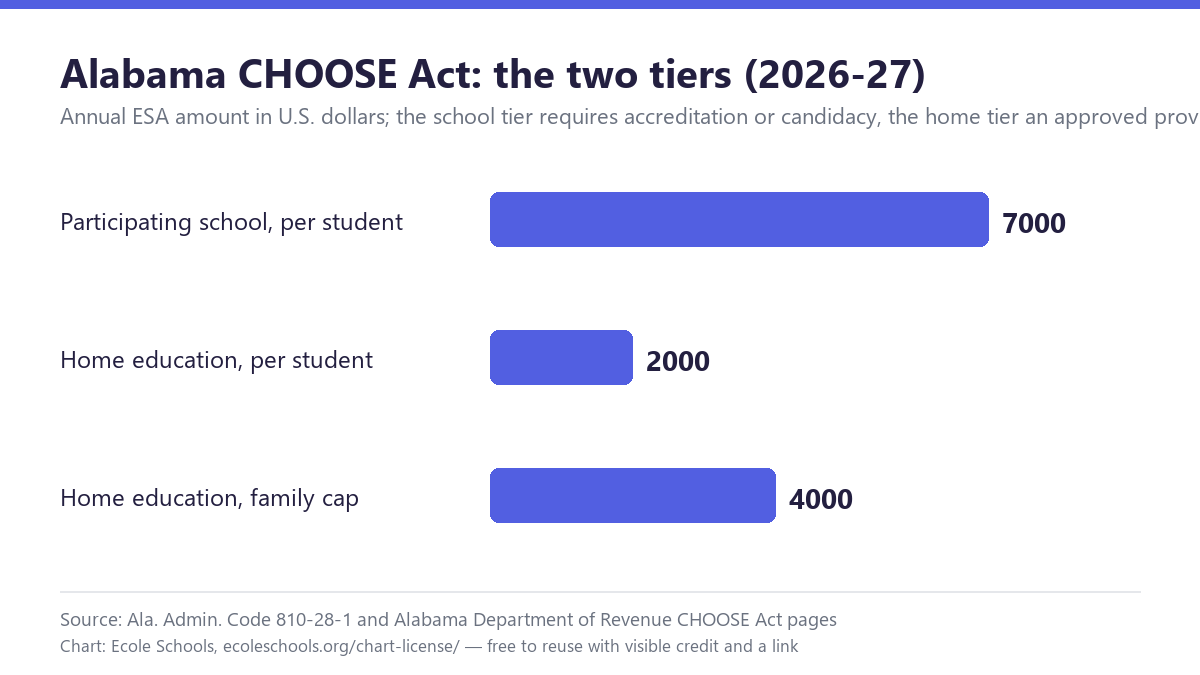
For a founder the two tiers are two different businesses. The $7,000 tier requires accreditation or candidacy with a listed body, plus testing and reporting — a school. The $2,000 tier requires only ESP approval and a product that a home-education family wants to buy — classes, tutoring, labs — which is how a microschool that is not yet accredited can still be paid with state money from its first year. Our cost guide covers how a two-tier customer base changes pricing; the California guide describes the same vendor logic under a different programme.
How does Alabama compare with the states around it?
Alabama’s closest relative in this series is Tennessee: both make a church-related umbrella the lightest lawful home for a microschool, and both pay state money only to a school that has passed an external gate — registration category in Tennessee, accreditation in Alabama. Where Tennessee gives home education nothing, Alabama’s $2,000 home-education tier is closer to Texas (which pays $2,000 to home-schooled students) and, in mechanism, to California’s charter vendor channel. And like Indiana and Iowa, Alabama makes accreditation the price of the full award — with the useful difference that “in the process of obtaining accreditation” counts.
How do you start a microschool in Alabama, step by step?
- Settle the sponsor question. A church willing to operate the school as its ministry removes licensing, registration and the teacher-certification rule; without one, plan as a registered private school with certified staff. The national five-step guide covers the rest of the sequence.
- Decide the CHOOSE tier you are building for. If $7,000: start accreditation candidacy with one of the listed bodies early, because candidacy itself is enough to participate. If $2,000: apply to the Department of Revenue for ESP approval.
- Background checks: participating schools and ESPs must comply with the Alabama Child Protection Act as if they were nonpublic schools; build this into hiring from the start.
- Occupancy and safety: a valid occupancy permit where the municipality requires it, plus the health and safety codes the programme rules reference; see the legal requirements guide.
- Testing: a participating school administers an annual standardised test from the approved list and reports school-level results (results for fewer than 20 participating students are withheld for privacy).
- Calendar the window: families apply 2 January – 31 March; be listed before it opens. The funding calendar tracks it.
Frequently asked questions
Are microschools legal in Alabama?
Yes. A microschool operates as a church school (a ministry of a church, with no licence, approval or teacher-certification requirement), as a registered private school (annual registration by 10 October, teachers certified as in public schools under the federal summary of state law), through a state-certified private tutor, or as an approved education service provider to home-educated students under the CHOOSE Act.
What does the Alabama CHOOSE Act pay a microschool?
7,000 dollars a year for each participating student enrolled in a participating school that is accredited, or in the process of obtaining accreditation, with a listed body; or 2,000 dollars per student, capped at 4,000 dollars per family, for students in a home education programme buying services from an approved education service provider.
Who is eligible for the CHOOSE Act?
Students aged 5 to 19 who have not graduated. For the 2025 and 2026 tax years the family adjusted gross income may not exceed 300 percent of the federal poverty level, about 93,600 dollars for a family of four; from 1 January 2027 the credit is available to any parent of an eligible student, with special-needs students, returning participants and military dependents prioritised.
Does an Alabama microschool need accreditation?
Not to operate: neither church schools nor registered private schools must be accredited. Accreditation, or candidacy with one of the listed bodies, is required only to receive the 7,000-dollar CHOOSE Act award as a participating school.
Do Alabama microschool teachers need a certificate?
In a church school, no. In a private school that is not a church ministry, the U.S. Department of Education summary of Alabama law states that certification requirements must be the same as for public school teachers; confirm with the Alabama State Department of Education. A private tutor must hold a state certificate.
When does the CHOOSE Act application open?
Once a year. For 2026-27, new families applied from 2 January to 31 March 2026, with renewals opening in mid-December; the portals closed at midnight on 31 March. Accounts are administered through ClassWallet.
Sources
- U.S. Department of Education — Alabama state regulations of private and home schools (church school definition, Ala. Code 16-28-1(2); private school registration by 10 October; teacher certification rule; private tutor 140 days and three hours; compulsory ages 6–17).
- Alabama Administrative Code, Chapter 810-28-1, The CHOOSE Act Program (definitions of participating school, education service provider and eligible student; accrediting bodies; income rule for 2025–2026 and universal availability from 1 January 2027; priority order; testing, occupancy and Child Protection Act requirements).
- Alabama Department of Revenue — The CHOOSE Act ($7,000 and $2,000 amounts, $4,000 family cap, priority tiers by year, 2026-27 portals closed 31 March 2026) and press release of 19 February 2025 (20,000 applications, $93,600 threshold).
- EdChoice — CHOOSE Act (18,484 participating students and $5,400 average account in 2025-26; $100 million appropriation; updated 16 December 2025).
General information, not legal advice. The Alabama State Department of Education’s own pages were not reachable by our automated checker; verify registration and certification rules there, and programme rules with the Department of Revenue, before committing.
Start the conversation
If you are opening in Alabama, the sponsor question and the CHOOSE tier you are building for decide staffing, accreditation and price before anything else. See our services or contact us.
Compare with other states
Northeast
- New Jersey — no state programme at all - families pay tuition directly
- New York — no state funding, but a defined substantial-equivalency test and the heaviest home-instruction paperwork in the series
- New Hampshire — universal eligibility, capped access, and no overlap with home education
South
- Florida — registration without supervision, and the largest ESA in the country
- Texas — a brand-new programme where accreditation decides the funding tier
- West Virginia — the only state that defines microschool in statute
- Arkansas — a universal programme that grew explosively, and an unusually detailed homeschool notice
- Tennessee — the state where your school category decides whether scholarship families can pay you
- North Carolina — a home school is at most two families by statute, so a microschool is a school - and a universal scholarship pays it
- Louisiana — GATOR pays tuition only at approved schools, but a registered microschool can be paid as a marketplace provider - with the largest disability award in the series
- Oklahoma — the tax-credit state: cheques go to accredited schools, and the freest homeschooling in the country gets 1,000 dollars
Midwest
- Ohio — the non-chartered school category, with hour and degree rules
- Indiana — the lightest unregistered status in the series, but the universal voucher is paid only to accredited schools
- Iowa — no unaccredited private schools exist - a teaching licence decides what you can be, and the ESA pays only accredited schools
- Missouri — a home school ends at four unrelated children and the first dollar of tuition; the only non-universal programme in the series
West
- Arizona — light regulation plus a universal ESA - the reference case
- Utah — no required subjects or days, and awards that differ by structure
- California — becoming a school is an October affidavit; the only public money arrives through charter vendor channels
- All fifty states — the framework, and how to resolve a state we have not covered in depth