

Short answer: Iowa is the state in this series where a teaching licence, not a building or a form, decides what a microschool can be. Iowa law defines a nonpublic school as one that is accredited (Iowa Code §256.11, §280.2) and staffs it with licensed teachers; below that level the only shapes are “independent private instruction” — no more than four unrelated students and no tuition, fees or other remuneration (§299A.1(2)(b)) — and “competent private instruction”, which either a parent or a licensed practitioner provides for at least 148 days a year (§299A.1, §299A.2). The Students First Education Savings Account is now universal and worth $8,148 per student for 2026-27, but it pays only for a child enrolled full-time at an accredited nonpublic school. So an Iowa founder without a licence can run a free four-child pod; a licensed teacher can run a tuition-charging microschool under competent private instruction; and only an accredited school can take the ESA.
Working through this for your own school? Ecole Schools supports founders with setup consulting, the Ecole SIS and LMS and mentor training — see what we do or talk to us.
Are microschools legal in Iowa?
Yes, in three shapes, and Iowa is unusual in drawing the lines by licence and headcount rather than by notice or approval. A child of compulsory age (6 to 16) may be placed under any of the following (§299A.1):
- Independent private instruction (IPI). Not accredited; enrols not more than four unrelated students; does not charge tuition, fees or other remuneration; teaches mathematics, reading and language arts, science and social studies; reports nothing unless a superintendent or the Department asks in writing. Exempt from other state education rules. A free co-op of up to four families’ children — not a business.
- Competent private instruction (CPI). At least 148 days a year, 37 in each quarter, either (a) by or under the supervision of a licensed practitioner holding a Board of Educational Examiners licence appropriate to the ages and grades taught (§299A.2), or (b) by the parent (§299A.3). Route (a) is how a licensed teacher can teach a group of other people’s children for a fee; the statute places no student cap on it, and each family files the report the parent route requires unless the instruction is part of a home school assistance programme run by an accredited school or district.
- An accredited nonpublic school. Accreditation by the Department of Education or an independent accreditor it recognises, licensed teachers for every teaching position (Iowa Admin. Code 281-12.4(8)), 180 days or 1,080 hours of instruction (§279.10), the accreditation standards on curriculum and records — and eligibility for the ESA.
Two consequences set Iowa apart. First, the phrase “unaccredited private school” has no meaning here: an unaccredited programme that charges tuition is either CPI under a licensed teacher or outside the law. Second, the licence is the gate. Nationally only 28% of microschool founders currently hold a teaching licence and 21% formerly did (National Microschooling Center, 2026); in most states that is a marketing question, in Iowa it is a legal one.
What does each shape actually require?
| Requirement | Independent private instruction | CPI by licensed practitioner | Accredited nonpublic school |
|---|---|---|---|
| Who may teach | Anyone | A licensed practitioner (or under their supervision) | Licensed teachers in every position |
| Students | No more than four unrelated students | No statutory cap | No cap |
| Tuition | Prohibited — no tuition, fees or remuneration | Permitted | Permitted; payable from the ESA |
| Days | None set | 148, with 37 in each quarter | 180 days or 1,080 hours |
| Notice and reporting | None unless requested in writing | Each family files the private-instruction report with its district (unless part of a home school assistance programme) | Accreditation reporting; permanent and cumulative student records (281-12.3(4)) |
| Assessment | None | The practitioner monitors progress; §299A.3–.7 evaluation rules do not apply to this route | Accreditation standards; district provides state testing on the same basis as public pupils (§256.12) |
| Subjects | Mathematics, reading and language arts, science, social studies | Appropriate to the licence held | Accreditation curriculum standards, incl. the grade 9–12 unit requirements (§256.11(5)) |
| ESA eligibility | No | No | Yes |
Fire and tornado drills (§100.31) and the ban on corporal punishment (§280.21) apply to schools; premises questions — zoning, occupancy, childcare licensing for young children — are local and are covered in our legal requirements guide.
What does the Students First ESA pay, and who can receive it?
| Item | Detail |
|---|---|
| Programme type | Education savings account administered by Odyssey for the Department of Education; funds go to tuition and fees first, then to approved marketplace expenses. |
| Eligibility | “Beginning with the 2025-26 school year, and for each subsequent year, all Iowa resident K-12 students are eligible regardless of income.” |
| Amount | $8,148 per student for 2026-27 (the state per-pupil amount; $7,826 in 2025-26 by published reports). |
| School condition | “Students must be enrolled full time at an accredited nonpublic school and attend classes for at least 75 percent of the full-time schedule.” |
| Application window | 2026-27: 16 April 2026, 8 a.m. – 30 June 2026, 11:59 p.m. (2025-26 ran 16 April – 30 June as well). Once a year. |
| Home or private instruction | Not eligible; the Department lists accredited nonpublic enrolment as the condition. |
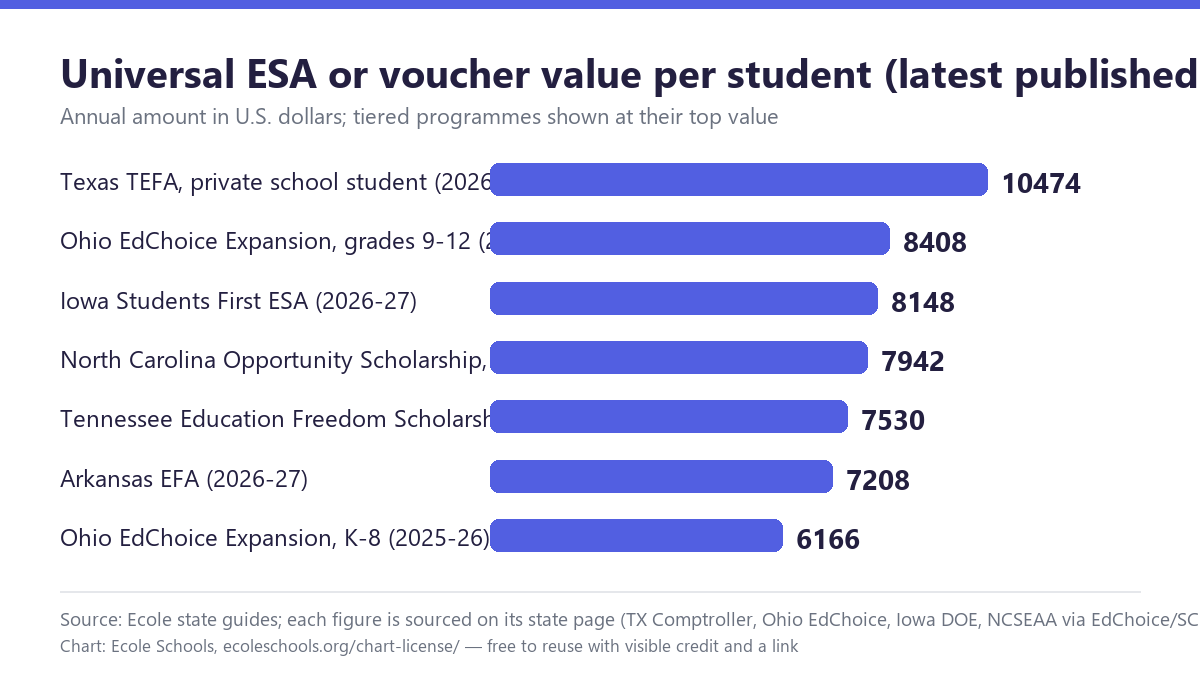
For a founder the arithmetic is stark. Twenty students — the national median — at $8,148 is about $163,000 a year of state money that reaches an accredited school and passes a CPI microschool by entirely. Against that sits the cost of accreditation: licensed staff for every teaching role, 180 days, the standards and the records. Our cost guide separates the two budgets; in Iowa the difference between them is the accreditation line.
Which Iowa route fits which founder?
- A licensed teacher opening alone: competent private instruction under §299A.2 is the fastest lawful start — tuition allowed, 148 days, families file the report, no ESA. Many grow into accreditation once enrolment justifies the staffing.
- An unlicensed founder: either partner with a licensed practitioner who provides or supervises the instruction, or open as an accredited school with a licensed staff from day one. A free four-student IPI is lawful but is not a business.
- A group of families: IPI if four or fewer unrelated children and nobody is paid; otherwise each family files for CPI and the instruction must be by or under a licensed practitioner.
- Anyone who wants ESA families: accreditation, full stop — and the 16 April to 30 June window means the school must be accredited and listed before families apply.
Read against the other states in this series, Iowa resembles Indiana — money only for the accredited — but with a harder floor: Indiana lets an unaccredited school charge tuition with no teacher rule, Iowa does not. It is the mirror image of Arizona, where the state neither supervises private schools nor conditions its ESA on accreditation.
How do you start a microschool in Iowa, step by step?
- Establish who holds the licence. It decides whether you can charge tuition at all (CPI) and whether you can ever be accredited. The national five-step guide covers the rest of the founding sequence.
- If CPI: plan 148 days with 37 per quarter, prepare the private-instruction report each family will file with its district, and keep attendance and progress records the practitioner can stand behind; the tools and resources guide describes what a record system must capture.
- If accredited: start the accreditation process early (licensed staffing, 180 days or 1,080 hours, curriculum standards, records), then register with the ESA administrator so families can select you in the April–June window.
- Price for the route: a CPI school prices for tuition-paying families only; an accredited school can price against $8,148 but must run the full accreditation cost base.
- Premises and safety: fire and tornado drill plans, local occupancy and zoning.
Frequently asked questions
Are microschools legal in Iowa?
Yes. A microschool operates as independent private instruction (no more than four unrelated students and no tuition), as competent private instruction provided by or under a licensed practitioner for at least 148 days a year, or as an accredited nonpublic school with licensed teachers and 180 days or 1,080 hours of instruction.
Can an Iowa microschool charge tuition without being accredited?
Only as competent private instruction by or under the supervision of a licensed practitioner. Independent private instruction may not charge tuition, fees or other remuneration and is limited to four unrelated students, and Iowa law defines a nonpublic school as an accredited one.
How much is the Iowa Students First ESA?
8,148 dollars per student for the 2026-27 school year, available to every Iowa resident K-12 student regardless of income since 2025-26. Funds pay tuition and fees first at an accredited nonpublic school where the student is enrolled full time and attends at least 75 percent of the schedule.
Can the Iowa ESA pay for a microschool that is not accredited?
No. The Department of Education conditions the account on full-time enrolment at an accredited nonpublic school, so competent private instruction and independent private instruction are not eligible uses.
Do Iowa microschool teachers need a licence?
For competent private instruction, yes: the instruction must be provided by or under the supervision of a practitioner licensed by the Board of Educational Examiners for the ages and grades taught. Accredited nonpublic schools must employ licensed teachers in every teaching position. Only independent private instruction, which cannot charge tuition, has no teacher requirement.
When is the Iowa ESA application window?
Once a year. For 2026-27 it runs from 8 a.m. on 16 April 2026 to 11:59 p.m. on 30 June 2026 through the Students First platform administered by Odyssey.
Sources
- Iowa Code chapter 299A (2026) — §299A.1 definitions of competent private instruction (148 days, 37 per quarter) and independent private instruction (not accredited, not more than four unrelated students, no tuition, fees or remuneration); §299A.2 competent private instruction by a licensed practitioner and the reporting rule.
- U.S. Department of Education — Iowa state regulation of private and home schools (nonpublic school defined as accredited, §256.11 and §280.2; licensed teachers, 281-12.4(8); 180 days or 1,080 hours, §279.10; records, testing, drills, corporal punishment).
- Iowa Department of Education — Students First Education Savings Accounts ($8,148 for 2026-27; universal eligibility from 2025-26; accredited nonpublic full-time and 75% attendance condition; 16 April – 30 June 2026 window; Odyssey).
- Iowa Department of Education press release, 15 April 2025 (2025-26 window 16 April – 30 June; universal eligibility).
- The national founder-licensing and size figures are from the National Microschooling Center’s May 2026 sector analysis, sourced on our statistics page.
General information, not legal advice. ESA amounts, windows and accreditation rules change between years — verify with the Iowa Department of Education before committing.
Start the conversation
If you are opening in Iowa, the licence question comes before the lease, the price list and the ESA — it decides which of the three shapes you can be. See our services or contact us.
Compare with other states
Northeast
- New Jersey — no state programme at all - families pay tuition directly
- New York — no state funding, but a defined substantial-equivalency test and the heaviest home-instruction paperwork in the series
- New Hampshire — universal eligibility, capped access, and no overlap with home education
South
- Florida — registration without supervision, and the largest ESA in the country
- Texas — a brand-new programme where accreditation decides the funding tier
- West Virginia — the only state that defines microschool in statute
- Arkansas — a universal programme that grew explosively, and an unusually detailed homeschool notice
- Tennessee — the state where your school category decides whether scholarship families can pay you
- North Carolina — a home school is at most two families by statute, so a microschool is a school - and a universal scholarship pays it
- Alabama — church schools are exempt from licensing and certification, private schools are not; the CHOOSE Act pays accredited schools 7,000 dollars and home education 2,000
- Louisiana — GATOR pays tuition only at approved schools, but a registered microschool can be paid as a marketplace provider - with the largest disability award in the series
- Oklahoma — the tax-credit state: cheques go to accredited schools, and the freest homeschooling in the country gets 1,000 dollars
Midwest
- Ohio — the non-chartered school category, with hour and degree rules
- Indiana — the lightest unregistered status in the series, but the universal voucher is paid only to accredited schools
- Missouri — a home school ends at four unrelated children and the first dollar of tuition; the only non-universal programme in the series
West
- Arizona — light regulation plus a universal ESA - the reference case
- Utah — no required subjects or days, and awards that differ by structure
- California — becoming a school is an October affidavit; the only public money arrives through charter vendor channels
- All fifty states — the framework, and how to resolve a state we have not covered in depth