

Short answer: New York has no microschool statute and no state-funded school-choice programme — EdChoice records that “New York does not have a private school choice program” — so a microschool here is paid by families and is judged by one test the state applies to every child taught outside a public school: is the instruction “substantially equivalent” to the local public school (Education Law §3204(2))? Operate as a nonpublic school and that test is applied to you by your local school authority under the 2022 Part 130 rules; operate as a service to home-instructed families and it is applied to each parent through the notice, plan, quarterly-report and assessment cycle in 8 NYCRR §100.10. Which side of that line you stand on is the founding decision in New York.
Working through this for your own school? Ecole Schools supports founders with setup consulting, the Ecole SIS and LMS and mentor training — see what we do or talk to us.
Are microschools legal in New York?
Yes. New York regulates the instruction a compulsory-age child receives (ages 6 to 16 in most of the state, 17 in some districts), not the word “microschool”. A microschool therefore takes one of three existing shapes:
- A nonpublic school (religious or independent). No state licence, approval or accreditation is required to open one; registration with the State Education Department is optional and matters mainly at high-school level. The school must provide instruction that is substantially equivalent to the local public school, and since September 2022 that is checked through the Part 130 process described below.
- A support service to home-instructed families. The parent stays legally responsible under §100.10, files the paperwork with the district, and may use your programme for some or all of the instruction — the regulation names “individuals providing instruction” in the plan without restricting who they are or where the teaching happens.
- A registered nonpublic high school. Registration is voluntary, but “only registered nonpublic high schools may issue diplomas and administer Regents Examinations” (8 NYCRR §100.2(p)). For a secondary-age microschool that wants to issue a diploma of its own, this is the route.
The practical difference between the first two is where the compliance burden sits. As a nonpublic school, the burden is yours and it is assessed once per pathway cycle. As a home-instruction service, the burden is repeated in every family’s file, four times a year.
What does “substantial equivalency” actually require of a nonpublic school?
The State Education Department describes substantial equivalency as “based upon the provision of instruction in the core subjects required by state law (science, math, social studies, and English language arts)”. The 2022 regulations (8 NYCRR Part 130) apply to all religious and independent schools serving compulsory-age children and give a school seven ways to show it meets the bar:
- being a registered high school;
- being a state-approved special education school;
- accreditation by an accreditor on the Department’s approved list;
- running an International Baccalaureate programme (online-only programmes excluded);
- being a federally approved school (currently one school statewide);
- the standardised assessment pathway — the school’s participation rate in listed state assessments must match or exceed the three-year statewide public school average, currently 76%;
- a local review by the local school authority.
For a new microschool the realistic choices are the last two, and the assessment pathway is easier to plan for than it sounds: a 20-student school needs roughly 15 or more eligible children sitting the tests each year. The review is run by the Local School Authority (the school district, or the city department in the big-city districts); the Department sets the annual rhythm — LSAs report every nonpublic school inside their boundaries by 1 September and each school’s chosen pathway by 1 December. Schools that were already open on 28 September 2022 had to receive a determination by 30 June 2025; a school opening now enters the cycle at its first report.
What does a nonpublic school in New York have to do beyond the core subjects?
| Requirement | What New York law says |
|---|---|
| Accreditation, licence, approval | No requirement for any of the three (federal summary of N.Y. law); registration is optional and affects diplomas and Regents only. |
| Teachers | “Instruction may only be given by a competent teacher” (§3204(2)) — no state certificate is required in a nonpublic school, except in approved special-education schools. |
| School year and day | A full-time day school must be in session not less than 190 days each year (§3204(4)), with hours at least equal to the public schools (§3210(2)). |
| Subjects, grades 1–8 | Arithmetic, reading, spelling, writing, the English language, geography, United States history, civics, hygiene and physical training (§3204(3)), plus the core-subject equivalency test above. |
| Records | Accurate attendance records (8 NYCRR §104.1) and individual pupil records (§104.2). |
| Health and safety | Certificates of immunisation for every pupil unless medically contraindicated (Public Health Law §2164); fire drills at least 12 times each school year (§807). |
| Transportation | Outside the cities, districts must transport nonpublic pupils living up to 15 miles from the school (§3635(1)) — a real recruiting advantage for a suburban microschool. |
Note what is missing from that table: there is no minimum enrolment, no building-type rule specific to schools in the Education Law, and no state tuition or financial-reporting requirement. Zoning, occupancy and childcare-licensing questions are decided locally and are covered in our legal requirements guide.
What does the home-instruction route require of each family?
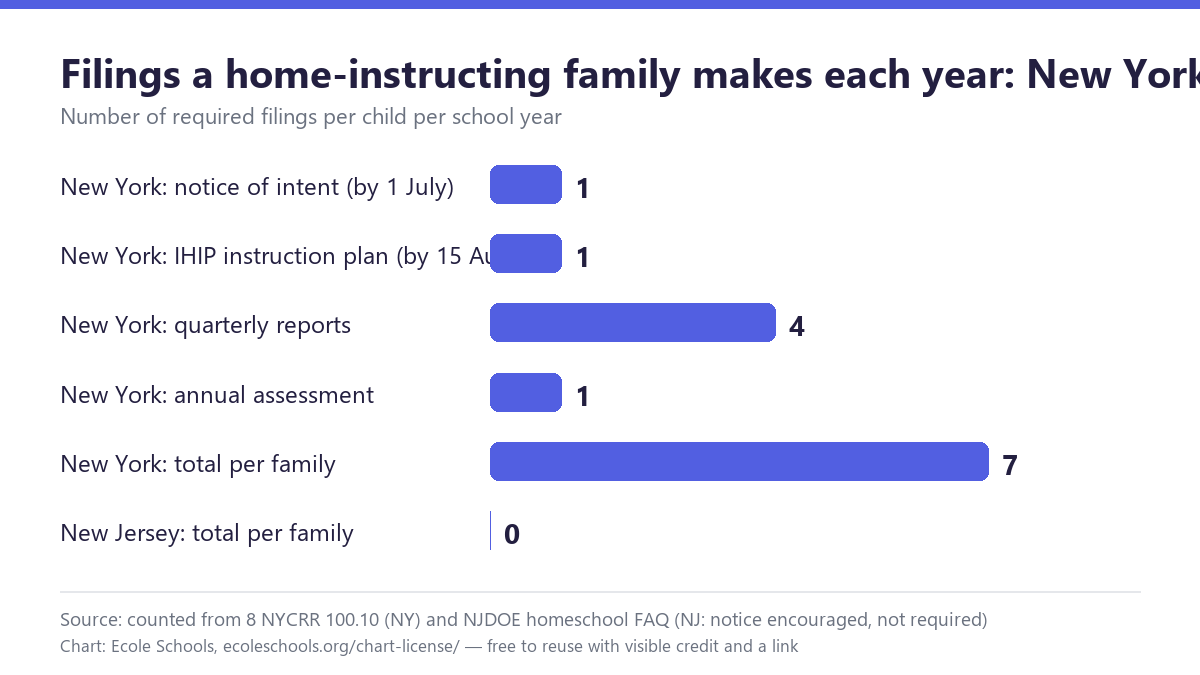
If your microschool serves children whose parents file as home instructors, every one of those families runs this cycle under 8 NYCRR §100.10 — and in practice they will expect you to produce most of the paperwork:
- Notice of intent to the district superintendent by 1 July each year, or within 14 days of starting home instruction mid-year.
- An Individualized Home Instruction Plan (IHIP), on the district’s form, within four weeks of receiving it or by 15 August, whichever is later.
- Instruction equivalent to 180 days: 900 hours a year in grades 1–6 and 990 hours in grades 7–12.
- Quarterly reports with hours, material covered and grades or a narrative, and an explanation if less than 80% of the planned work was completed.
- Annual assessment: a written narrative is enough in grades 1–3; in grades 4–8 a narrative may replace a test no more often than every other year; in grades 9–12 a standardised test is required every year. An adequate result is a composite above the 33rd percentile on national norms or one year’s growth; an inadequate result puts the programme on probation.
This is why a home-instruction-based microschool in New York is an administrative product as much as an educational one. The Ecole approach is to generate the IHIP, the quarterly reports and the assessment evidence from the school’s own records so that parents sign rather than write — the tools and resources guide explains what the record system has to capture for that to work. (That is practitioner advice, not a requirement of the regulation.)
Is there any state funding for microschool families in New York?
No. New York has no education savings account, voucher or tax-credit scholarship programme. Families pay tuition, and the sliding-scale and deposit practices described in our cost guide carry more weight here than in the eighteen states with ESAs. Two narrow public entitlements do exist: district transportation for nonpublic pupils within 15 miles outside the cities, and special-education services for home-instructed students with disabilities, who are treated as nonpublic school students under Education Law §3602-c. Neither pays tuition. If state funding is central to your model, the laws-by-state framework and the funding calendar show which neighbouring states have it — New Jersey does not either.
New Jersey or New York — which side of the river is easier for a founder?
Ecole Schools works from North Bergen, directly across the Hudson from Manhattan, so this is a question we are asked in almost every first conversation. The honest comparison:
| Question | New Jersey | New York |
|---|---|---|
| Does a home-instructing family have to notify anyone? | No — the state education department encourages but does not require notice. | Yes — notice by 1 July, IHIP by 15 August, quarterly reports, annual assessment. |
| Minimum hours or days for home instruction | No state policy. | 180-day equivalent; 900 or 990 hours a year. |
| Nonpublic school approval or licence | None; the department does not accredit nonpublic schools. | None; but substantial-equivalency review under Part 130 since 2022. |
| Minimum school year for a nonpublic school | No state policy on days. | 190 days for a full-time day school. |
| State funding for families | None. | None. |
| Who can sit state exams / issue a state-recognised diploma | Not applicable. | Only a registered nonpublic high school may administer Regents and issue diplomas. |
Read as a founder: New Jersey is lighter on paperwork for a home-instruction-based model, New York is more structured but gives a nonpublic school a clear, once-a-cycle test and a path to a recognised diploma. Our New Jersey guide has the statutory detail for the other bank, and the North Bergen page covers the Hudson County market itself.
How do you start a microschool in New York, step by step?
- Decide the status first — nonpublic school or home-instruction service — because it decides whether Part 130 or §100.10 governs you, what your families must file and whether a diploma is possible. The five-step national guide walks through the same decision.
- If nonpublic: choose your equivalency pathway before you open (assessment participation or local review are the realistic ones), set a calendar that delivers 190 days, and build attendance and pupil records from day one.
- If home-instruction: prepare an IHIP template, a quarterly-report template and an assessment plan for each grade band, so that every family’s 1 July and 15 August deadlines are met from your records.
- Premises: resolve zoning, certificate of occupancy and fire-drill logistics locally; plan 12 drills a year into the calendar.
- Health files: immunisation certificates for every pupil before the first day.
- Price for tuition, not subsidy: there is no state money to wait for, so deposits and a sliding scale decide cash flow.
Frequently asked questions
Are microschools legal in New York?
Yes. New York has no microschool statute. A microschool operates either as a nonpublic school, subject to the substantial-equivalency rules in Education Law 3204(2) and 8 NYCRR Part 130, or as a service to families who file as home instructors under 8 NYCRR 100.10.
Does New York have an ESA or voucher a microschool family can use?
No. New York has no private school choice programme of any kind, so microschool tuition is paid by families. Districts outside the cities must provide transportation to nonpublic pupils within 15 miles, and home-instructed students with disabilities can receive special-education services, but neither pays tuition.
Do New York microschool teachers need a state certificate?
Not in a nonpublic school: the law requires that instruction be given by a competent teacher, and only approved special-education schools must employ certified professionals. Home instruction has no parent qualification requirement either.
What is substantial equivalency and does it apply to a microschool?
It is the requirement that instruction outside a public school be substantially equivalent to the local public school, centred on science, mathematics, social studies and English. Since 2022 every religious or independent school serving compulsory-age children must demonstrate it through one of seven pathways, most often a local review or a standardised-assessment participation rate of at least 76 percent.
What deadlines do home-instructing families in New York face?
Notice of intent to the superintendent by 1 July (or within 14 days of starting mid-year), the IHIP within four weeks of receiving the form or by 15 August, quarterly reports during the year, and an annual assessment. Instruction must equal 180 days, 900 hours in grades 1 to 6 and 990 hours in grades 7 to 12.
Is it easier to open a microschool in New Jersey or New York?
New Jersey requires no notice, no minimum hours and no approval, so a home-instruction-based model carries less paperwork there. New York is more structured, with notice, plans, quarterly reports and a 190-day year for nonpublic schools, but it offers a defined equivalency pathway and, for a registered nonpublic high school, the ability to issue a diploma and administer Regents examinations. Neither state funds families.
Sources
- New York State Education Department — Substantial Equivalency (Education Law §3204(2), 8 NYCRR Part 130, the seven pathways, the 76 percent participation threshold, LSA reporting dates of 1 September and 1 December, the 30 June 2025 determination deadline, compulsory ages).
- NYSED — Home Instruction and the regulation text at 8 NYCRR §100.10 (Cornell LII) (notice of intent, IHIP, 180 days, 900 and 990 hours, quarterly reports, assessment rules and the 33rd-percentile standard).
- U.S. Department of Education — New York state regulation of private and home schools (no accreditation or licence, optional registration and §100.2(p), competent-teacher rule, 190 days, required subjects, records, immunisation, 12 fire drills, 15-mile transportation, §3602-c).
- EdChoice — New York (“New York does not have a private school choice program”).
- New Jersey comparison figures are taken from our New Jersey guide, where each is sourced to the NJ Department of Education and the federal summary.
General information, not legal advice. Regulations and deadlines change between years, and local school authorities apply Part 130 differently — verify with the State Education Department and your district before committing.
Start the conversation
If you are opening in New York, the status decision and the equivalency pathway are the two things that shape everything else — and they are decided before the lease, not after. See our services or contact us.
Compare with other states
Northeast
- New Jersey — no state programme at all - families pay tuition directly
- New Hampshire — universal eligibility, capped access, and no overlap with home education
South
- Florida — registration without supervision, and the largest ESA in the country
- Texas — a brand-new programme where accreditation decides the funding tier
- West Virginia — the only state that defines microschool in statute
- Arkansas — a universal programme that grew explosively, and an unusually detailed homeschool notice
- Tennessee — the state where your school category decides whether scholarship families can pay you
- North Carolina — a home school is at most two families by statute, so a microschool is a school - and a universal scholarship pays it
- Alabama — church schools are exempt from licensing and certification, private schools are not; the CHOOSE Act pays accredited schools 7,000 dollars and home education 2,000
- Louisiana — GATOR pays tuition only at approved schools, but a registered microschool can be paid as a marketplace provider - with the largest disability award in the series
- Oklahoma — the tax-credit state: cheques go to accredited schools, and the freest homeschooling in the country gets 1,000 dollars
Midwest
- Ohio — the non-chartered school category, with hour and degree rules
- Indiana — the lightest unregistered status in the series, but the universal voucher is paid only to accredited schools
- Iowa — no unaccredited private schools exist - a teaching licence decides what you can be, and the ESA pays only accredited schools
- Missouri — a home school ends at four unrelated children and the first dollar of tuition; the only non-universal programme in the series
West
- Arizona — light regulation plus a universal ESA - the reference case
- Utah — no required subjects or days, and awards that differ by structure
- California — becoming a school is an October affidavit; the only public money arrives through charter vendor channels
- All fifty states — the framework, and how to resolve a state we have not covered in depth