


Last updated: · Ecole Schools
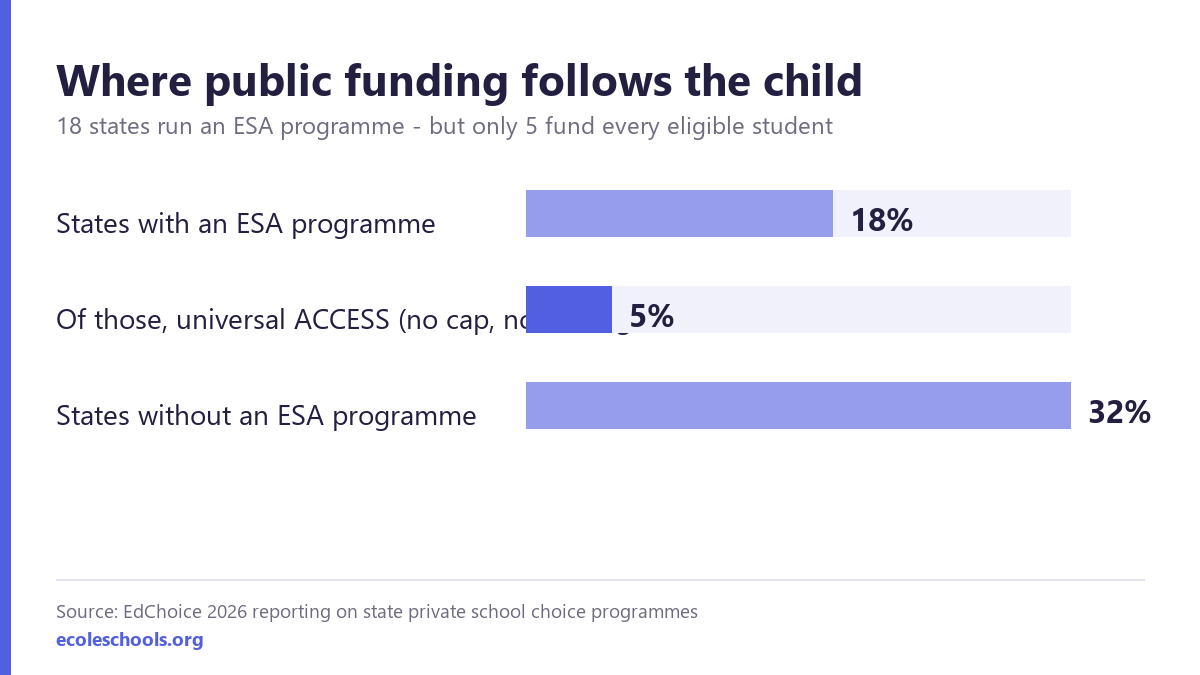
Short answer: New Hampshire is the clearest live example of why universal eligibility is not universal access. Since June 2025 every K–12 student in the state is eligible for an Education Freedom Account — but the programme still runs against an enrolment cap that only rises when the previous year fills it. And there is a trap families miss: you cannot be a registered home educator and an EFA student at the same time.
Working through this for your own school? Ecole Schools supports founders with setup consulting, the Ecole SIS and LMS and mentor training — see what we do or talk to us.
Are microschools legal in New Hampshire?
Yes. New Hampshire has no microschool statute, so a microschool operates as a nonpublic school or as a service to families who are home educating under RSA 193-A or using an Education Freedom Account. As everywhere, the question that decides your obligations is whether you are the child’s school or a service the family buys.
What changed in 2025?
In June 2025 the Governor signed legislation expanding the Education Freedom Account programme to universal eligibility: every K–12 student in New Hampshire now qualifies regardless of household income. Before that the programme was income-limited.
That is a genuine expansion. It is also where the misunderstanding starts.
Eligible does not mean funded: how the cap works
| Mechanism | Detail |
|---|---|
| Enrolment cap, 2025-26 | 10,000 students |
| How it grows | If the previous year’s enrolment exceeds 90% of that year’s cap, the cap rises once by 25% when enrolment opens for the next year |
| Practical effect | 9,000+ students in 2025-26 would lift the cap to 12,500 for the following year |
So the programme is universal in eligibility and capped in access. For a founder that distinction is the whole planning question: a family who qualifies is not a family who is funded. Tell prospective families that plainly — and build your enrolment plan so a capped-out family can still join. The national version of this distinction is on microschool laws by state.
How much is an EFA worth?
| Component | Amount |
|---|---|
| Base grant | About $4,265 per student, tracking the state’s per-pupil allocation |
| Student with a disability | Additional $2,142 |
| Household meeting free and reduced lunch thresholds | Additional $2,346 |
| Commonly quoted average | Around $5,200 |
Two consequences for a microschool. First, the base grant is well below the national tuition band — 74 percent of U.S. microschools charge $10,000 a year or less, so an EFA typically covers part of tuition, not all of it. Second, the differentials mean two children in the same classroom can bring very different amounts; a fee policy that assumes a single award figure will not survive contact with a real cohort. The arithmetic is worked through on our cost guide.
The trap: home education and EFA are not compatible
This is the New Hampshire detail that catches families and schools alike. A student who has previously notified as home educating under RSA 193-A must terminate that home education programme — in line with NHED rule Ed 315.06 and RSA 193-A:5(III) — before enrolling in the EFA programme, as required by RSA 194-F:2, IX.
In other words the two statuses are alternatives, not layers. If your model assumes families keep their home education registration while spending EFA funds with you, that model does not work in New Hampshire. Confirm each family’s status in writing before you count their funding — and be the school that tells them this before they discover it themselves.
What still bites in New Hampshire?
- Cap timing. Enrolment opens against a fixed number; late families may qualify and still be unfunded.
- Status switching. Terminating home education is a formal step with its own rule reference — not a form you can improvise in August.
- Award variability. Base plus differentials means your revenue per child is not a single number.
- Zoning and occupancy are municipal, and child care licensing is a separate matter — neither is affected by the EFA programme.
How do you open a microschool in New Hampshire, step by step?
The steps below are the New Hampshire-specific layer. The national sequence that sits underneath them — legal status, zoning, space, team and insurance — is set out in the national five-step guide, and the funding calendar covers which application windows open when.
- Decide whether you are the school or a service to home-educating and EFA families.
- Check municipal zoning and occupancy before signing anything.
- Map each family’s status — home education under RSA 193-A, EFA, or neither — and get it in writing.
- Register with the programme administrator before enrolment opens, and watch the cap.
- Build a fee policy that survives award variability, including a path for unfunded families.
- Keep records from day one — see the tools guide.
Frequently asked questions
Are microschools legal in New Hampshire?
Yes. New Hampshire has no microschool statute, so a microschool operates as a nonpublic school or as a service to families home educating under RSA 193-A or using an Education Freedom Account.
Is the New Hampshire EFA programme universal?
Eligibility is universal since June 2025 – every K-12 student qualifies regardless of income. Access is not: the programme runs against an enrolment cap of 10,000 for 2025-26, which rises once by 25 percent when the prior year exceeds 90 percent of the cap.
How much is a New Hampshire Education Freedom Account?
About $4,265 as a base grant, with an additional $2,142 for a student with a disability and an additional $2,346 for households meeting free and reduced lunch thresholds. The commonly quoted average is around $5,200.
Can a homeschooled student use an EFA?
Not while remaining a registered home educator. A student who previously notified as home educating under RSA 193-A must terminate that programme, in line with NHED rule Ed 315.06 and RSA 193-A:5(III), before enrolling in the EFA programme under RSA 194-F:2, IX.
Does an EFA cover full microschool tuition?
Usually not. The base grant is below the national tuition band – 74 percent of U.S. microschools charge $10,000 a year or less – so an EFA typically covers part of tuition.
Why do two students in the same class bring different amounts?
Because the award is a base grant plus differentials for disability and for households meeting income thresholds. A fee policy built on one award figure will not match a real cohort.
Sources
- EdChoice — New Hampshire Education Freedom Account programme profile — eligibility, award structure and cap mechanism.
- Children’s Scholarship Fund New Hampshire — programme administration and application detail.
- New Hampshire Department of Education, Education Freedom Accounts pages — the official authority for current amounts, cap status and forms. (The department’s site did not respond to automated requests at the time of writing; open it directly in a browser.)
- Statutory references: RSA 194-F (Education Freedom Accounts), RSA 193-A and NHED rule Ed 315.06 (home education termination).
- Tuition context: National Microschooling Center sector data, quoted on our statistics page.
General information, not legal advice. Cap status, award amounts and programme rules change between years — verify with the New Hampshire Department of Education and the programme administrator before committing.
Start the conversation
If you are planning a New Hampshire microschool, the two decisions that matter most are family status mapping and a fee policy that survives award variability. See our services or contact us.
Compare with other states
Northeast
- New Jersey — no state programme at all - families pay tuition directly
- New York — no state funding, but a defined substantial-equivalency test and the heaviest home-instruction paperwork in the series
South
- Florida — registration without supervision, and the largest ESA in the country
- Texas — a brand-new programme where accreditation decides the funding tier
- West Virginia — the only state that defines microschool in statute
- Arkansas — a universal programme that grew explosively, and an unusually detailed homeschool notice
- Tennessee — the state where your school category decides whether scholarship families can pay you
- North Carolina — a home school is at most two families by statute, so a microschool is a school - and a universal scholarship pays it
- Alabama — church schools are exempt from licensing and certification, private schools are not; the CHOOSE Act pays accredited schools 7,000 dollars and home education 2,000
- Louisiana — GATOR pays tuition only at approved schools, but a registered microschool can be paid as a marketplace provider - with the largest disability award in the series
- Oklahoma — the tax-credit state: cheques go to accredited schools, and the freest homeschooling in the country gets 1,000 dollars
Midwest
- Ohio — the non-chartered school category, with hour and degree rules
- Indiana — the lightest unregistered status in the series, but the universal voucher is paid only to accredited schools
- Iowa — no unaccredited private schools exist - a teaching licence decides what you can be, and the ESA pays only accredited schools
- Missouri — a home school ends at four unrelated children and the first dollar of tuition; the only non-universal programme in the series
West
- Arizona — light regulation plus a universal ESA - the reference case
- Utah — no required subjects or days, and awards that differ by structure
- California — becoming a school is an October affidavit; the only public money arrives through charter vendor channels
- All fifty states — the framework, and how to resolve a state we have not covered in depth