


Last updated: · Ecole Schools
Short answer: most guides hand parents a list of questions and stop there. A list is only half the tool — you also need to know what a normal answer sounds like. Below is the question set, and beside each one the figure from the sector’s own research, so you can tell an ordinary answer from an unusual one. A school in a church basement with no letter grades and 18 students is typical. A school that will not tell you how it operates legally in your state is not.
Working through this for your own school? Ecole Schools supports founders with setup consulting, the Ecole SIS and LMS and mentor training — see what we do or talk to us.
Why base rates matter more than the questions
Microschools are small and varied, and a first visit can leave you unsure whether what you saw was normal. The National Microschooling Center surveyed 800 operating and pre-launch microschools across all fifty states and the District of Columbia in 2025. That gives us numbers to anchor on. Where a figure exists, it is quoted below with its source; where none exists, we say so rather than invent one.
1. How does this school operate legally in our state?
Ask: Are you a private school, or a service to families who are home schooling? Who is legally responsible for my child’s education — you or me?
Why it matters: this single answer determines everything downstream: whether you must file a homeschool notice, who issues a transcript, and whether state scholarship money can even reach the school. Microschool has no legal definition in the United States, so every school sits inside an existing category.
A normal answer is specific and immediate, and names the statute or the state programme. Our fifty-state framework shows what that looks like where you live. Vagueness here is the one red flag that is never acceptable.
2. Who teaches, and what is their background?
Ask: Who will be with my child every day? What is their training, and what happens if they leave mid-year?
Base rate: 54 percent of microschool leaders are licensed educators, and a further 32 percent are professional educators who never held a public-school licence. So roughly six in seven come from education — but a leader without a teaching licence is not unusual, and a licence alone is not the whole answer.
A normal answer describes the person’s actual experience and is comfortable with the follow-up about cover and succession. Ask about background checks directly; in most states these are required of non-public schools, and any school should answer without hesitation.
3. What does it cost, and what does the price actually include?
Base rate: 74 percent of U.S. microschools charge $10,000 a year or less — 26 percent under $5,000 and 48 percent between $5,001 and $10,000. The median reported cost of educating one child is about $6,500, and roughly 65 percent offer discounts or sliding-scale tuition based on family need.
What this tells you: a published price is often not the price a given family pays — it is normal to ask about sliding scale. A fee well above $10,000 is not wrong, but it is outside the sector norm and worth understanding. Details are on our cost guide.
4. Can state funding pay for this, and has this school registered for it?
Ask: Does our state have an education savings account or scholarship, is this school registered to receive it, and when does the application window open?
Why it matters: in many states the money reaches only registered providers, and windows open once a year. A school that has not registered cannot be paid from the programme no matter how good it is. Check the state page for your state and the funding calendar for dates.
5. How many children are enrolled, and what happens if that number drops?
Base rate: the median non-public microschool enrols 22 students (public and charter microschools run larger, median 36). So a school of 15 to 25 is the norm, not an undersized start.
The uncomfortable question, asked plainly: small schools live or die on enrolment, and 75 percent of microschool leaders name funding as their primary need. Asking what happens if enrolment falls is not rude — it is the question a school with a real plan will answer best. Ask what the minimum viable number is, and what the school would do below it.
6. Where does the school physically operate, and is the space approved?
Base rate: 39 percent of microschools operate in commercial or non-profit space, 29 percent in houses of worship and 17 percent in private residences. Nearly half the sector is therefore in buildings not originally built as schools.
So a church hall or a converted house is completely normal. What matters is whether the space has been through the local checks — zoning or occupancy classification, fire safety, and any health requirements. A prepared school will say which inspections it has passed.
7. How will I know my child is learning?
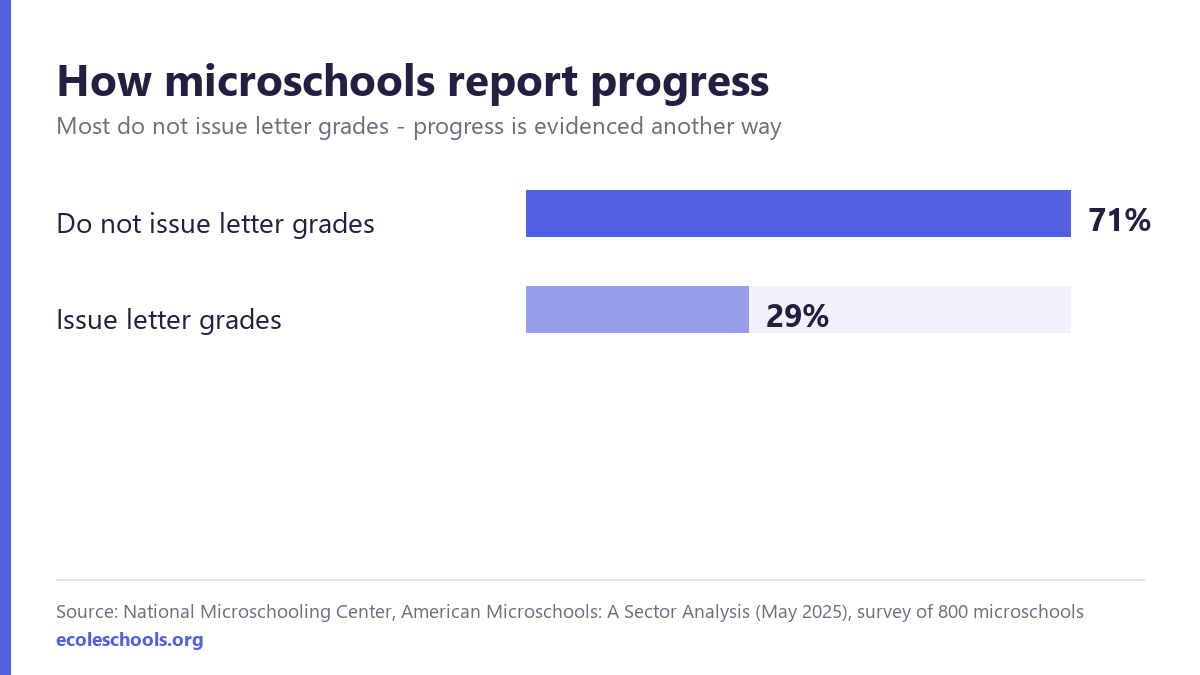
Base rate: only 29 percent of microschools issue letter grades. Most report progress through mastery evidence, portfolios and conferences. Separately, 81 percent report between one and two years of academic gains within a single school year — a self-reported figure, and worth reading as the sector’s own claim rather than an audited result.
So the absence of a report card is not a red flag. The right follow-up is: show me what evidence of progress looks like for a child my child’s age. A school with a real system will show you an actual portfolio or assessment record, not a description of one.
8. Is the school accredited, and does that matter for us?
Base rate: 22 percent report being accredited, while 80 percent say they would be interested in an accreditation pathway designed for microschools.
So most microschools are not accredited, and in most states that is lawful. It matters in two specific situations: some state scholarship programmes require it, and some families need an accredited transcript for a later transfer or for a district diploma. Ask what happens to records if your child moves on.
9. Where do the other families come from?
Base rate: microschool students previously attended district public schools (43 percent), home education (30 percent), public charter schools (9 percent) and private schools (9 percent).
Why ask: a room that is mostly former home schoolers runs differently from one that is mostly former district students — different rhythms, different expectations about structure. Neither is better; you want to know which one your child is joining.
10. What does an ordinary day look like — and a hard day?
Ask: Walk me through a Tuesday. What happens when a child is struggling, or when two children are in conflict? What are the hours, the calendar, meals, and the policy when a child is ill?
Why it matters: this is where a school’s real character shows, and no survey figure can stand in for it. Visit in person and watch the adults with the children before you weigh anything else.
What other families report afterwards
EdChoice survey work reports that 76 percent of microschool parents are very satisfied, 17 percent somewhat satisfied and 5 percent dissatisfied, and that 76 percent say their child’s sense of belonging improved a great deal after the move. That is a positive picture, and it is parent-reported — useful as a signal, not as a guarantee about any one school.
The short red-flag list
- Cannot say how it operates legally in your state, or changes the answer when pressed.
- Will not discuss background checks or who is alone with children.
- No answer at all on what happens if enrolment falls or the lead teacher leaves.
- Cannot show any concrete evidence of how progress is recorded.
- Discourages a visit during an ordinary school day.
Note what is not on that list: no letter grades, no accreditation, a small roll, or a building that was not built as a school. All four are sector norms.
Frequently asked questions
What questions should I ask before enrolling my child in a microschool?
Start with how the school operates legally in your state and who is legally responsible for your child’s education. Then ask who teaches and what background checks are done, what the fee includes and whether sliding-scale support exists, how many children are enrolled and what happens if that number falls, whether the space has passed zoning and fire checks, and how the school evidences progress.
Is it normal for a microschool not to give letter grades?
Yes. Only 29 percent of microschools issue letter grades. Most report progress through mastery evidence, portfolios and conferences, so the absence of a report card is not a warning sign on its own.
Do microschool teachers have to be certified?
Requirements vary by state and by the category the school operates in. Across the sector, 54 percent of microschool leaders are licensed educators and a further 32 percent are professional educators without a public-school licence.
How much does a microschool cost a family?
Seventy-four percent of US microschools charge $10,000 a year or less, with 26 percent under $5,000 and 48 percent between $5,001 and $10,000. About 65 percent offer discounts or sliding-scale tuition, so the published price is often not the price a family pays.
Should I worry that a microschool is not accredited?
Most are not: 22 percent report being accredited. It matters mainly if your state scholarship programme requires accreditation, or if your child will later need an accredited transcript for a transfer or a district diploma.
How many students should a microschool have?
The median non-public microschool enrols 22 students, and public or charter microschools have a median of 36. A roll of roughly 15 to 25 is the sector norm rather than an undersized start.
Moving mid-year?
If you are considering the move part-way through a school year, the questions above still apply — but three extra things decide how smoothly it goes: the records you collect from the current school, how your state classifies the microschool, and whether a funding window is open. We set those out in switching to a microschool mid-year.
Sources
- National Microschooling Center, American Microschools: A Sector Analysis (May 2025, PDF) — survey of 800 operating and pre-launch microschools in all fifty states and D.C.: median enrolment, tuition distribution, leader background, facility types, accreditation, grading practice, funding need.
- National Microschooling Center, American Microschools: A Sector Analysis, 2026 edition (May 2026, PDF) — 1,000 microschools. Where it updates a base rate used above: median nonpublic enrolment 20 (22 in 2025), 28% give letter grades (29%), 67% are not accredited, 38% operate under homeschool law / 34% as registered nonpublic schools / 26% as unregistered nonpublic schools, and about half have at least some families on state school-choice funding. None of these shifts changes what counts as normal when you visit.
- EdChoice, The State of Microschooling (June 2025) — parent satisfaction and belonging figures.
- Full figures, with the caveats about how the sector is counted, are on our microschool statistics page.
General information, not legal advice. Requirements differ by state and change between years — check your state’s rules and ask the school directly.
Start the conversation
If you are weighing a microschool for your child and want a second read on what you were told, contact us. If you are thinking about starting one instead, the five-step founder guide is the other side of this page.