

Last updated: · Ecole Schools
Short answer: the difference is not size or style — it is who is legally responsible for the child’s education, and whether money changes hands for instruction. In a homeschool the parent is responsible. In a learning pod families stay legally responsible and share the teaching. In a microschool a paid guide teaches and families pay tuition, which in most states makes those children private-school students in the eyes of the law. That single shift is what pulls in registration, records, zoning and insurance obligations.
Working through this for your own school? Ecole Schools supports founders with setup consulting, the Ecole SIS and LMS and mentor training — see what we do or talk to us.
Microschool vs homeschool vs learning pod vs co-op vs private school
| Model | Who is legally responsible | Who teaches | Tuition? | Usual legal treatment |
|---|---|---|---|---|
| Homeschool | The parent | The parent (may buy curriculum or hire tutors) | No | State homeschool law: notice of intent, sometimes assessment |
| Learning pod | Each family, separately | Parents rotate, or families jointly hire a guide | Cost-sharing rather than tuition | Usually treated as supplemental to each child’s homeschool registration — a legal grey area in most states |
| Homeschool co-op | Each family, separately | Parents teach each other’s children | Fees for materials, rarely salaries | Same as pods: families remain homeschoolers |
| Microschool | The school | A paid guide or mentor | Yes | Usually private school — or a homeschool-umbrella arrangement where state law allows |
| Private school | The school | Employed teachers | Yes | State private-school law: registration or licensing, facility and staffing rules |
A note on spelling. You will see this written both ways. Families, journalists and a good deal of search traffic use micro school as two words; the sector’s research bodies write microschool as one. They mean the same thing, and nothing in the legal picture below changes with the spelling — what changes it is who is responsible for the child and whether money moves.
Why does charging tuition change the legal picture?
Because compulsory-attendance law asks a single question: under which lawful arrangement is this child being educated? While a parent directs the education and no one is employed to teach, the child remains a homeschooler and the family’s own registration covers them. As soon as a school enrols children, employs an instructor and charges for it, the arrangement starts to look like a school — and in most states that means the children are private-school students, with whatever registration, record-keeping and facility rules that state applies to private schools.
The practical consequences arrive together: building occupancy classification, fire inspection, background checks, liability and abuse/molestation insurance, and in some states minimum instructional days or hours. Our microschool legal requirements guide works through each of them, and the cost page shows what they do to a budget.
Do any states actually define these terms in law?
A few do, and West Virginia is the clearest example. West Virginia Code §18-8-1 exempts a child from compulsory attendance when the child participates in a learning pod or a microschool, and defines both:
- Learning pod — a voluntary association of parents grouping their children together for elementary or secondary study as an alternative to public school, private school, homeschool or microschool, including activities or services provided in exchange for payment.
- Microschool — a school initiated by one or more teachers, or by an entity created to operate a school, that charges tuition for enrolled students and is an alternative to public school, private school, homeschool or a learning pod.
The statute also requires the parent to file a notice of intent with the county superintendent, naming each participating child of compulsory school age, assuring instruction in reading, language, mathematics, science and social studies, and providing for annual assessment.
Two lessons travel beyond West Virginia. First, the drafters used tuition as the dividing line between a pod and a microschool — the same instinct that operates informally in states with no definition. Second, most states have not written these definitions, so the same programme can be a private school in one state and a homeschool support service in the next. Never assume a neighbouring state’s answer.
West Virginia writes this distinction into law, including a certification requirement that applies to microschool instructors but not to pod instructors — see the West Virginia guide.
Which model do families actually move between?
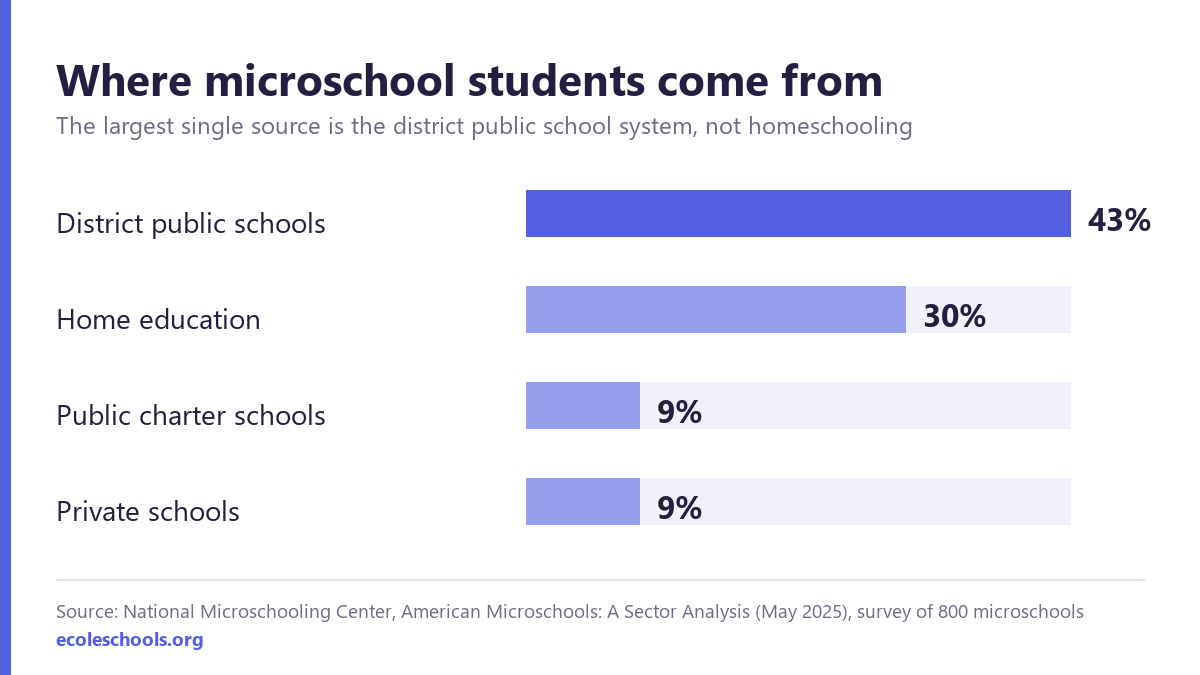
Sector data shows microschools drawing from every direction, not just from homeschooling: 43 percent of microschool students come from district public schools, 30 percent from home education, 9 percent from public charter schools and 9 percent from private schools. Microschooling is a destination for families leaving conventional school at least as much as it is a step up from homeschooling. The full data set is on our microschool statistics page.
Which one fits a family?
| If you want… | The usual fit |
|---|---|
| Full control over curriculum and calendar, one child at a time | Homeschool |
| Company for your children and shared teaching, while you keep legal responsibility | Learning pod or co-op |
| A professional running the day, small mixed-age groups, a real school year | Microschool |
| Accreditation, transcripts, athletics and a large institution | Private school |
Which one fits a founder?
If you intend to be paid for teaching, you are building a microschool, whatever you call it in your marketing. The question then is only which legal container the state gives you: a registered private school, or a homeschool-umbrella model where families stay responsible and you provide instruction as a service. That choice drives funding eligibility too — in Texas accreditation separates the funding tiers, and in Florida registration separates them. The step-by-step guide starts exactly here.
Is a microschool better than homeschooling?
They answer different problems. Homeschooling gives maximum flexibility and costs the least in money and the most in parent time. A microschool buys back the parent’s time and adds a peer group and a trained guide, at a price — 74 percent of microschools charge $10,000 a year or less. Neither is inherently stronger academically; what matters is whether the child gets a coherent programme, a competent adult and evidence of progress. That last one is where informal arrangements most often fall short, which is why record keeping appears in every section of this site.
What is an umbrella school, and where does it fit?
An umbrella school (sometimes a cover school) is an organisation that enrols homeschooled students on paper so that the family’s compliance runs through it: it holds records, may issue transcripts, and reports as required by state law. A microschool can operate under one, which keeps the children legally homeschoolers while the microschool provides the teaching. Where this is permitted it is the fastest route to open — and the trade-off is that the funding programmes reserved for private schools may not be available.
Frequently asked questions
What is the difference between a microschool and homeschooling?
In homeschooling the parent is legally and educationally responsible for the child’s education. A microschool employs a paid guide and charges tuition, which in most states makes the enrolled children private-school students rather than homeschoolers.
What is the difference between a learning pod and a microschool?
In a learning pod each family remains legally responsible for its own child’s education and the pod is treated as supplemental. A microschool enrols students and charges tuition. West Virginia’s statute uses exactly that distinction, and also requires microschool instructors to hold teaching certification while pod instructors need not.
Is a microschool a private school?
In most states, yes — or it operates under a homeschool umbrella where state law allows. Very few states have a separate microschool category; West Virginia is one of the exceptions.
Can homeschoolers attend a microschool part time?
Often yes. Part-time or hybrid attendance is common, and in that arrangement families usually keep their homeschool registration while paying the microschool for instruction or services. Rules vary by state, and funding programmes may treat part-time students differently.
What is an umbrella school?
An organisation that enrols homeschooled students for compliance purposes, holds their records and reports to the state as required. A microschool can operate under one so that its students remain legally homeschoolers.
Is a microschool cheaper than private school?
Usually. Seventy-four percent of microschools charge $10,000 a year or less, and about 65 percent offer sliding-scale tuition or discounts.
Do microschool students come mostly from homeschooling?
No. Sector survey data puts 43 percent coming from district public schools, 30 percent from home education, 9 percent from charter schools and 9 percent from private schools.
What are the drawbacks of learning pods?
They follow directly from the pod’s legal position rather than from its teaching quality. Because each family stays legally responsible for its own child’s education and the pod counts as supplemental, the compliance burden is not shared — every family files, records and assesses separately, and the pod cannot discharge that duty for them. There is also no external quality floor: West Virginia, one of the few states to define these terms in statute, requires a microschool instructor to hold teaching certification but sets no such requirement for a pod instructor. And funding is the sharpest limit — state education savings account programmes generally pay a registered or accredited provider, so a pod that is not one usually has nothing to bill against, which is why families seeking portable public money tend to move toward microschools. The trade is real in both directions: a pod is faster to start and lighter to run precisely because it carries none of that structure.
Once you have chosen the model, the next job is judging a specific school. Our parent question set covers what to ask on the visit.
Sources
- West Virginia Code §18-8-1 — statutory definitions of “learning pod” and “microschool,” compulsory-attendance exemption, notice of intent and assessment requirement.
- National Microschooling Center, American Microschools: A Sector Analysis (May 2025) — student origin and tuition figures.
- EdChoice, The State of Microschooling (June 2025).
- State Policy Network, Protecting learning pods: a 50-state guide to regulations — on how differently states treat pod arrangements.
General information, not legal advice. Definitions and obligations vary by state and change; verify with your state department of education before deciding which model to operate.
Start the conversation
If you are deciding between these models, the fastest way to an answer is a conversation about your state and your intent. Read the step-by-step guide, see our services, or contact us.