


- 14 Aug, 2026
- 0 Comments
- 5 Mins Read

Microschool Tour: What to Look For (and What Is Normal)
Short answer: on a microschool visit, most of what surprises a parent is normal for the sector — and the things that should actually worry you are rarely about the building. A school of twenty children in a converted office looks nothing like the school you attended, and that difference is not evidence of anything. This guide separates the two: what is ordinary (with the sector figure beside it, so you can judge for yourself) and what is genuinely a warning sign.
Watch the children, not the premises
The single most useful thing you can do on a tour is stop looking at the room and start looking at the learners. Are they working on something they can explain to you? Does an adult get down to a child’s level when they need help? When a child is stuck, does anything happen? Small settings make this observable in a way a fifty-child classroom does not — which is the point of visiting at all.
Ask to see work in progress rather than display work. In a school that does not issue letter grades — and only about 29% of microschools do (National Microschooling Center, May 2025) — the portfolio, the narrative report and the mastery checklist are the assessment system, so ask to see a real example with a name removed.
Which microschool surprises are actually sector norms?
Short answer: Tiny groups, a building that was never a school, no accreditation certificate and a leader who also teaches are sector norms, not warning signs.
| What you notice on the tour | Sector norm | What it actually means |
|---|---|---|
| The group is tiny | The median microschool serves about 22 students in total, against about 20 students in the average US public-school class | A room with nine children in it is not a failing school; it is the model. |
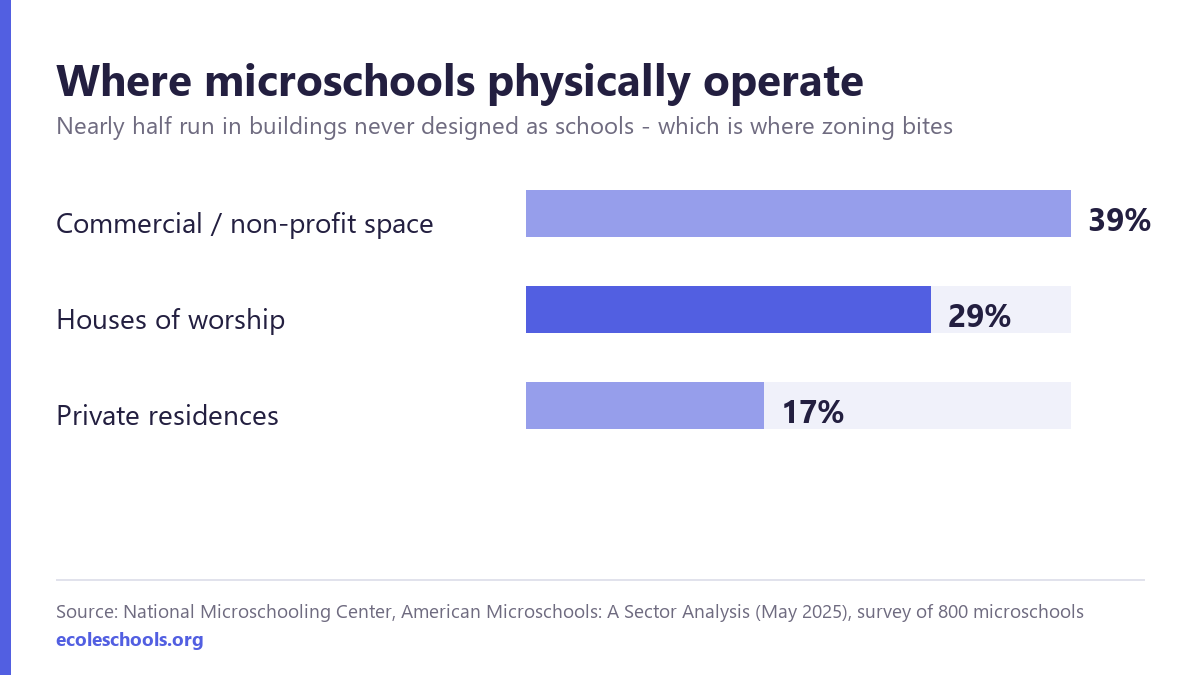
| The building was not built as a school | Roughly 39% operate in commercial space, 29% in a place of worship and 17% in a home | A converted suite with good light and a fire exit is the sector norm, not a compromise. |
| There is no accreditation certificate on the wall | About 22% of microschools are accredited, though around 80% of leaders say they would seek it if the route were practical | Its absence tells you about the accreditation system, not about the teaching. |
| The person showing you round also teaches | About 54% of leaders are licensed educators and another 32% are professionals from other fields | In a school this size the founder is usually in the room every day — that is a feature, though it makes the next question more important. |
The five answers worth pressing on
None of these are hostile questions. A confident school answers them in a sentence each.
- “How do you operate legally in this state?” There is a right answer everywhere — registered private school, an approved education service provider, or a group of home-educated learners. A school that cannot name its own category is the one genuinely unresolved red flag. Our state-by-state guide tells you which answers exist where you live.
- “Who else is in the building when you are teaching?” One adult and a locked door is a different proposition from two adults; there is no universal rule, but you want the answer to be deliberate rather than improvised.
- “What happens in the first two weeks to work out where my child actually is?” Listen for a method, not a reassurance.
- “What do you send a future school if we move?” This is the question most families forget and most regret forgetting. Records, portfolios and any assessment results are what a receiving school reads — we cover the mechanics in switching schools mid-year.
- “What happens to the fees if this does not work out?” Ask before you like the place, not after. Tuition is usually well below local private schools — 74% of microschools charge $10,000 a year or less, median near $6,500 — but the refund policy is where the surprises live.
Signs that should genuinely slow you down
Evasiveness about legal status. No background-check policy for adults who are alone with children. Pricing that changes during the conversation. A tour where you are steered away from rooms, or hurried. Promises of guaranteed academic outcomes — no school of any size can honestly offer that. And unexplained staff turnover in a school with two or three adults, where one departure changes everything.
If your instinct says something is off, the useful next step is not another tour — it is asking for two current families to speak to, without the school in the room.
Before you go, and after
Take our question set with base rates to the visit so you can tell an unusual answer from an ordinary one, and read what a microschool costs so the fee conversation is not the first time you have thought about the number. If you are weighing this against homeschooling or a co-op, the comparison guide sets out the legal and practical differences.
Frequently asked questions
How long should a microschool visit take?
Long enough to see a transition — the move from one activity to the next is where a school’s real culture shows. A tour that only covers the rooms while children are elsewhere tells you very little.
Should my child come on the microschool tour?
Bring them for at least part of it if you can. In a group of about twenty, how the existing children respond to a newcomer is meaningful information, and it is hard to gather any other way.
Is it a bad sign if a microschool is not accredited?
On its own, no. Around 22% of microschools are accredited and roughly 80% of leaders say they would pursue it if the route were practical. What matters more is whether the school can explain how it operates legally in your state.
What if the microschool does not give letter grades?
That is the majority position — only about 29% use letter grades. Ask instead what a future school or scholarship programme would receive: narratives, portfolios, mastery checklists or standardised results.
Sources
- National Microschooling Center — American Microschools: A Sector Analysis (May 2025) — median enrolment, premises distribution, accreditation and grading rates, leader backgrounds and tuition figures quoted above.
- EdChoice — The State of Microschooling — family-side context on satisfaction and belonging.
- NCES — National Teacher and Principal Survey, average public school class size (2020–21) — comparison class-size figure quoted above (19.1–22.0 depending on school level and class type).