


Last updated: · Ecole Schools
Short answer: two different questions hide inside “how much does a microschool cost.” For a family, 74 percent of U.S. microschools charge $10,000 a year or less, and the median cost of educating one child is about $6,500. For a founder, practitioner guides put a first full year of operations in the region of $85,000–$100,000 for a small school in rented space, while a home- or church-based start can open for a fraction of that. This page separates the two and shows which decisions actually move the number.
Working through this for your own school? Ecole Schools supports founders with setup consulting, the Ecole SIS and LMS and mentor training — see what we do or talk to us.
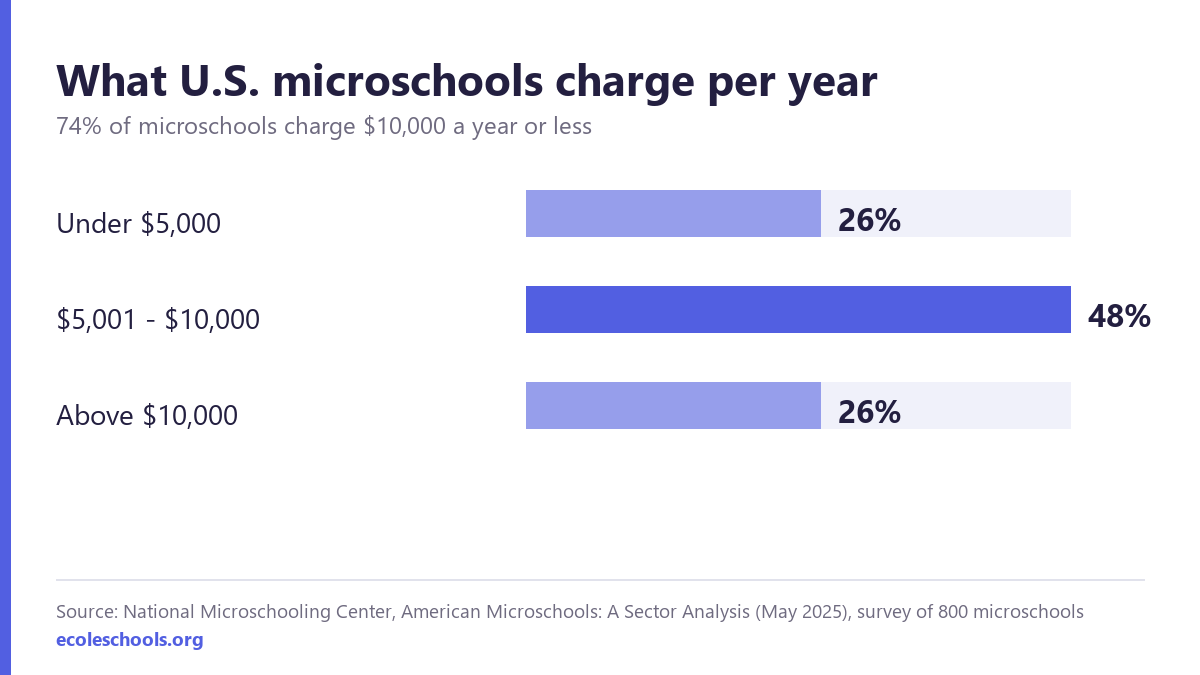
What does a microschool cost a family?
| Annual tuition and fees | Share of microschools |
|---|---|
| Under $5,000 | 26% |
| $5,001 – $10,000 | 48% |
| Above $10,000 | 26% |
Roughly 65 percent of microschools offer discounts or sliding-scale tuition based on family need, so the published price is often not the price a given family pays. These figures come from the National Microschooling Center’s 2025 sector survey of 800 schools; the fuller data set is on our microschool statistics page.
Why is microschool tuition lower than private school tuition?
Because the cost base is different, not because the education is thinner. A microschool typically has no administrative layer, no athletics plant, no transport fleet and no purpose-built campus — 29 percent operate in houses of worship and 17 percent in private residences. Staffing is the dominant cost, and a mixed-age group of about 22 learners needs far fewer adults than four separate grade-level classrooms.
What does it cost to start a microschool?
There is no sector-wide audited figure for start-up cost, so treat every number in this section as a practitioner estimate rather than research. Published operator guides converge on the following ranges for a school in rented space:
| Cost line | Typical range (practitioner estimates) | Notes |
|---|---|---|
| Lead teacher / guide compensation | ~$50,000 per year including about 15% benefits | The single largest line in almost every budget |
| Space (about 1,500 sq ft storefront) | $22,500 – $30,000 per year | Church or community space can cut this by 70–100% |
| Insurance, utilities, furniture, incidentals | $1,000 – $1,500 per month | General liability and abuse/molestation cover are non-optional |
| Curriculum, software, assessment | Per-student licensing | See the tools guide for what the stack has to include |
| First full year, rented space | ~$85,000 – $100,000 | Conservative assumptions, one lead teacher |
| Lean start (home, co-op or shared space) | ~$10,000 – $25,000 | Founder teaches; space cost near zero |
Does the maths actually work?
Take the sector’s own medians rather than optimistic ones: 22 students at a $8,000 tuition point is $176,000 of gross revenue; at the $5,000 point it is $110,000. Against an $85,000–$100,000 operating base, the model closes — but only if enrolment fills. At 10 students it does not, which is why enrolment, not curriculum, is the number that decides a first year.
Three consequences follow, and they are the reason most founders under-plan:
- Enrolment is the binding constraint. The gap between 10 and 20 learners is the gap between a hobby and a salary.
- Space is the second lever. A church or community lease can remove the second-largest cost line entirely in year one.
- Discounting is structural, not exceptional. Two-thirds of schools discount, so a budget built on list price is already wrong.
Which decisions move the cost most?
| Decision | Cost impact | Where it is covered |
|---|---|---|
| Legal status (homeschool umbrella vs private school) | Licensing, inspection and insurance obligations follow from it | Legal requirements |
| Building type and zoning | Occupancy classification can trigger construction costs far above rent | Legal requirements |
| Whether the founder teaches | Removes or adds the largest single line | Teacher-to-founder roadmap |
| State funding programme | An ESA can replace family tuition entirely for eligible students | Texas ESA guide |
| Accreditation path | Optional in most states, but decisive for higher ESA funding tiers | Texas ESA guide |
How do education savings accounts change the numbers?
In states with an ESA or voucher-style programme, part or all of tuition can be paid from a state-funded account rather than by the family. Texas is the clearest current example: participating families are expected to receive roughly $10,500 per private-school student, up to $30,000 for a student with a disability and up to $2,000 for a homeschooled student — which is more than the annual tuition of three-quarters of the microschools in the country. That is why 75 percent of microschool leaders name funding as their primary need: the programmes, not the price list, decide who can afford to attend.
What does Ecole Schools change about this?
Most of the start-up cost of a school is not teaching — it is everything around teaching: policies, records, curriculum selection, enrolment systems, marketing, mentor training. Ecole Schools provides those as a network so a founder is not buying, building and maintaining each one alone. The Ecole SIS and LMS replace a stack of separate subscriptions, and setup consulting covers the legal, space and enrolment decisions above before they turn into sunk cost.
Frequently asked questions
How much does it cost to start a microschool?
Practitioner guides put a first full year in rented space at roughly $85,000 to $100,000, with lead-teacher pay the largest line. A home-, church- or co-op-based start where the founder teaches can open for roughly $10,000 to $25,000. There is no audited sector-wide figure, so these are estimates from operators rather than research.
How much is microschool tuition per year?
Seventy-four percent of U.S. microschools charge $10,000 a year or less: 26 percent under $5,000 and 48 percent between $5,001 and $10,000. About 65 percent offer discounts or sliding-scale pricing.
How many students does a microschool need to break even?
It depends on tuition and space cost, but the arithmetic is simple: an $85,000–$100,000 operating base needs roughly 11 to 13 students at $8,000, or about 20 at $5,000. The sector’s median non-public microschool enrols 22.
Can an ESA pay for microschool tuition?
In states with an ESA programme, yes, subject to that programme’s rules on provider status. In Texas, accredited private schools receive tuition directly, while non-accredited microschools can register as vendors or service providers.
What is the cheapest way to start a microschool?
Use space you already have or can borrow, teach the first cohort yourself, keep the legal structure as simple as your state allows, and buy an integrated system rather than assembling separate subscriptions.
Is a microschool cheaper than private school?
Usually, yes. Most microschools charge under $10,000 per year, which is below typical private-school tuition in much of the United States, mainly because there is no administrative layer, campus plant or transport fleet to fund.
Comparing schools as a family? The fee is only one of the questions worth asking — what to ask a microschool before enrolling sets out the rest, with the sector norm beside each one.
Sources
- National Microschooling Center, American Microschools: A Sector Analysis (May 2025) — tuition distribution, cost per child, median enrolment, facility types, funding need. Survey of 800 schools in all fifty states and D.C.
- EdChoice, The State of Microschooling (June 2025).
- Operator budgeting guides used for the start-up ranges, marked as practitioner estimates: The Schoolhouse and PaFEC.
Cost figures vary widely by state and city. Treat the ranges here as a planning frame, not a quotation, and build a local budget before committing to a lease.
Start the conversation
If you are costing out a microschool, the fastest way to a realistic number is a conversation about your state, your space and your enrolment plan. Read the step-by-step guide, see our services, or contact us.