


Last updated: · Ecole Schools
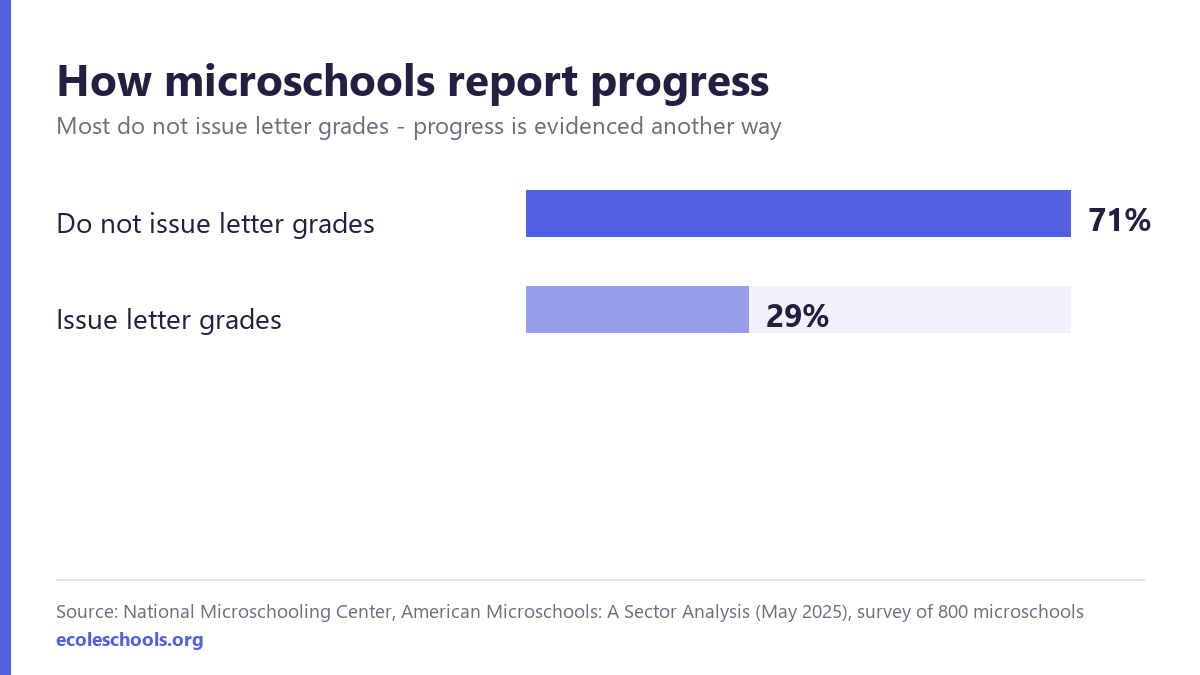
Short answer: a microschool needs five systems — a student information system, a learning platform, curriculum, enrolment and billing, and an assessment record. The last one decides the others: only 29 percent of microschools issue letter grades, so progress evidence has to be documented well enough to satisfy parents, accreditors and funding programmes.
Working through this for your own school? Ecole Schools supports founders with setup consulting, the Ecole SIS and LMS and mentor training — see what we do or talk to us.
Every microschool runs on the same tool categories: a student information system (SIS) for records and enrollment, a learning management system (LMS) for lessons and assignments, curriculum content, family communication, billing, and assessment. Founders can assemble these from separate commercial products — or use an integrated stack where the pieces already work together. This guide explains what each layer does and how to decide.
What tools does a microschool actually need?
- Student Information System (SIS): enrollment, attendance, student records, reporting.
- Learning Management System (LMS): lessons, assignments, progress, portfolios.
- Curriculum and content: standards-aligned materials your mentors can teach from.
- Communication and enrollment: family messaging, application forms, billing.
- Assessment and reporting: progress evidence for families — and for programs (like ESAs) that require testing.
What does an SIS do for a school this small?
Even at 20 students, someone must track enrollment, attendance, and records accurately — especially where private school status brings reporting expectations. A purpose-built SIS replaces the spreadsheet sprawl that eats founder evenings. The Ecole SIS is included in the network stack, so founders do not shop for one separately.
Scale is the reason most mainstream SIS platforms feel wrong here: the median American microschool serves about 22 students (National Microschooling Center, May 2025 survey of roughly 800 schools). A system priced and designed for a 600-student campus buries a two-person team in modules they will never open. The practical test for any SIS candidate is whether one founder can run enrollment, attendance and records in under an hour a week at that size.
What should the LMS handle?
In a self-directed model the LMS is the daily workspace: students plan sessions, work through structured content, submit what they create, and build portfolios. The Ecole LMS is built around exactly that plan → create → present → portfolio chain, with Ecole AI acting as a learning coach inside each session — guidance and feedback at scale without replacing the mentor.
Where does curriculum come from?
Options range from assembling open resources to licensing commercial curricula subject by subject. The network approach ships standards-aligned learning content with the platform, so a new school opens with a coherent program instead of a patchwork — and mentors are trained on it as part of mentor and teacher training.
Piecing tools together vs an integrated network
| Factor | Separate tools | Integrated network (Ecole) |
|---|---|---|
| Setup effort | Research, trials, and integration for each layer | One stack, pre-integrated |
| Data flow | Manual exports between systems | SIS, LMS, and AI share one student record |
| Cost structure | Multiple subscriptions, varies | Part of network membership |
| Support | Per-vendor | One partner, with training included |
| Flexibility | Maximum tool choice | Model-aligned, opinionated |
Neither path is “best” for everyone: founders who want maximum tool choice assemble their own stack; founders who want to open sooner with less operational risk pick an integrated one.
What about communication, enrollment, and billing?
Three small-but-daily layers decide how professional a school feels to families:
- Family communication: announcements, progress updates, and session summaries in one channel — not scattered across text threads.
- Enrollment: application forms, document collection, and status tracking; this is SIS territory, and it is where spreadsheets fail first as the school grows.
- Billing: tuition schedules, invoicing, and — where ESA programs operate — compatibility with approved payment channels (see how Texas routes ESA funds through certified organizations).
How does assessment connect to funding programs?
Assessment is not just pedagogy — it is increasingly a compliance layer. ESA programs commonly require norm-referenced testing for funded students, and accreditation reviews ask for progress evidence. A stack that captures portfolio work and assessment results as a byproduct of daily learning — rather than a year-end scramble — keeps both families and programs satisfied.
Funding readiness is not a side quest: about 75% of microschool leaders name sustainable funding as a primary need (NMC, May 2025). Tool choices decide whether ESA and scholarship paperwork is an export button or a weekend of copy-paste — see our state funding calendar for the deadlines that paperwork has to meet.
What does Ecole AI add to the stack?
Ecole AI works inside the LMS as a learning coach: it helps students start, continue, and complete structured sessions, and gives mentors visibility into where each student needs attention. For a founder, that means one mentor can genuinely run personalized learning for a small cohort — the promise most microschools make and the hardest one to keep with disconnected tools.
What has to be recorded when a school doesn’t give grades?
Only 29 percent of microschools issue letter grades (National Microschooling Center, 2025 sector survey); the rest run on mastery evidence. That evidence still has to exist in a form other people accept: attendance registers, dated work samples, portfolio entries with mentor comments, conference notes, and norm-referenced test results where a funding programme asks for them. A school that keeps this in shared drives and message threads can usually not reconstruct one student’s year on request — which is exactly what an accreditation review, a custody dispute or an ESA audit asks for.
The Ecole SIS and LMS are built around that record: every plan → create → present → portfolio cycle leaves a dated artefact attached to the student, so a year of mastery-based learning can be exported as a coherent file rather than assembled from memory. See how the same records support funding programmes in the Texas ESA guide and the legal requirements guide.
Sector data source: National Microschooling Center, American Microschools: A Sector Analysis (May 2025), Don Soifer & Ashley Soifer — survey of 800 operating and pre-launch microschools in all fifty states and the District of Columbia.
One sector base rate puts this whole section in context: only about 29% of microschools report progress with letter grades (NMC, May 2025). The rest rely on narratives, portfolios, mastery checklists and standardized measures — which is exactly why record-keeping tooling matters more, not less, in a school without a gradebook: the evidence of learning has to live somewhere that a family, a district or a scholarship program can read.
Frequently asked questions
What software does a microschool need on day one?
At minimum: enrollment and records (SIS), a learning workspace (LMS), curriculum, and family communication. Billing and assessment follow quickly.
Can I run a microschool on free tools?
You can start that way, but record-keeping, reporting, and portfolio needs usually outgrow free tools within the first year — plan the migration cost into the decision.
What is different about the Ecole stack?
SIS, LMS, curriculum, and Ecole AI are one integrated system designed for the Ecole learning model, and they come with mentor training rather than as bare software.
Do I need all of this before opening?
You need enrollment records, a learning workspace, and curriculum on day one. Billing automation and richer assessment can phase in during the first term — but plan the data migration if you start on temporary tools.
How long does the Ecole stack take to set up?
Setup happens during the founding process alongside mentor training — the school opens with SIS, LMS, content, and Ecole AI already connected, rather than assembling them after launch.
Sources
- National Microschooling Center — American Microschools: A Sector Analysis (May 2025) — median school size, progress-reporting methods and founder-need base rates used on this page.
- EdChoice — The State of Microschooling — sector context for how families find and fund microschools.
Start the conversation
Ecole Schools helps founders, educators, and families start and run microschools with consulting, the Ecole SIS and LMS, mentor training, and marketing support. See our services or contact us to talk about your plans.