


Last updated: · Ecole Schools
Short answer: teachers are the mainstream founders of microschools — 54 percent of microschool leaders are licensed educators. The transition turns on three things: reaching a viable enrolment, replacing salary and benefits, and learning the business side of running a school. A realistic path from decision to opening day runs about twelve months.
Working through this for your own school? Ecole Schools supports founders with setup consulting, the Ecole SIS and LMS and mentor training — see what we do or talk to us.
More teachers are leaving traditional classrooms to found microschools — small, multi-family learning environments they design and lead themselves. The appeal is real: educational freedom, direct relationships with families, and ownership of the results. The risks are real too: salary continuity and health insurance are the two pressures that end most transitions early. This page lays out a realistic path from classroom to founder, including what the first year usually looks like and where support networks change the math.
Why are teachers leaving the classroom to start microschools?
The most common reasons founders cite are autonomy over curriculum and schedule, small groups where personalized learning is actually possible, and the chance to build something owned rather than assigned. A microschool lets an experienced educator apply everything they know about how children learn — without the constraints that pushed many of them out of the system.
How much can a microschool founder earn?
Honest answer: it varies widely, and no one should promise you a number. One documented case: educator Apryl Shackelford went from about $34,000 in a public school role to about $101,000 leading a microschool, as reported by Fortune. That is one person’s outcome, not a typical result. What is typical, according to educator-entrepreneur communities, is that many founders take little or no salary in year one and reinvest revenue in the school.
What are the two biggest risks in the transition?
- Salary continuity: revenue follows enrollment, and enrollment takes time. Plan personal finances for a lean first year.
- Health insurance: leaving district employment usually means leaving group coverage; price marketplace options before you resign, not after.
This page is general information, not financial advice. Income examples are individual cases, not typical results.
What funding exists for new founders?
Startup philanthropy for educator-founders is real. VELA microgrants are a widely used first step for new founders, and where state programs like the Texas Education Freedom Accounts exist, per-student funding changes the enrollment math from day one. Legal setup costs are covered in our legal requirements guide.
What does a founder actually do all day?
Less lecturing, more leading. In the Ecole model the founder-mentor guides students through planned, self-directed learning sessions — plan, learn, create, present — while running the school’s operations: family relationships, enrollment, compliance, and finances. Because lead mentors hold a stake in the school they help build, turnover stays low and families know who is accountable. See how a school gets started, step by step.
How does Ecole Schools support the transition?
The hardest parts of founding — legal setup, systems, curriculum, and marketing — are exactly what the network provides: school setup consulting, the Ecole SIS and LMS, standards-aligned learning content, mentor training, and marketing support. You bring the teaching; the infrastructure comes with the network.
Should you start as a mentor first?
For many teachers, the lowest-risk path is to work as a mentor inside the model before founding. You learn the system with support, then decide whether to open your own school. Selection follows our published founder, mentor and teacher selection policy — when you are ready, apply as a mentor.
What does a realistic first-year timeline look like?
- Months 1-3 (still employed): choose your legal status and entity, start the zoning search, open conversations with 10-15 interested families.
- Months 4-6: secure the space, complete registrations, set tuition, begin enrollment. Apply for startup funding (VELA and similar microgrants).
- Months 7-9: mentor training, curriculum setup, systems onboarding — in the Ecole network this is when the SIS, LMS, and Ecole AI go live for your school.
- Months 10-12: open with a manageable cohort, run the model, gather family feedback, and plan year-two growth.
Founders who compress this into a summer usually pay for it in the fall; the ones who plan while employed keep their income until enrollment justifies the leap.
Which teaching skills transfer directly — and which gaps surprise founders?
Transfers directly: instructional design, assessment judgment, classroom culture, and parent communication — the core of the job.
Common gaps: pricing and cash-flow planning, enrollment marketing, facilities and compliance, and record systems. These are exactly the layers the Ecole network provides — consulting, SIS/LMS, mentor training, and marketing support — so the founder’s time stays on teaching and families.
Who actually runs a microschool today?
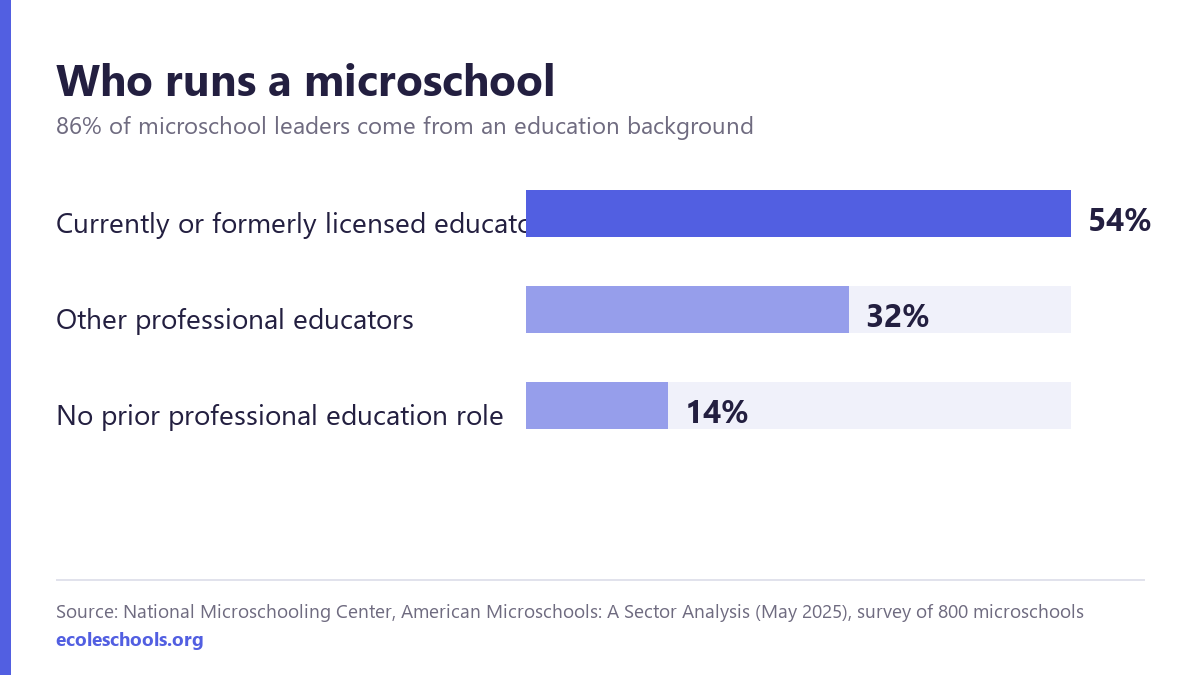
Founders with a classroom background are the majority, not the exception. In the National Microschooling Center’s 2025 sector survey, 35 percent of microschool leaders were currently licensed teachers or administrators, 19 percent were formerly licensed, and a further 32 percent had professional educator experience without ever holding a public-school licence — around 86 percent with an education background, up from 71 percent a year earlier. The sector is being built by teachers who left the classroom, so the transition you are considering is the mainstream path into microschooling, not an outlier bet.
Two numbers from the same survey set expectations for the business you are stepping into: median enrolment in a non-public microschool is 22 students, and 74 percent of schools charge $10,000 or less per year. Multiply those and you get the revenue envelope most founders actually operate inside — which is why the ESA-funded states and shared back-office support change the maths so much.
Sector data source: National Microschooling Center, American Microschools: A Sector Analysis (May 2025), Don Soifer & Ashley Soifer — survey of 800 operating and pre-launch microschools in all fifty states and the District of Columbia.
The sector data backs this up: about 54% of microschool leaders are licensed educators and another 32% are unlicensed professionals with other relevant backgrounds (National Microschooling Center, May 2025 survey of roughly 800 schools). If you are a certified teacher weighing this move, you would be joining the single largest group of founders — teaching experience is the modal path into microschool leadership, not an unusual one.
Frequently asked questions
Do I need a teaching certificate to found a microschool?
In most states, no certification is required for private or home-based instruction — but check your state in our legal guide.
How many students does a viable microschool need?
Small groups are the point: the Ecole model plans elementary rooms around a 1:12 mentor-to-student ratio, and viability depends on your cost base and local pricing rather than a universal number.
Can I keep teaching while I prepare?
Yes — many founders plan for a year while employed: legal setup, space search, and family outreach can run before you resign.
How many families do I need to commit before resigning?
There is no universal number — the honest test is whether committed enrollment covers your school’s fixed costs plus the minimum income you need. Build that arithmetic before setting a resignation date.
Can I found a microschool while still teaching full-time?
The planning phase, yes — status, entity, zoning, and family outreach fit alongside a job. Running the school does not; plan the handoff for a natural break like summer.
What if it doesn’t work?
Design the downside before you start: a lease with an exit clause, a lean first-year budget, and teaching credentials kept current mean an orderly return path rather than a cliff.
Sources
- National Microschooling Center — American Microschools: A Sector Analysis (May 2025) — founder background, school size and funding-need base rates referenced on this page.
- VELA Education Fund — microgrants for founders referenced in the funding section.
Start the conversation
Ecole Schools helps founders, educators, and families start and run microschools with consulting, the Ecole SIS and LMS, mentor training, and marketing support. See our services or contact us to talk about your plans.