


- 23 Jan, 2025
- 0 Comments
- 3 Mins Read

The Future of Education: How Ecole Schools is Redefining Learning
Education is no longer confined to traditional classrooms with rigid curricula and one-size-fits-all teaching methods. In a rapidly changing world, education must evolve to meet the needs of modern learners. At Ecole Schools, we are at the forefront of this transformation, pioneering an innovative, student-centric approach that prepares learners for real-world success.
Why Education Needs a New Approach?
Short answer: because memorisation and standardised testing do not build the four skills the article goes on to describe — critical thinking, creativity, adaptability and technological fluency.
Traditional education systems have long relied on memorization and standardized testing, but these methods often fail to equip students with the skills they truly need. Today’s world demands critical thinking, creativity, adaptability, and technological fluency—qualities that cannot be nurtured by outdated teaching strategies.
What Makes Ecole Schools Different?
Short answer: four things — personalised learning paths, technology-integrated classrooms, real-world application instead of rote learning, and a global, multilingual perspective.
Ecole Schools is not just another educational institution; it is a vision for the future of learning. Here’s how we stand apart:
1️⃣ Personalized Learning Paths
Every student is unique, and so is their learning journey. At Ecole Schools, we embrace adaptive learning methodologies that allow students to progress at their own pace. Personalized curricula ensure that learners grasp concepts deeply instead of simply memorizing facts.
2️⃣ Technology-Integrated Classrooms
The digital age demands a tech-savvy generation. Our classrooms incorporate:
✅ AI-driven assessments to analyze students’ strengths and weaknesses
✅ Gamification techniques to make learning engaging and interactive
✅ Online learning tools and virtual collaboration to prepare students for the digital workforce
3️⃣ Real-World Application Over Rote Learning
Instead of just theory, we emphasize practical learning through:
📌 Project-based education, where students work on real-world challenges
📌 Internships and mentorship programs with industry professionals
📌 Entrepreneurship training, encouraging students to think innovatively
4️⃣ Global Perspective & Cultural Awareness
Education should go beyond borders. At Ecole Schools, we:
🌍 Incorporate international best practices into our teaching strategies
🌍 Offer multilingual education, helping students develop global competencies
🌍 Promote cross-cultural exchanges through international collaboration
“Education is not about filling a bucket, but lighting a fire.” 🔥
Join the Education Revolution 🚀
At Ecole Schools, we believe that education should empower students to think critically, innovate boldly, and create fearlessly. Our mission is to equip learners with the tools they need to thrive in an unpredictable future.
🔗 Learn more: Ecole Schools
#EducationRevolution #FutureOfLearning #EcoleSchools #InnovativeTeaching #PersonalizedEducation
What the numbers say about this shift
The move away from one-size-fits-all schooling is not a marketing claim — it is measurable. Independent sector research puts numbers on how quickly families are choosing smaller, more personalised settings, and those numbers shape what a school like ours has to get right.
Three findings from the National Microschooling Center’s American Microschools: A Sector Analysis (May 2025, roughly 800 schools across 50 states and DC) explain why the model works the way it does:
- Small by design, not by accident. The median microschool serves about 22 students, against about 20 students in the average US public-school class. Personalised paths are possible because the group is small enough for one guide to know every learner.
- Progress is reported differently. Only about 29% of these schools use letter grades; the rest rely on narratives, portfolios and mastery checks. That is the practical face of “deep understanding over memorisation”.
- Educators are leading the shift. About 54% of founders are licensed educators and another 32% are professionals from other fields — teachers are not leaving education, they are rebuilding it.
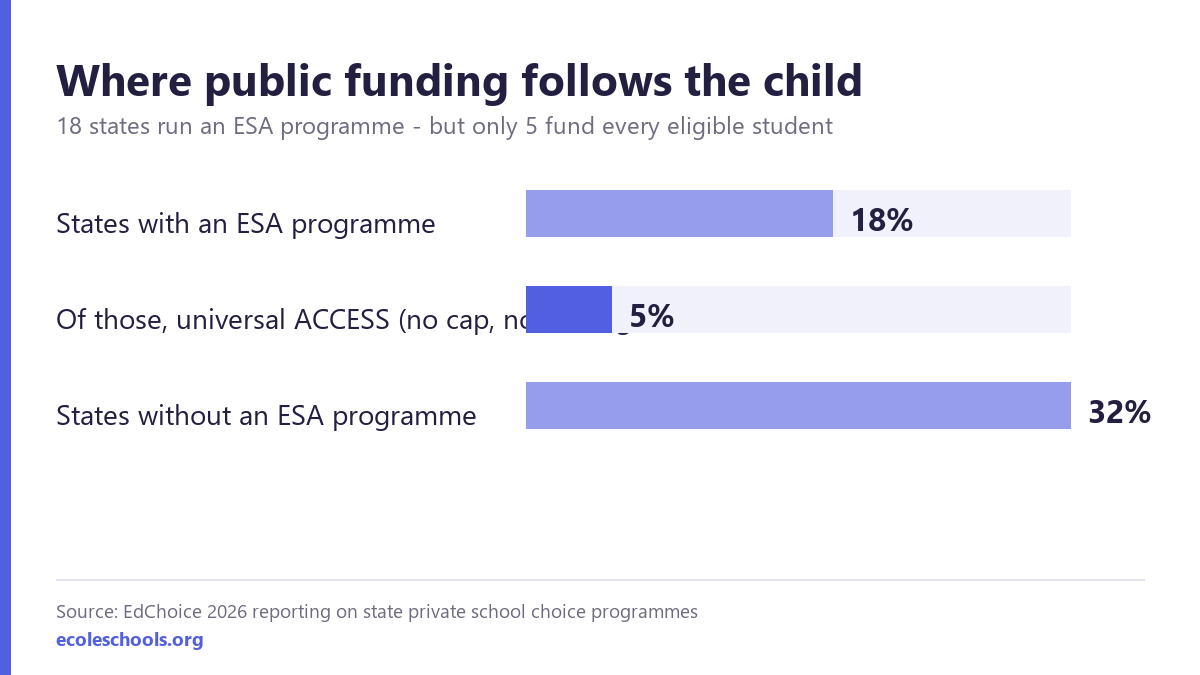
Funding is the other half of the story. As of 2026, 18 states operate education savings accounts or similar portable funding, but only five combine universal eligibility with genuine access; 32 states have no ESA programme at all. Where a family lives still decides whether “the future of education” is affordable today.
Where to go next
If this article describes the school you want for your child, our questions to ask before you enrol gives you the sector base rate behind every answer you will hear. If you are an educator thinking about building it, start with how to start a microschool and the state-by-state rules and funding map. For the full data set behind the figures above, see our microschool statistics page.
Sources
- National Microschooling Center — American Microschools: A Sector Analysis (May 2025) — median enrolment, progress reporting and founder background figures quoted above.
- EdChoice — The State of Microschooling — programme counts behind the funding map.
- NCES — National Teacher and Principal Survey, average public school class size (2020–21) — comparison class-size figure quoted above (19.1–22.0 depending on school level and class type).